



The Desert Problem Nobody Talks About
When engineers in temperate climates design transformers, they use a standard ambient temperature of 30°C with a maximum of 40°C. Their transformers are designed to operate with a top-oil temperature rise of 60°C, giving a maximum oil temperature of around 100°C.
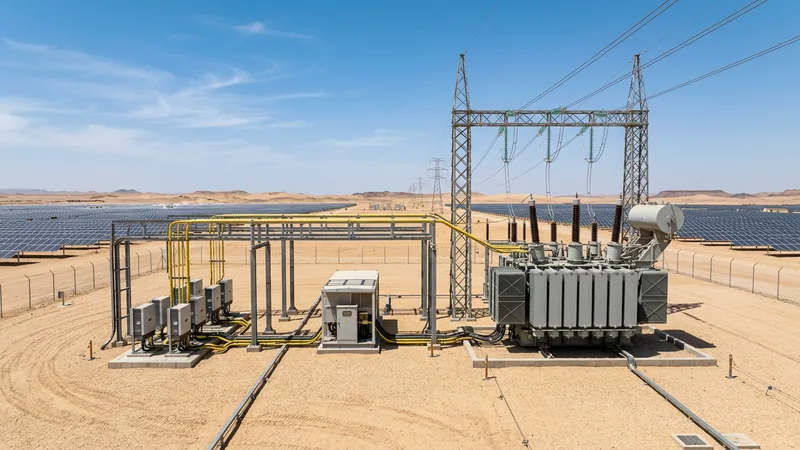
Now consider the Arabian Gulf. Summer ambient temperatures routinely hit 50°C. Ground temperatures can reach 70°C. The air itself is loaded with salt, sand, and humidity levels that swing from 20% to 90% within hours.
Apply the same 60°C temperature rise, and your transformer oil hits 110°C. At that temperature, the rate of cellulose degradation in the paper insulation doubles for every 6°C increase — a principle known as the Arrhenius rule. Your 30-year transformer just became a 12-year transformer.
Solution 1: Design for the Real Ambient
The most fundamental solution is refreshingly simple: don't pretend you're in Sweden. Transformers destined for Gulf conditions are designed with:
- 55°C temperature rise instead of the standard 65°C rise
- Oversized radiators — 30-40% more cooling surface area than standard designs
- ONAN/ONAF dual-rated cooling — natural convection at base load, forced air for peak demand
- Enhanced oil circulation — wider oil ducts and optimised flow paths through the winding
This means a transformer rated 1,000 kVA in Europe might be de-rated to 850 kVA in the Gulf — or the manufacturer must build a physically larger unit to maintain the same rating.
Solution 2: The Oil Chemistry Game
Standard mineral oil has been the transformer insulating fluid for over a century. But in extreme heat, alternatives start making serious sense:
- Natural ester fluids have a fire point of 360°C versus mineral oil's 170°C — critical in environments where fire risk is amplified by heat
- Ester fluids absorb 20x more moisture from the paper insulation, extending insulation life by pulling water out of the cellulose
- Higher viscosity at operating temperature actually improves cooling efficiency in hot climates
Several Gulf utilities have begun specifying ester-filled transformers for indoor substations and locations near residential areas.
Solution 3: Sand and Salt — The Silent Killers
Desert substations face a unique challenge: abrasive sand particles carried by wind. These particles:
- Score radiator surfaces, reducing heat exchange efficiency over time
- Infiltrate control cabinets, causing relay failures
- Combine with salt-laden coastal humidity to create highly corrosive films on all exposed metal
The countermeasures read like a military specification:
- C5-M marine-grade coating on all external surfaces — the highest corrosion protection class under ISO 12944
- Sand trap louvers on substation enclosures — allowing airflow while blocking particles above 50 microns
- IP55 or IP65 protection for all control and measurement equipment
- Stainless steel hardware replacing standard zinc-plated bolts
Solution 4: Underground and Modular
Dubai's rapid urban development has driven innovation in compact, underground substations. Cast resin dry-type transformers eliminate oil fire risk entirely, while package substations combine transformer, switchgear, and protection into factory-tested modules that can be installed in building basements.
These units are designed for indoor ambient temperatures — typically air-conditioned to 35-40°C — removing the extreme heat variable from the equation entirely.
The Numbers That Matter
Dubai's electricity authority, DEWA, operates one of the world's most reliable grids despite the extreme conditions:
- 99.98% supply reliability — comparable to top European utilities
- 3.3 minutes average customer interruption duration (vs. UK average of 30 minutes)
- Peak demand exceeding 10 GW in summer months
These numbers aren't achieved by accident. They're the result of decades of engineering specifications refined by real-world desert operation.
What This Means for Your Project
If you're specifying transformers for hot climates, here's your checklist:
- Specify the actual maximum ambient temperature — not the IEC standard 40°C
- Request temperature rise tests at the specified ambient, not just standard conditions
- Verify the coating specification matches your environment's corrosion class
- Consider ester fluids for indoor and fire-sensitive locations
- Insist on desert-rated accessories: sealed conservators, silica gel breathers with extended capacity, and sand-resistant cable boxes
The desert doesn't forgive engineering shortcuts. But with the right specifications, transformers can operate reliably for 30+ years in the most extreme conditions on Earth.