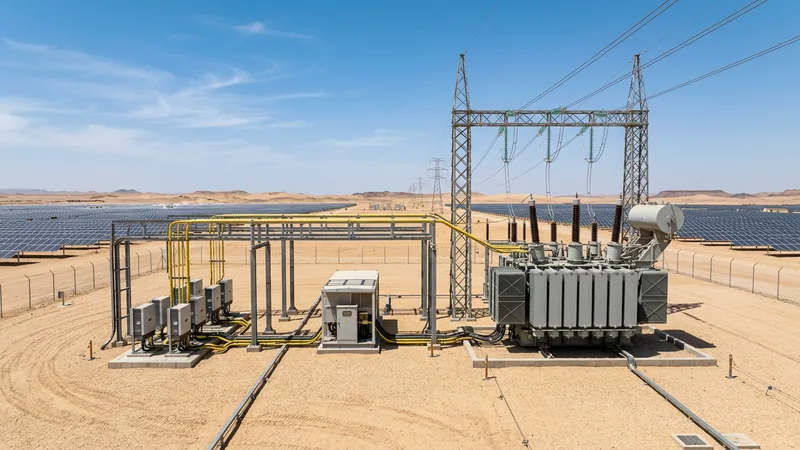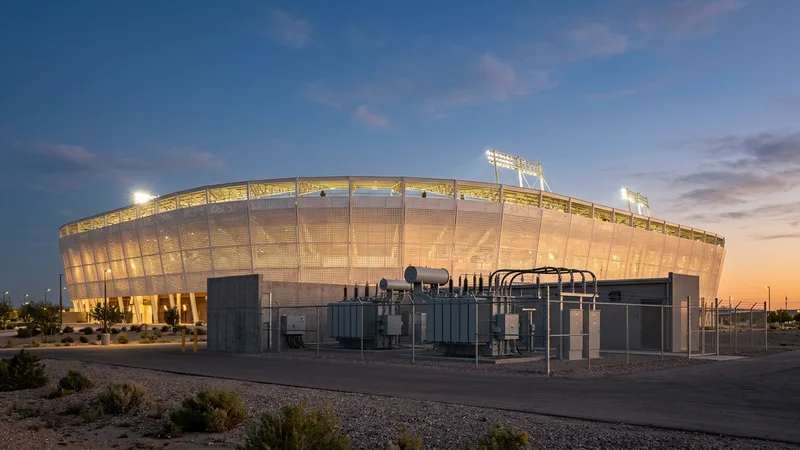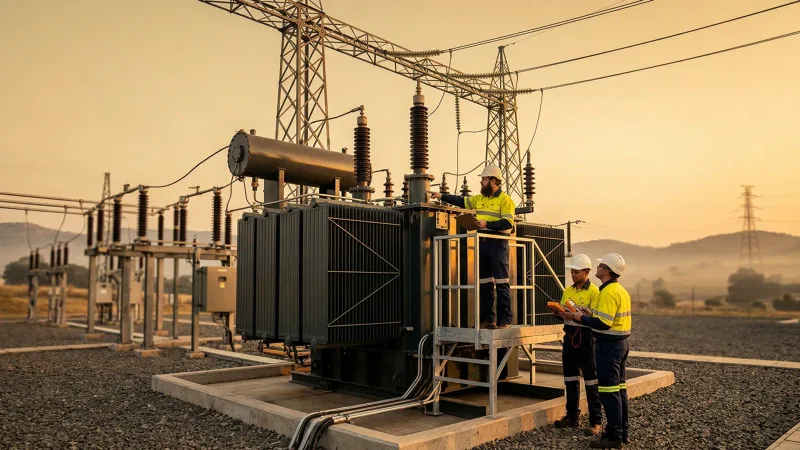




A microgrid 170 km long is, in transmission terms, a system in its own right. NEOM's reference architecture pairs a 4 GW solar build-out with the world's largest planned green-hydrogen offtake and, between them, a 380 kV HVAC and ±525 kV HVDC backbone. The transformer fleet that links those layers — generator step-ups, converter transformers, and grid-forming inverter step-ups — has no operating precedent at this scale. This piece sketches what the engineering reference looks like today.
A Line in the Sand for Grid Design
Powering a 170-kilometer-long, 200-meter-wide structure requires treating the city not as a load *on* a grid, but as a component *of* one. Feeding it conventionally from one, or even both, ends is a non-starter. The immutable laws of physics intervene: the impedance of such a long conductor would create a voltage drop so severe that the city's middle sections would be left with unusable power, regardless of how much you pushed in at the ends.
The brute-force engineering "solutions" are equally impractical. One could specify impossibly thick, expensive conductors to lower the impedance, creating immense structural and supply-chain problems. Alternatively, one could envision a chain of substations along the city's length to constantly boost voltage back up, turning a transmission challenge into a logistical nightmare of siting and maintenance inside a skyscraper.
Even if the voltage issue were solvable, this linear topology creates catastrophic fragility. In a traditional grid, networks provide redundancy. Here, a single major fault anywhere along the line could theoretically sever the city's power backbone, creating an outage across tens of kilometers. Standard N-1 contingency planning—the ability to withstand the loss of any single component—becomes almost meaningless when a huge portion of the "grid" is one contiguous component.
The Solution: A Cellular, Redundant Backbone
The engineering answer is to not treat The Line as one city, but as a chain of roughly 17 self-sufficient urban cells. The electrical system follows this logic. Instead of a single, fragile transmission spine, the core of the design is a parallel, double-circuit 380 kV ring running the length of the project. Think of it less as a transmission line and more as a circulatory system.
Each "cell" of the city, perhaps every 10 kilometers, will be fed by a dedicated grid substation that taps into both sides of this ring. This topology offers immense resilience, an N-2 security level baked into the core architecture.
Here’s how it works:
1. Fault Isolation: If a fault occurs on one of the 380 kV circuits, power continues to flow uninterrupted through the parallel circuit. The faulted section can be isolated and repaired without resident-facing outages.
2. Substation Redundancy: If an entire substation goes down for maintenance or failure, its load can be temporarily rerouted from adjacent substations through the medium-voltage network, as the cells on either side are still fully energised by the ring.
3. Load Balancing: The ring allows power to flow in either direction, enabling exceptional flexibility in balancing loads and generation resources across the entire 170 km length. Power generated in the south can seamlessly support loads in the north, and vice-versa, with minimal losses.
This is a familiar concept for urban ring-main units, but applied on a transmission scale. It substitutes capital investment in robust switchgear and infrastructure for the unacceptable operational risk of a simpler, but brittle, linear design.
The Problem: The Unblinking Eye of a 100% Renewable Grid
NEOM’s mandate is a grid powered entirely by renewable sources—primarily solar and wind. While noble, this presents a staggering stability challenge. Unlike the immense rotational inertia of traditional thermal power plants that naturally resists frequency changes, a grid dominated by inverter-based resources (like solar and batteries) has virtually no inertia. When a large load connects or a generator trips, frequency can deviate with terrifying speed.
This creates a system constantly on a knife’s edge. A cloud passing over a major solar array would cause an immediate generation drop, threatening to send the local grid cell’s frequency plummeting. Evening load ramps—as millions of residents return home and turn on appliances—would occur just as solar generation fades to zero. Without a massive, fast-acting buffer, the lights would flicker, sensitive electronics would fail, and the grid would collapse into localized blackouts daily.
The Solution: Hyper-Local, Embedded Energy Storage
The key to taming this volatility is not centralized, grid-scale batteries, but a distributed network of Battery Energy Storage Systems (BESS) embedded within each city cell. The blueprint calls for substantial BESS "pods," potentially in the range of 200-400 MWh each, located at or near the 380 kV substations every 10 kilometers.
These BESS units serve multiple roles beyond simple energy arbitrage (charging on solar during the day, discharging in the evening):
- Fast Frequency Response (FFR): Using advanced inverters, the BESS can inject or absorb real power in milliseconds, far faster than any mechanical turbine. This synthetic inertia is what will keep the frequency locked at 50 Hz, ensuring stability second-by-second.
- Voltage Support: By providing reactive power, the BESS helps manage the voltage profile along the line, counteracting the effects of impedance and ensuring all equipment operates within its designated parameters per standards like IEC 60038.
- Black Start Capability: In the event a cell does go dark, the BESS has the authority to energise the local distribution network independently, creating a stable island that can then be re-synchronised with the main 380 kV ring. This makes restarts faster and safer.
This distributed approach provides resilience. The failure of a single BESS unit impacts only one cell, not the entire city, and its duties can be partially covered by neighbouring units.
The Problem: The ‘Dark Winter’ Scenario
Batteries are perfect for managing short-duration intermittency—from a few seconds to several hours. But they are economically and technically unsuitable for managing long-duration energy deficits. What happens if a rare weather pattern brings a week of low sun and minimal wind to the Tabuk region? This scenario, known in the industry as a "Dunkelflaute" (a German term for a dark, calm period), would exhaust even the most oversized BESS fleet, leading to a prolonged, city-wide power shortage.
The Solution: Hydrogen for the Long Haul
This is where a second, slower, but deeper energy storage medium comes in: green hydrogen. The NEOM grid architecture plans to leverage its vast renewable generation to do more than just meet real-time demand. During periods of excess solar and wind, that energy will be channeled into large-scale electrolyzers.
These electrolyzers split water into hydrogen and oxygen. The green hydrogen can then be stored in vast quantities, likely in pressurized tanks or underground salt caverns. This stored hydrogen acts as the city’s strategic energy reserve. When a multi-day renewable shortfall occurs and the BESS fleet is nearing depletion, this hydrogen will be used as fuel for hydrogen-fired gas turbine power plants. These plants can then provide reliable, dispatchable power for days or even weeks, refilling the batteries and keeping the city running until the sun and wind return. It’s the ultimate insurance policy against the weather. While the round-trip efficiency is lower than batteries, a custom-engineered package substation can integrate these resources seamlessly.
The Problem: Heat, Dust, and Salt
Finally, the physical environment itself is an adversary. The coastal sections of The Line are subject to some of the most challenging conditions for electrical equipment on Earth: ambient temperatures exceeding 50°C, high salinity from sea spray, and fine, abrasive dust. Standard air-cooled transformers would rapidly overheat and derate, their cooling fins would clog with dust, and salt accumulation on bushings and insulators would lead to flashovers and catastrophic failures.
The consequences are reduced equipment lifespan, constant high-stakes maintenance, and a persistent risk of fire. It’s a battle of materials science and thermal management.
The Solution: Hardened, Liquid-Cooled Hardware
To survive, the distribution-level infrastructure must be purpose-built for the environment. The brief’s mention of "sea-water-cooled distribution transformers" points to the use of OFWF (Oil Forced, Water Forced) or similar liquid-to-liquid cooling designs.
Instead of relying on ambient air, these transformers use an oil-to-water heat exchanger. One loop circulates the transformer’s insulating oil, while a second, isolated loop uses seawater (or treated brackish water) as the ultimate cooling medium. This is orders of magnitude more effective than air cooling in high-temperature environments, allowing the transformer to run at its full MVA rating even on the hottest days. It’s a technology long used in marine and industrial applications, now being deployed for utility distribution.
Other hardening measures will be essential:
- IP65 or higher rated enclosures for switchgear and control panels to prevent dust and water ingress.
- Specialised epoxy or silicone coatings for all outdoor insulators to create hydrophobic surfaces that resist salt build-up.
- Pressurized, climate-controlled substation buildings to protect sensitive relays, communications gear, and battery systems.
This is the unglamorous, component-level engineering that makes the grand vision possible. You can read more on our resources page.
Key Takeaways
- Cellular, Not Linear: The Line is not powered by a single grid but by a series of interconnected microgrids, creating resilience through a modular, cellular architecture.
- Hybrid Storage is Essential: Short-duration batteries (BESS) provide second-to-second stability, while long-duration green hydrogen provides multi-day energy security, creating a complete solution for a 100% renewable grid.
- Environment Dictates Design: In extreme coastal and desert locations, standard equipment fails. Hardened, liquid-cooled transformers and sealed enclosures are not optional luxuries but core design requirements for reliability.
The Engineer's Takeaway
Powering The Line is less about inventing new physics and more about combining existing, proven technologies in a novel topology and at an unprecedented scale. The project serves as a full-scale laboratory for the post-inertia grid, forced by its unique geometry to solve the problems of decentralization, storage, and resilience that all power systems will eventually face. What is being built in the Saudi desert is not just a city, but a blueprint.