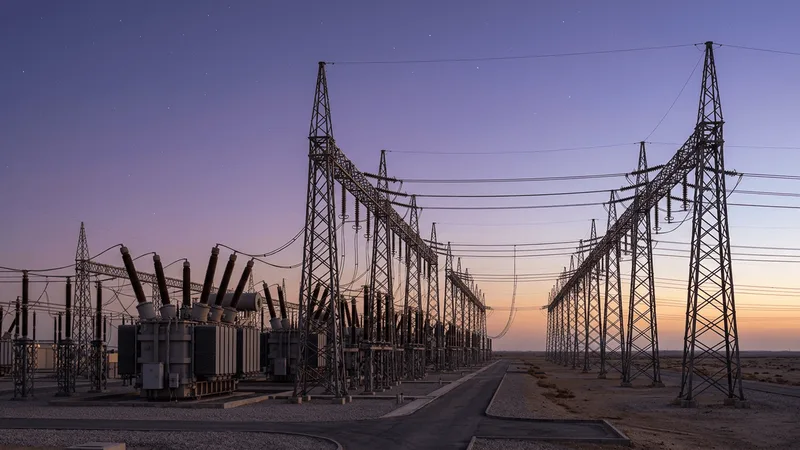




If your nuclear plant commissioning checklist has the Generator Step-Up (GSU) transformer as its top electrical priority, youve misunderstood the assignment. The GSU is about revenue; the unit auxiliary transformers are about survival. They are what separates a momentary voltage dip from a full-scale reactor trip at plants from Barakah to the planned Saudi fleet.
Survival is Not a GSU Function
A plant’s main GSU is a monument to commercial operation, its entire purpose to move gigawatts of power and revenue onto the transmission network. Yet it does nothing for the plant itself. The operational integrity of a nuclear station depends on a far less glamorous, parallel power system: the network of auxiliary transformers that form a grid-within-the-grid.
These transformers are the workhorses of the plant’s internal electrical load. They power the non-negotiable systems—from the main coolant pumps and control rod drives to the instrumentation that allows operators to see what is happening inside the core. Without them, the main generator is just a very large, very inert piece of metal.
Failure is therefore not an option. An auxiliary transformer fault is not a maintenance headache; it is a direct challenge to the plants safety case. Getting their specification right is one of the most deceptively complex parts of new-build nuclear projects, derailing timelines long before the first fuel is loaded.
UATs, SSTs, and the Class 1E Chasm
Not all auxiliary transformers are created equal. The family is broadly split into two main types based on their power source.
- Unit Auxiliary Transformers (UATs): These are connected directly to the main generator's isolated phase busbars, taking a small percentage (typically 5-7%) of the power produced by the unit *before* it gets stepped up to transmission voltage. This is the normal, most efficient source of power for the reactor's own needs while it is operating.
- Station Service Transformers (SSTs): These are fed from the external high-voltage grid, often from a dedicated switchyard. Their primary job is to power the plant when the reactor is shut down (e.g., for refueling) or to provide a "black start" capability to get the plant's systems running from a cold state. They are also the first line of defence if the UAT supply is lost while the reactor is online.
The true complexity, however, lies not in the UAT/SST distinction, but in the nuclear-specific classification system: Class 1E versus non-1E. Class 1E is the designation for electrical equipment and systems essential to the safe shutdown of a reactor, containment isolation, core cooling, and heat removal. A non-1E transformer might be critical for plant availability and revenue, but a Class 1E transformer is critical for safety.
What does it mean to be Class 1E? It's a chasm of engineering, quality assurance, and documentation that separates it from standard utility hardware.
- Seismic Capability: It must be proven, through analysis or physical shake-table testing, to remain functional during and after a Design Basis Earthquake. At a site like Barakah, this means withstanding peak ground accelerations up to 0.3g.
- Environmental Qualification: It must operate in the harsh post-accident environment it might be exposed to, which could include elevated temperatures, pressure, humidity, and radiation.
- Redundancy & Separation: Class 1E systems are built with multiple redundant trains (e.g., A, B, C, D) that are physically and electrically separated to prevent a single event from disabling a safety function.
- Quality Assurance: The entire manufacturing process, from raw material sourcing to final testing, falls under the exacting quality assurance standards of nuclear regulations.
Specifying a "highly reliable" general-purpose transformer from our transformer product line for a Class 1E bus is a category error. The world's most robust IEC 60076 transformer is non-compliant without the paper trail to prove it meets every nuclear-specific requirement.
Sizing Errors and Seismic Surprises
The consequences of getting these specifications wrong are severe. They range from operational headaches to full-blown project compliance failures that can halt construction or delay commissioning by months or even years. The pain points typically emerge in two key areas: load analysis and seismic qualification.
First, sizing. An APR1400 reactor, like those at Barakah, requires a massive amount of auxiliary power. Its UATs are typically rated around 70-80 MVA. The temptation is to specify these based on a simple summation of steady-state loads. This is a classic trap. The real test comes during transient conditions, like a hot restart, where several large motors for pumps and fans are started simultaneously. These motor-starting inrush currents can cause a momentary voltage drop severe enough to trip other sensitive equipment or even the protection relays on the transformer itself if not properly accounted for in the load flow and short-circuit studies. This can lead to a cascade of failures that prevents the plant from being synchronised back to the grid.
Here are some of the most common specification mistakes that can derail a project:
1. Underestimating Motor Loads: Basing sizing on the continuous running current of pumps, not the 5-7x inrush current during startup.
2. Harmonic Management: Failing to account for the harmonic distortion produced by the hundreds of variable frequency drives (VFDs) throughout the plant, which can lead to transformer overheating.
3. Generic Short-Circuit Specs: Not matching the transformer's impedance and short-circuit withstand capability (kA rating) to the specific fault levels of the plant's complex medium-voltage bus configuration.
4. Assuming Seismic Equivalence: Believing that a structurally "rugged" design is the same as a seismically *qualified* one per IEEE C57.12.59. The qualification is about certified performance and documentation, not just mechanical strength.
5. Neglecting Voltage Regulation: Failing to properly specify the tap range and type (On-Load vs. Off-Circuit) needed to compensate for both grid voltage swings and internal plant loading conditions.
6. Forgetting the Heat: Under-specifying cooling systems (ONAN/ONAF/OFAF) for the harsh ambient conditions of the Gulf, leading to accelerated aging and potential derating on the hottest summer days.
7. Treating QA as Paperwork: Discounting the level of documentary evidence required. A missing material certificate or an uncalibrated weld machine can render a multi-million dollar transformer inadmissible for a Class 1E application.
Lessons for the KSA SMR Fleet
The Kingdom of Saudi Arabia's ambitious plans for a fleet of Small Modular Reactors (SMRs) presents a new set of challenges and opportunities. While smaller than the gigawatt-scale APR1400s, the fundamental principles of auxiliary power design remain paramount. An SMR might only require a 20 MVA UAT instead of an 80 MVA one, but the safety function is identical.
The solution is to treat auxiliary electrical systems as a core design discipline from day one. This means moving beyond basic data sheets and engaging in a deep technical dialogue with suppliers. EPCs and utility planners must provide detailed load studies, site-specific seismic response spectra, and a clearly delineated map of Class 1E vs. non-1E boundaries. For KSA, this means embedding these requirements into the procurement strategy for their future SMRs now.
Integrated solutions, like pre-engineered and factory-tested package substations, can de-risk much of this interface complexity by combining switchgear, transformers, and control systems into a single qualified assembly. Whether for a large-scale plant or a modular reactor, the lesson is the same: the reliability of the whole system depends on getting the auxiliary details right.
Key Takeaways
- Class 1E is a System, Not a Sticker: This designation demands a holistic approach to design, manufacturing, and documentation that goes far beyond a standard transformer's specifications.
- Sizing is About Transients, Not Averages: Auxiliary transformer MVA must be determined by rigorous analysis of motor-starting inrush currents and other transient loads, not just a simple sum of nameplate ratings.
- Proof is Paramount: Seismic and environmental qualification is a documentary exercise. A transformer without a verifiable paper trail proving compliance to standards like IEEE C57.12.59 is, for nuclear purposes, a paperweight.
The Engineer's Takeaway
The main generator step-up transformer gets the glory, but the auxiliary transformers do the real work. In a nuclear plant, they are the silent, steadfast guardians separating a routine grid event from a plant-wide upset. Specifying them requires more than a data sheet; it demands a deep understanding of the entire plant's operational soul and a commitment to integrating them not as components, but as a critical system. Don't hesitate to get in touch with our engineering team to discuss your project.