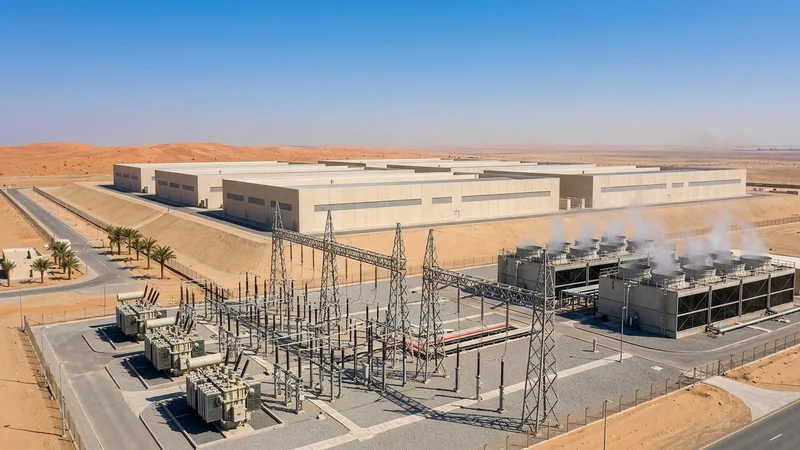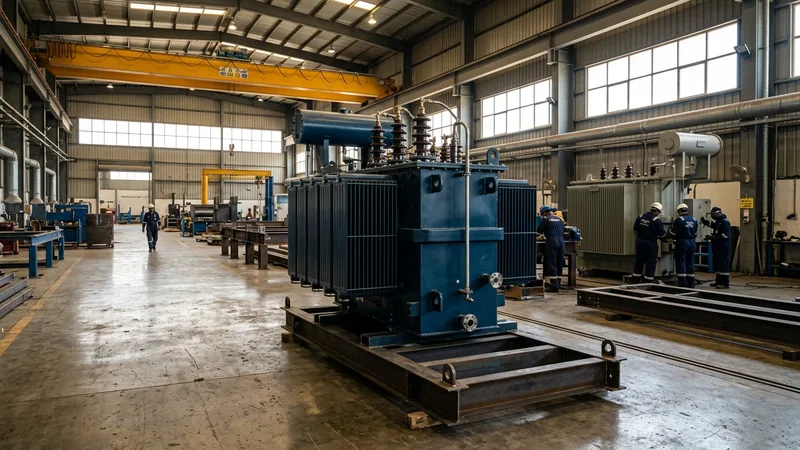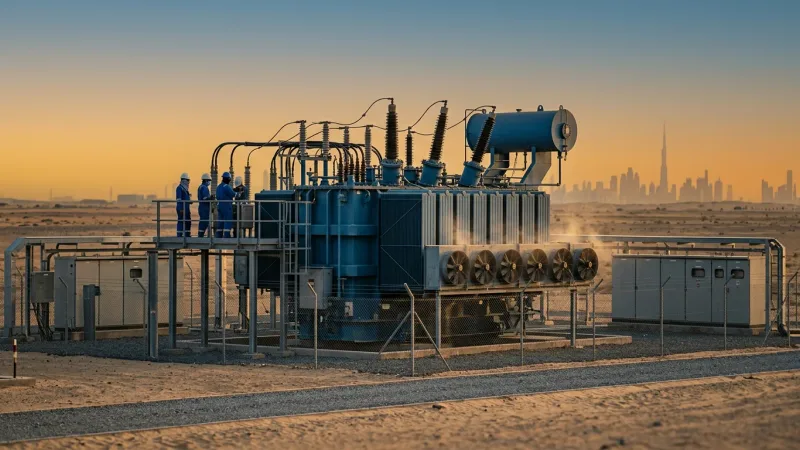






Closed-loop distribution is rare globally and standard in Abu Dhabi. ADWEA's convention pairs every 11 kV pad-mount distribution transformer with a four-position ring-main unit and a fault-passage indicator scheme that closes the loop without operator intervention. This article unpacks why the architecture exists, what it asks of the transformer, and where the spec deviates from the broader GCC distribution convention.
The Problem: Radial Grids are Simple, and Brittle
For any utility planner, the core tension is between cost and reliability. The simplest, cheapest way to get power from a primary substation to a set of customers is a radial feeder. Think of a tree trunk with branches. Power flows one way, from the source to the load. It’s intuitive, easy to model, and requires the minimum amount of cable and switchgear. This is the predominant model in many dense urban areas, including large parts of neighbouring Dubai.
The problem, of course, is that simplicity creates a single point of failure. If our unfortunate Mussafah contractor had been working on a standard radial feeder, that single cable fault would have de-energised every single customer downstream of the break. The outage would last for hours—the time required for a crew to locate the fault, physically isolate the damaged section (often by cutting and removing it), and then perform the necessary switching to re-route power, if a backup is even available. This creates dismal reliability metrics like SAIDI (System Average Interruption Duration Index) and frustrates high-value industrial and commercial customers who see every minute of downtime in lost production and revenue.
This brittleness is the fundamental problem that the Abu Dhabi Distribution Company (ADDC) and Al Ain Distribution Company (AADC), under the guidance of TRANSCO, sought to solve. The solution? Abandon the simple tree for a more robust and responsive mesh.
The Mechanism: Abu Dhabi’s “Normally Closed” Loop
Instead of a one-way street, imagine a traffic circle. This is the essence of Abu Dhabi’s 11 kV, 22 kV, and 33 kV distribution networks. They are designed and operated as “normally closed” loops. Each substation isn’t just the end of a branch; it’s a node in a ring. Power can, and does, flow to each substation from two different directions.
A typical ring might feed 5-10 package or pocket substations, starting at a primary substation breaker and returning to a different breaker at that same primary sub. Both ends of the loop are energised. Should a fault occur anywhere on that loop—either in a cable segment or within a substation’s equipment—the protection systems instantly detect and isolate the problem. Directional overcurrent relays and dedicated fault passage indicators (FPIs) pinpoint the faulted section between two substations. The Ring Main Units (RMUs) in those two substations then automatically trip their relevant circuit breakers, de-energising only the damaged segment. For everyone else on the loop, the power remains on, fed from the other direction.
This stands in stark contrast to an “open loop” system, which is architecturally a ring but operated like a radial feeder with a “Normally Open” point somewhere in the middle. In an open loop, a fault still causes an initial outage for half the customers, requiring manual or automated switching to restore power from the other side. Abu Dhabi’s normally closed philosophy aims to skip that outage step entirely for the majority of customers on the ring.
The Consequence on Hardware: Your RMU Spec is Different Here
The loop design isn't just a diagram on a planner's wall; it has profound consequences for the hardware you specify and procure. An RMU destined for a simple radial feeder is a fundamentally different beast from one serving a closed loop.
Here’s how the ADDC/AADC philosophy changes your bill of materials:
1. Three is the Magic Number (Usually): Your typical RMU will be a 3-function or 4-function unit. For a standard intermediate substation on the loop, you’ll need at least a `[Ring In] - [Ring Out] - [Transformer Feeder]` configuration. This is often designated as CCT (Cable-Cable-Transformer) or RRT. In radial networks, a single switch-fuse and a transformer are often sufficient. Here, the RMU is the core of the system’s intelligence.
2. Circuit Breakers, Not Just Switches: The transformer feeder is almost always a vacuum circuit breaker (VCB) with a full protection relay, not just a fuse. The two ring functions might be switch-disconnectors (load break switches) or, increasingly, full circuit breakers themselves to allow for more sophisticated automated isolation schemes.
3. Directional Fault Indication is Mandatory: Standard FPIs just tell you that a fault current has passed. For a loop, that’s not enough information—you need to know which direction it was heading. Was the fault upstream or downstream of the substation? Directional FPIs, often communicating via SCADA, are essential for the system to locate and isolate faults without guesswork. Without them, the loop is just a confusing radial.
These seemingly small changes in specification are what allow the network to function. Using a simpler, cheaper RMU designed for a radial system would completely undermine the reliability of the loop.
You can learn more about the types of switchgear that fit these demanding applications.
The Solution in Practice: Smarter, Integrated Package Substations
This philosophy all comes together in the design of the package substations seen across Abu Dhabi. Because the RMU is so critical, its integration with the transformer and low-voltage distribution board (LVDB) must be seamless and compliant with TRANSCO, ADDC, and AADC standards.
Key considerations for a loop-ready package substation include:
- Protection Coordination: The settings on the RMU’s protection relay must be precisely coordinated with the upstream primary substation relays and the transformer’s own protection. With power flowing from two directions, this is a more complex task than in a radial system. An incorrect setting on one relay can lead to sympathetic tripping, causing a wider outage than necessary.
- SCADA and Automation: The RMUs must be motorised and have the necessary RTU (Remote Terminal Unit) to communicate with the distribution control centre. A “dumb” manually operated RMU cripples the network’s ability to automatically and rapidly restore power.
- Physical Layout and Type Testing: ADDC/AADC have stringent requirements for the physical construction, ventilation, and safety features of package substations. The enclosure must be type-tested per IEC 62271-202, ensuring it can handle the specific environmental conditions of the UAE and the internal stresses of housing loop-ready equipment, which often runs hotter than its radial-fed counterparts.
- Transformer Inrush vs. Fault Current: The protection must be smart enough to differentiate between the large inrush current when a transformer is first energised and a genuine fault current. In a loop system that performs rapid automatic switching, this is a non-trivial challenge that requires sophisticated relays and accurate settings.
An EPC or consultant who simply copy-pastes a specification from a radial project will find their submission rejected. The entire substation, from the 22 kV connections to the 400 V customer outputs, must be conceived with the dynamics of the ring in mind.
Key Takeaways
- Abu Dhabi’s MV distribution network is primarily a “normally closed” loop design, providing significantly higher reliability and fault tolerance than a simple radial network.
- This design philosophy mandates specific equipment, including 3- or 4-function Ring Main Units with circuit breakers, directional fault indicators, and full SCADA automation compatibility.
- Package substations must be engineered as integrated systems where the RMU, transformer, and protection schemes are fully coordinated to handle bi-directional power flow and rapid fault isolation, in compliance with strict ADDC/AADC and TRANSCO standards.
For assistance navigating these specific requirements on your next project, it's often best to contact specialists familiar with the local utility landscape.
The Engineer's Takeaway
Don't start with the catalogue; start with the one-line diagram. The network's philosophy—be it a forgiving loop or a brittle radial—dictates the specification of every component within it. In Abu Dhabi, the ring is king, and your hardware had better be fit to serve it.