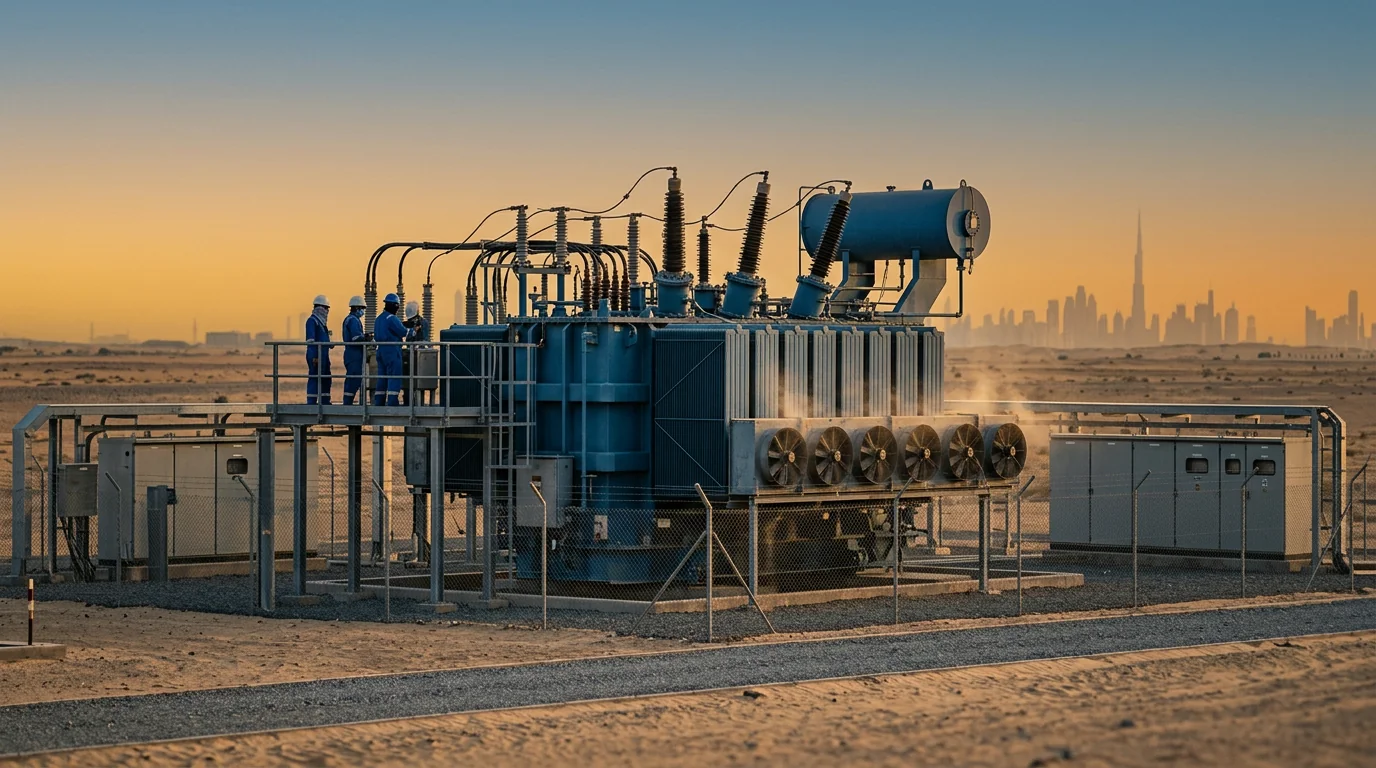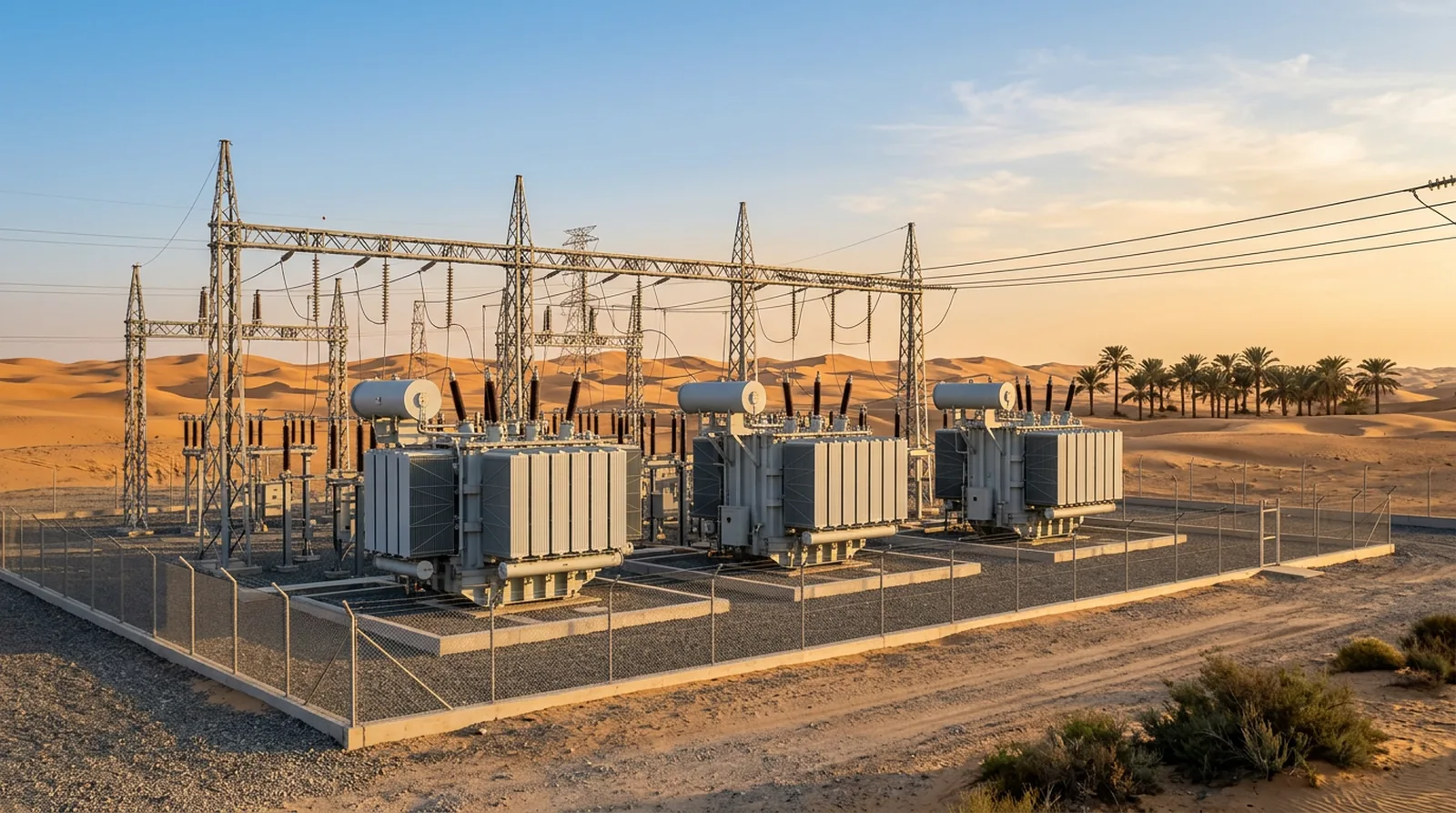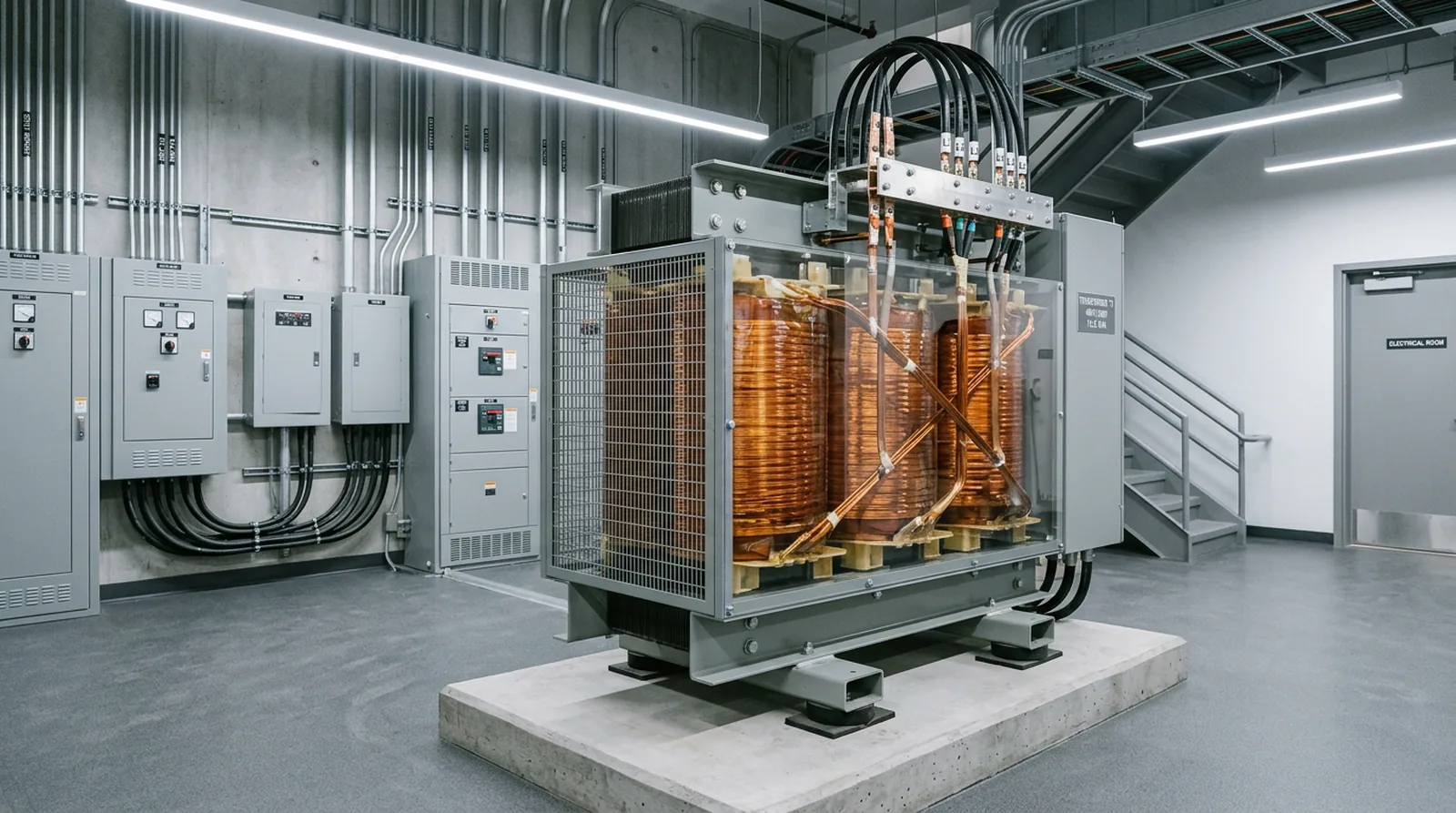




'The sound produced by a transformer originates from the vibrations in the core and windings and, when in service, from the associated cooling equipment.' This line from IEC 60076-10, clause 4.1, is the standard’s remarkably placid summary of a phenomenon that has sent junior engineers chasing phantom loose panels for decades. The reality is that the ubiquitous 100 Hz hum is data. An experienced engineer learns to parse it for signs of everything from core degradation to impending tap-changer failure.
The Core of the Matter: Magnetostriction
The dominant sound from an energised-but-unloaded transformer is a direct result of its physics. The core is built from laminations of grain-oriented silicon steel. This material is chosen for its excellent magnetic permeability, which minimises hysteresis losses. It has a side effect: magnetostriction. As the alternating magnetic field expands and contracts the steel laminations, they physically change in length. This deformation cycle occurs twice for every one cycle of the AC power supply.
In a 50 Hz system, as found across the GCC from DEWA to KAHRAMAA, the core vibrates at 100 Hz. In a 60 Hz system like those in parts of Saudi Arabia or serving specific assets, it is 120 Hz. This fundamental frequency and its harmonics are the transformer’s signature hum. For a typical 40 MVA, 132/11 kV distribution transformer, this no-load noise—almost entirely from the core—might be specified at around 65–70 dB(A). For a 250 MVA, 400/132 kV grid auto-transformer, the figure is closer to 75–80 dB(A) before any load is applied or forced cooling is active. Any deviation from this clean, bass-heavy tone is cause for investigation. A rattling or metallic grinding sound layered on top suggests that the core clamping bolts, which hold the laminations under immense pressure, might be loosening.
Load Noise vs. Core Noise
Once a transformer is loaded, a second category of noise joins the chorus. Load current flowing through the windings and busbars generates electromagnetic forces, known as Lorentz forces. These forces cause the conductors—and the mechanical structures supporting them—to vibrate. This sound is distinct from the core’s magnetostriction hum. It is directly proportional to the square of the load current and has a broader frequency spectrum.
An engineer can distinguish the two sources with a simple observation. The core hum is constant from the moment the transformer is energised at its primary voltage. Winding noise, however, will rise and fall with the demand on the secondary side. A sudden increase in this load-dependent noise on a unit that has been in service for years can indicate winding looseness, a condition that degrades insulation and can be a precursor to a short-circuit fault. This is why acoustic measurements during factory acceptance tests (FAT), per IEC 60076-10, are so critical. They establish a baseline fingerprint. Without a baseline, diagnosing a deviation years later becomes guesswork.
The Roar of the Fans
Power transformers generate immense heat. Cooling is not optional. The simplest method is Oil Natural Air Natural (ONAN), where heat dissipates from the tank and radiators via natural convection. As load increases, this becomes insufficient. The control system then activates the next stages: Oil Natural Air Forced (ONAF), switching on electric fans to blow air across the radiators, and finally Oil Forced Air Forced (OFAF), which uses pumps to circulate the insulating oil as well.
Each of these stages adds a significant acoustic penalty. The transition from ONAN to ONAF can add 8-10 dB(A) to the overall sound pressure level. Kicking in the OFAF pumps might add another 2-5 dB(A). This cooling noise is broadband and aerodynamic in nature, often masking the subtler diagnostic sounds from the core and windings. A large grid transformer at full load with all fans running, such as one at the Jebel Ali complex on a 45°C Dubai summer day, can easily exceed 100–105 dB(A). The sound signature completely changes from a tonal hum to an industrial roar. This masking effect is a particular challenge in the Gulf, where high ambient temperatures mean cooling fans at sites from Mussafah to Jubail have a very high duty cycle, robbing maintenance teams of a clear acoustic signal for long periods.
\*Relative contributions for a ~250 MVA grid transformer. Baseline is energised, no-load (ONAN).
Decoding Acoustic Anomalies
The transformer’s sound is a rich data stream. Changes signal specific issues:
- Harmonic Injection: The proliferation of non-linear loads, especially HVDC converter stations or large industrial sites with variable frequency drives, can inject DC bias or harmonic currents into the AC network. A DC component in the AC waveform can cause asymmetric magnetic flux, driving the core into partial saturation. The result is a dramatic increase in the amplitude of the 100/120 Hz hum and the generation of a wider, harsher spectrum of even and odd harmonics. An engineer hearing this might first suspect an upstream power quality issue, not a transformer fault itself.
- Tap Changer Problems: On-load tap changers (OLTCs) are complex mechanical switches. As they operate, they produce a distinct clunking or whirring sound. An OLTC that sounds laboured, makes grinding noises, or whose motor runs for an excessive duration points to worn contacts, misaligned mechanisms, or failing motor drives. Given that OLTCs are one of the most common failure points, their acoustic signature is watched closely.
- Loose Components: Any buzzing, rattling, or high-frequency ticking that is out of character suggests something is mechanically loose. It could be core clamping bolts as noted, but it could also be loose magnetic shunts, support bracing, or even control cabinet panels. While some are benign, internal vibrations can cause wear and create conductive dust, compromising insulation.
The IEC 60076-10 Field Guide
Sound level is a contractual requirement and a diagnostic tool. IEC 60076-10 specifies two primary methods for measuring it: the Sound Pressure method and the Sound Intensity method. The pressure method is simpler, averaging readings from microphones placed in a perimeter around the unit. Its weakness is that it is easily contaminated by background noise.
The Sound Intensity method is superior, especially for field measurements at noisy sites like those operated by ARAMCO or National Grid ESO. It uses a paired probe to measure both pressure and particle velocity, allowing it to calculate the direction and magnitude of sound energy flow. This makes it far better at rejecting ambient noise from adjacent equipment. A contractor attempting to fudge a test result by waiting for a lull in site traffic will be foiled by the intensity probe; it only measures the sound radiating *from* the transformer. Understanding which test was specified and how to interpret its results is non-negotiable for project acceptance.
> Quick Reference: Key Clauses for On-Site Acoustic Checks
> An engineer should keep a printout of these IEC 60076-10 clauses.
>
> * Clause 4.1: Defines the three principal sources of sound (core, windings, cooling). Essential for isolating the cause of an anomaly.
> * Clause 7.4: Prescribes the microphone positions for the Sound Pressure measurement method. Use it to verify a contractor’s test setup.
> * Annex D: Details the Sound Intensity measurement procedure. Crucial for acceptance testing in high-noise environments.
> * Clause 8.3: Specifies load conditions for testing. Confirms that no-load (core) and on-load tests are performed correctly to establish a baseline.
The transformer is not a silent black box. It communicates its state of health constantly through vibration and sound. Learning to listen is as fundamental to a power systems engineer as reading a wiring diagram.