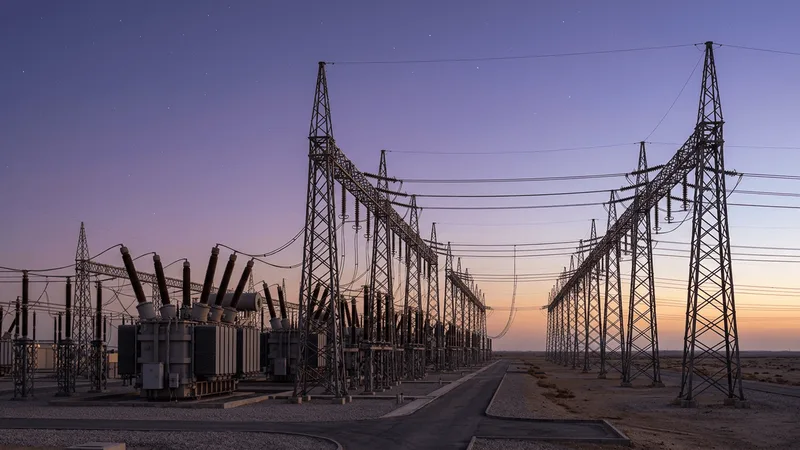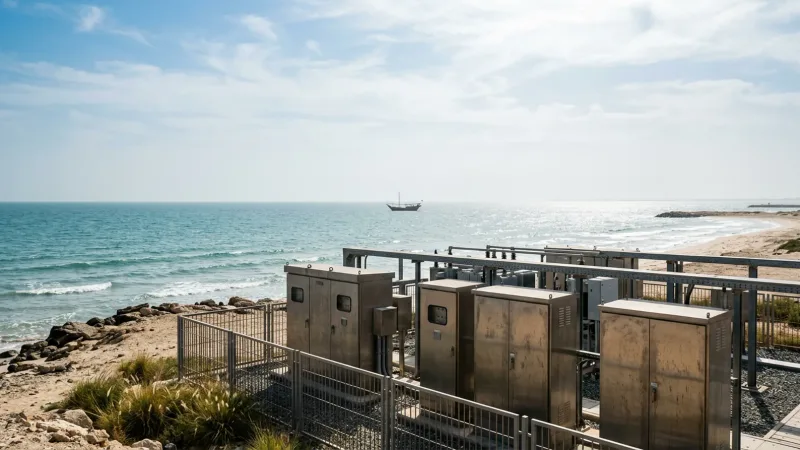




In the high-voltage quiet of a substation on the outskirts of Riyadh, the hum of a power transformer is the only sound that cuts through the heat. To the casual observer, the massive steel tank and the porcelain bushings look identical to the iron giants found in the suburbs of Chicago or the heart of Tokyo. But if you were to press a sensitive ear—or a diagnostic probe—to the enclosure, the vibration would tell a different story. These transformers are breathing at fifty cycles per second, a rhythmic heartbeat that dictates every millimeter of their internal geometry.
The choice of a 50 Hz or 60 Hz system is the ultimate architectural fork in the road for any nation’s electrical infrastructure. For the GCC grid, this wasn’t merely a technical preference; it was a geopolitical and economic alignment that reshaped the industrial landscape of the Middle East. While North America followed the 60 Hz path blazed by Westinghouse, the Gulf nations largely aligned with the European 50 Hz standard. This decision influences everything from the flux density in a transformer’s core to the speed at which a desalination pump spins, creating a specialised engineering ecosystem that demands rigorous adherence to international standards.
The Historical Tug-of-War Over Frequency
The divergence between 50 Hz and 60 Hz is one of the great "what ifs" of industrial history. In the late 19th century, frequency was a chaotic frontier. Engineers experimented with everything from 25 Hz for heavy traction motors to 133 Hz for lighting. The 60 Hz standard eventually won out in the United States because it was the lowest frequency that didn't cause incandescent bulbs to flicker noticeably, and it synchronised perfectly with the base-60 system of timekeeping. Meanwhile, in Germany, AEG pushed for 50 Hz to better fit the metric system and handle the nuances of European turbine design.
When the modern Gulf states began building their national grids, they faced a choice. The influence of European engineering firms and the proximity to Mediterranean and African markets made 50 Hz the natural contender. Today, the GCC Interconnection Authority manages a unified 50 Hz backbone, ensuring that power can flow seamlessly from Kuwait to Oman. However, this legacy creates a fascinating tension for manufacturers like ETS Group, who must design equipment for a region that often imports technology from 60 Hz markets. You cannot simply drop a 60 Hz transformer into a 50 Hz grid and expect it to survive the afternoon.
The Physics of the Hum: Why 50 Hz and 60 Hz are Not Interchangeable
At the heart of the 50 Hz versus 60 Hz debate is the physical relationship between frequency and magnetic flux. To understand why the Gulf picked the European frequency, one must understand the cost of that choice in terms of raw materials. According to the fundamental transformer electromotive force (EMF) equation, the voltage is proportional to the product of the frequency and the magnetic flux. When you decrease the frequency from 60 Hz to 50 Hz, the magnetic flux in the core must increase by roughly 20% to maintain the same voltage level.
This increase in flux necessitates a larger, heavier Transformer design. A 50 Hz transformer requires more silicon steel in the core to prevent saturation, making it physically bulkier and more expensive than its 60 Hz counterpart of the same kVA rating. For a utility operator like DEWA or a major industrial plant in Jubail, this means larger footprints for substations and higher transportation costs. However, the 50 Hz system offers a slight advantage in transmission efficiency over very long distances, as inductive reactance—a primary cause of voltage drop—is lower at lower frequencies.
Designing Transformers for the GCC Grid Environment
Engineering for the Gulf requires a dual mastery of frequency-specific physics and extreme environmental compensation. When ETS Group designs a transformer for the region, the core and coil must be built to IEC 60076 standards, which govern power transformers globally. Because 50 Hz machines run "hotter" magnetically, the choice of core steel grade is critical. Utilising high-permeability, grain-oriented silicon steel allows designers to mitigate the increased flux density without letting the unit grow to an unmanageable size.
Beyond the magnetic circuit, the lower frequency impacts cooling. Motors driving the cooling fans on a transformer’s radiators will spin slower on 50 Hz than on 60 Hz if they are not specifically wound for that frequency. This is a critical consideration in a climate where ambient temperatures regularly exceed 50°C. If a cooling system designed for a 60 Hz American grid is installed on a 50 Hz GCC grid without modification, the reduced airflow could lead to catastrophic thermal runaway.
The Standards That Bridge the Gap: IEC 60076 vs IEEE C57
The world of international power is divided into two major legislative camps. In 60 Hz North America, the IEEE C57 series of standards dictates the design and testing of transformers. In the 50 Hz world of Europe and the Middle East, IEC 60076 is the gold standard. These are not merely different ways of saying the same thing; they reflect different philosophies of safety, insulation, and performance.
For instance, IEC 60076-2 focuses heavily on temperature rise limits in high-ambient conditions, a factor that is non-negotiable for Gulf utilities. The insulation coordination, defined in IEC 60076-3, must account for the specific lightning and switching surge profiles of the 50 Hz GCC grid. While some sophisticated modern equipment is "dual-rated" to operate on both systems, this usually involves a compromise in efficiency or a significant over-specification of components. In the high-stakes world of transmission and distribution, "close enough" is a recipe for a multi-million-dollar failure.
The Impact on Industrial Motor Loads
It isn't just the transformers that feel the frequency shift. Induction motors, the workhorses of the oil and gas industry, are slave to the grid’s frequency. An induction motor’s speed is directly proportional to frequency; a four-pole motor will spin at 1,800 RPM on a 60 Hz grid but only at 1,500 RPM on a 50 Hz grid. For a Gulf refinery, this means pumps, compressors, and fans must be specifically geared and sized for the 50 Hz standard to achieve the required flow rates and pressures.
This synchronicity extends to the protection relays and switchgear. Modern digital relays, compliant with IEC 61850 for substation automation, must accurately sample the 50 Hz waveform to detect faults. If the sampling rate is misconfigured or the equipment is not rated for the specific frequency response of the GCC grid, protective tripping could be delayed or triggered falsely, potentially damaging expensive downstream assets.
Why the Gulf Stayed the Course
The decision to stick with 50 Hz across the Middle East—with the notable historical exception of parts of Saudi Arabia that have since transitioned—was driven by the need for regional integration. The GCC Interconnection Authority (GCCIA) has created one of the most robust cross-border energy markets in the world. By maintaining a uniform 50 Hz frequency across the member states, they have enabled a level of energy security that would be impossible with a fragmented grid.
This uniformity allows a UK DNO or a Gulf utility to source equipment from a global supply chain that understands the 50 Hz / IEC ecosystem. It simplifies the spare parts inventory and ensures that a transformer manufactured in Europe can, with the right environmental adaptations, serve as a drop-in replacement in a desert substation. The scale of the 50 Hz market—comprising most of the world outside of the Americas—ensures that R&D investment remains focused on squeezing every possible percentage of efficiency out of these 50-cycle machines.
The Future of Frequency in a DC-Dominant World
We are entering an era where the rigid silos of 50 Hz and 60 Hz are being softened by power electronics. High-Voltage Direct Current (HVDC) links are increasingly used to connect disparate grids, and Variable Frequency Drives (VFDs) allow industrial motors to operate at whatever speed the process requires, regardless of the line frequency. However, the fundamental backbone of the grid remains AC, and the physics of the transformer remain unchanged.
As the Gulf continues its massive push into renewable energy, the 50 Hz standard provides the framework for integrating massive solar PV arrays and wind farms. Inverters must be programmed to inject power that is perfectly synchronised with the 50 Hz heartbeat of the GCC grid, and transformers must be designed to withstand the harmonics that these power electronics introduce, a challenge addressed in standards like IEEE C57.110 and mirrored in the IEC's evolving guidelines.
Ultimately, the choice of 50 Hz in the Gulf was a choice for connectivity and standardised excellence. It dictates the size of the copper, the thickness of the steel, and the speed of the hum. While 60 Hz might offer smaller footprints, the 50 Hz path has built a cohesive energy empire across the sands.
The hum of the transformer is more than just noise; it is the physical manifestation of a historical choice. Whether in the heart of a European city or the centre of a Gulf industrial hub, the 50 Hz frequency is the invisible tempo that keeps the modern world in motion. If you get the frequency wrong, the rest of the engineering doesn't just fail—it vibrates itself to pieces.