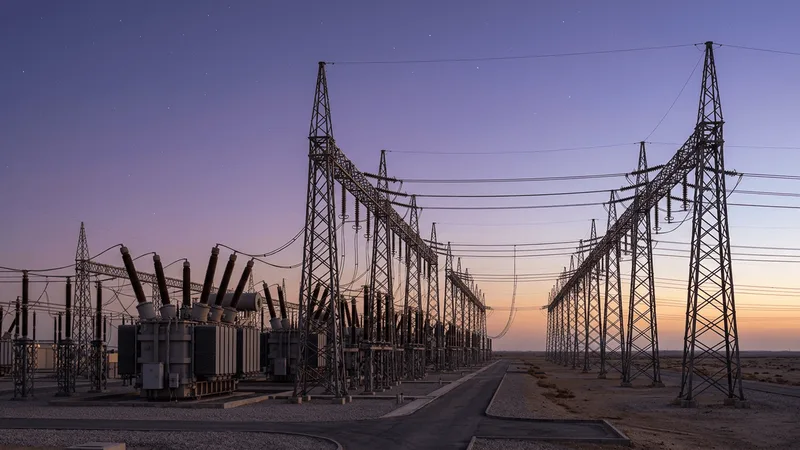






The initial phases of a utility-scale solar project often follow a familiar and proven blueprint. A defined plot of land, a block of photovoltaic (PV) modules, and a straightforward grid connection. This model is efficient for rapid deployment, but world-scale energy ambitions demand more. At benchmark developments like the Mohammed bin Rashid Al Maktoum Solar Park, the engineering narrative is one of phased growth, where the electrical topology must mature alongside the expanding generation portfolio.
Initial Connections and Known Variables
In its infancy, a solar park’s grid connection is relatively simple. The primary engineering challenge is to step up the low-voltage DC power, converted to AC by thousands of inverters, to a suitable transmission voltage, such as 132 kV or 400 kV. This is achieved through a network of pad-mounted transformers and one or more large generator step-up (GSU) transformers located at the main substation. For a project’s first phase, the GSU transformer specification is based on a known, singular generation profile: solar PV.
The load cycle is predictable, peaking at midday and ceasing after sunset. The harmonic content, a product of the power inverters, is well-characterised. Engineers can specify a transformer with a standard cooling system (e.g., ONAN/ONAF) and a winding configuration optimised for the expected load and fault conditions.
The protection philosophy for the transformer and the outgoing feeder bays is conventional, designed to handle predictable fault scenarios originating from the inverter field or the grid. At this stage, the park is a single, monolithic power source from the grid operator’s perspective, albeit an intermittent one whose behaviour is dictated entirely by local irradiance.
The Complexity of Mixed-Technology Busses
The engineering calculus changes dramatically when a new technology, such as Concentrated Solar Power (CSP) with thermal storage, is added to the same substation bus. Unlike PV, a CSP plant operates more like a conventional thermal power station. It uses solar energy to heat a medium (like molten salt), which then generates steam to drive a turbine.
This introduces a synchronous generator onto the same electrical node as the asynchronous, inverter-based PV arrays. The two technologies have fundamentally different operational and fault characteristics. A CSP’s steam turbine provides physical inertia, which can help stabilise grid frequency, a valuable ancillary service.
PV inverters, being power electronic devices, have no physical inertia but offer near-instantaneous control over active and reactive power. Their fault behaviour is also different; inverters have ride-through settings dictated by firmware, while synchronous generators have a more complex electro-mechanical response. Coupling these disparate sources at a common high-voltage bus requires a holistic re-evaluation of the entire substation design, from protection coordination to reactive power management and transient stability studies, ensuring they operate as a cohesive, reliable power plant.
Evolving Generator Step-Up Transformer Design
Designing a GSU transformer for a park that will eventually host both PV and CSP presents a significant challenge, especially when future phases are not yet fully specified. Do you procure a transformer sized only for Phase 1, risking a costly and disruptive replacement later? Or do you invest in a larger, more complex unit from day one, potentially leaving expensive capacity idle for years?
A forward-looking approach may involve specifying transformers with a higher tolerance for harmonic distortion than a standard thermal plant would require, anticipating future PV expansion. Another strategy is the use of multi-winding transformers. A three-winding transformer, for instance, could theoretically accept power from a PV array on one secondary winding and a CSP generator on another, with both feeding a single primary winding connected to the grid.
This consolidates the grid connection, saving space and switchgear cost. However, it introduces complexities in protection and impedance management. The transformer’s vector group, impedance, and on-load tap changer (OLTC) strategy must be carefully chosen to manage power flows and voltage regulation from two very different sources operating on asynchronous schedules, such as PV by day and CSP by night.
Comparing Transformer Design Philosophies
The choice of GSU transformers is central to the operational success and economic viability of a multi-phase solar complex. The design considerations extend far beyond simple MVA rating, requiring a nuanced understanding of the evolving generation mix. A direct comparison highlights the shift in engineering priorities as a park matures.
Substation Control and Grid Integration
A mature, multi-technology solar park cannot function as a simple collection of individual generators. Grid operators require a single, predictable, and controllable point of interconnection. This necessitates a sophisticated, plant-wide Power Plant Controller (PPC).
The PPC acts as the "brain" of the solar park, receiving a single dispatch instruction from the grid operator (e.g., "produce X active power and Y reactive power") and then orchestrating the various assets—PV arrays, CSP turbines, and even battery storage systems—to meet that target. The controller must continuously balance the fast-ramping, intermittent output of the PV fields with the slower, dispatchable power from the CSP plant. It manages the overall voltage profile at the high-voltage bus, commands inverters to adjust reactive power output, and ensures the entire complex adheres to increasingly stringent grid code requirements for frequency response and fault ride-through.
This layer of automation is what transforms a sprawling construction site of disparate projects into a unified, dispatchable power station that enhances, rather than challenges, grid stability. The success of such a system relies on robust substation communication networks and a control philosophy that is planned from the outset, long before the final generating unit is synchronised.