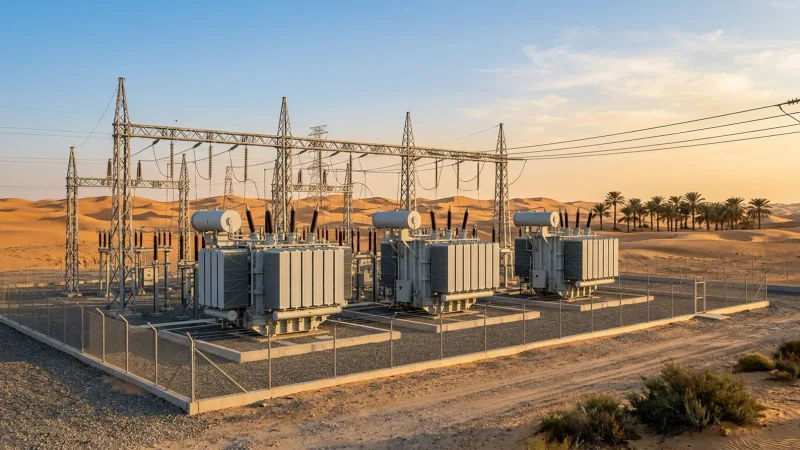






The thermometer at the perimeter fence of a 132 kV substation in the western part of Abu Dhabi reads 49 °C in the shade at three in the afternoon on a Tuesday in August. There is no shade. The gravel pad reflects another 6 to 8 °C back at anything standing on it, the radiator banks on the main transformers are running every fan they have. And the oil at the top of the tank is sitting at around 78 °C — a number that would trigger an alarm in most temperate-climate networks and which, here, is the ordinary operating point for roughly three months of the year.
Maintaining a substation in the Gulf is not the same job as maintaining one in Hampshire, or in Loudoun County, or even in Phoenix. The ambient is hotter, the diurnal swing is smaller, the dust and salt loading is higher, the humidity in the coastal corridor is brutal, and the load — driven by air-conditioning across the entire residential, commercial, and industrial fleet — barely moves at night. The discipline that has evolved across DEWA, TRANSCO, FEWA, EWEC, ADDC, AADC, and SEWA over the past two decades is, in the view of most of the international engineers who have worked across multiple climates, the most rigorous transformer and substation maintenance regime in operation anywhere in the world. It has to be.
The Loading Curve That Does Not Help
A typical European 132 kV distribution transformer spends most of its life at somewhere between 35 and 55 percent of nameplate rating, with steep drops between two and five in the morning that allow the oil and the active part to cool, the moisture to settle, and the dissolved-gas baseline to stabilise. The same unit in the UAE, during the summer months, sits between 70 and 90 percent of its rating from May through September, with overnight drops of perhaps fifteen percentage points and minimum top-oil temperatures that rarely fall below 55 °C even at sunrise.
The accelerated thermal ageing this implies is well understood. The IEEE C57.91 loading guide is explicit: the rate of cellulose insulation ageing roughly doubles for every 6 to 8 °C increase in winding hot-spot temperature above the reference value. A unit operating continuously with a 95 °C hot-spot — entirely normal for a UAE summer afternoon — is ageing its paper insulation at perhaps four to six times the rate of a European unit operating at its reference 78 °C. The implication is that a transformer rated for a 30-year service life in a temperate climate has, under a strict reading of the standards, perhaps an 8-to-12-year equivalent life in the Gulf without compensatory design and maintenance practice.
In practice, units in the region routinely deliver 25 to 35 years of service. That gap — between what the thermal model predicts and what the fleet actually achieves — is closed entirely by specification discipline at the procurement stage and by maintenance discipline through the asset life.
What Procurement Already Solved
Most of the maintenance advantage in the Gulf is built into the original transformer specification, long before the unit is energised. The regional utilities specify, almost universally, a 50 °C maximum ambient design point against the international 40 °C default. Thermally upgraded insulation systems, including aramid-blended kraft for the inner winding layers, are standard rather than optional.
The oil is specified for higher dielectric breakdown after thermal cycling, lower pour point is irrelevant here, and oxidation inhibitors are dosed for tropical service. Conservator tank designs with sealed nitrogen blankets are preferred over silica gel breathers because the ambient moisture loading would saturate the gel in weeks.
The active part is built for the harmonic content of a load dominated by chiller plant and inverter-driven motors. The radiator surface area is sized for forced-cooled operation as the default, not the exception. The tap-changers are specified with extended contact life, because the load profile produces more daily operations than a typical European installation. And the on-load mechanism is increasingly vacuum-interrupter-based to avoid the carbonisation that conventional oil contacts suffer at the regional service intensity.
The result is that a UAE substation transformer is, before it ever sees a maintenance crew, a different animal from a European one — physically heavier, electrically more conservative, thermally over-engineered, and considerably more expensive on the procurement invoice. The maintenance programme then has the job of preserving that built-in margin for as long as possible.
DGA Every Six Weeks, Not Every Year
The clearest expression of the discipline is the dissolved-gas analysis programme. International practice for a healthy distribution-class transformer is typically an annual oil sample, with intervals shortened only when an anomaly appears. The major UAE utilities run a six-weekly sampling interval as standard on every transformer above 20 MVA. And a four-weekly interval on any unit with a flagged condition history or operating above 80 percent of nameplate. Online DGA is now installed on essentially the entire transmission fleet above 132 kV. And the alarm thresholds are tuned for the regional loading profile rather than the IEC default values.
The analysis itself is done in regional laboratories — DEWA's central testing facility in Jebel Ali, TRANSCO's lab in Abu Dhabi, and a handful of independent test houses including ETS Group's regional facility — under turnaround times that would be considered aggressive elsewhere. A sample taken on Sunday morning at a substation in the Western Region typically returns a full gas-and-furan profile by Tuesday afternoon, with trend analysis against the unit's own baseline rather than against a generic acceptance table.
The reason for the cadence is simple. At Gulf operating temperatures, an incipient fault that would take six months to become visible in a European unit can become a serious condition in eight to ten weeks. The sampling interval has to be short enough to catch the trend while there is still useful intervention time.
Annual sampling, in this climate, is not maintenance. It is post-mortem.
The Sand, the Salt, and the Switchgear
The outdoor switchgear and bushings carry their own discipline. Salt fog along the coastal corridor from Ras Al Khaimah down to Abu Dhabi deposits a conductive film on porcelain insulators that, combined with the morning dew that forms even in summer when humidity exceeds 80 percent at sunrise, can produce surface tracking and flashover on units that would be perfectly healthy two hundred kilometres inland. The standard response is silicone-rubber composite insulators with hydrophobic surfaces, specified to a creepage distance of 31 mm per kV line-to-line — substantially above the IEC heavy-pollution recommendation — and a wash-down programme that, in the worst exposure zones, runs every four to six weeks with deionised water and dedicated equipment.
The inland sand exposure is a different problem. Fine windblown silica works its way into ventilation louvres, control cabinet seals, breaker mechanisms, and OLTC drive housings. The maintenance practice has evolved towards sealed enclosures with positive-pressure clean-air systems on the most critical assets, including all main control rooms and the indoor portions of GIS installations. The outdoor equipment is inspected on a monthly cycle for seal integrity. And the periodic deep-clean intervention — full breaker disassembly, mechanism cleaning, regreasing — is run on a three-year cycle rather than the five-to-seven-year international norm.
The Workforce Built for the Climate
The maintenance workforce in the Gulf is, in one important respect, easier to describe than its American or British counterparts. It is younger, more international in composition, and growing rather than shrinking. The national workforce development programmes — Tawteen at DEWA, Emiratisation targets at TRANSCO and the ADNOC-linked utilities, comparable programmes in Saudi Arabia, Qatar, and Oman — have over the past decade put thousands of regional engineers and technicians into substation maintenance roles. The expatriate technical workforce, drawn primarily from India, Pakistan, the Philippines, and increasingly from southern Europe, fills the senior commissioning and specialist intervention layers.
The training infrastructure has matured alongside. The Higher Colleges of Technology in the UAE, the Saudi Electricity Academy, and a handful of OEM-linked training centres including ETS Group's regional engineering academy in Sharjah run dedicated transformer and substation curricula that are, in content terms, the equal of any equivalent programme in Europe or North America. The challenge is not the pipeline. The challenge, increasingly, is retaining mid-career specialists against the pull of the data-centre and oil-and-gas employers who are competing for the same skills.
What the Regional Programme Has Quietly Achieved
The numbers that matter are the operational ones. The major UAE utilities now report fleet-wide forced outage rates on transmission-class transformers that are, on the published GCC interconnection authority data, within the top quartile globally. The mean time between unscheduled interventions on a 132 kV distribution transformer in the DEWA network is, on the most recent published figures, longer than the equivalent number for several European TOs. This is achieved on a fleet operating in conditions that would be considered punitive anywhere else.
The lesson, for utilities elsewhere now facing rising ambient temperatures, heavier loading, and tighter outage windows, is that the Gulf approach is not climatic exotica. It is a coherent programme: design generously, sample frequently, intervene on trend rather than calendar, and invest continuously in the people who carry out the work. The substation at 49 °C in the August afternoon does not survive by accident. It survives because three thousand engineers across half a dozen utilities decided, twenty years ago, that the climate would set the standard, and that everything else would adjust to it.