



The IEC/ISO/IEEE 80005-1 standard is remarkably direct for a document born of three separate committees. It specifies the high-voltage plug that lets a container ship connect to shore power, and many port operators read it as a simple hardware requirement. This is a profound misreading; the standard is less a component specification and more an electrical treaty between a floating city and a terrestrial grid, and treating it as a plug-and-play affair is the first step to blacking out a terminal.
The 12-Megawatt Question
A container ship berthed at Jebel Ali is not a passive visitor; it is an active industrial load. For the 24 to 72 hours it spends in port, its own diesel generators must run continuously to power everything from navigation systems to the crew’s quarters. The primary driver of this demand, however, is the thousands of refrigerated containers (“reefers”) which require a constant, stable energy supply to prevent cargo spoilage.
This nonstop generation blankets the port and its surroundings in a haze of sulphur oxides (SOx), nitrogen oxides (NOx), and particulate matter. The industry’s term for the solution is “cold ironing”: connecting the vessel to the terminal’s electrical grid, shutting down the diesels, and transferring the load to the local utility. An elegant fix in theory, this manoeuvre simply trades an atmospheric problem for a terrestrial electrical one.
A single large vessel can present a sudden, volatile load of 12 MVA or more. This is not a trivial demand. It is the electrical equivalent of dropping a small, unpredictable town onto a grid that was never designed for such a concentrated load profile. Getting the interface wrong creates harmonics, voltage dips, and cascading failures with magnificent potential for expense.
It's More Than Just a Big Plug
At the heart of shore power is a standard: IEC/ISO/IEEE 80005-1. This is the code that ensures a ship from Hamburg can plug into a port in Dubai. It standardizes everything from the plug and socket geometry to the control pilot circuits that verify a safe connection before energising. But the standard’s real meat is in the electrical service requirements. Most large vessels require high-voltage power at either 6.6 kV or 11 kV, delivered at 50 or 60 Hz.
This immediately presents a challenge. The local distribution network—in Dubai, typically 33 kV or 11 kV—is rarely the right voltage. And while the GCC grid is a stable 50 Hz, many visiting ships, particularly from the Americas, operate on a 60 Hz system. This means the shore power system must be capable of:
- Voltage Transformation: Stepping down the utility’s medium voltage to the vessel’s required 11 kV or 6.6 kV.
- Frequency Conversion: When necessary, converting the grid’s 50 Hz supply to 60 Hz, typically using large, expensive static frequency converters (SFCs).
- Complex Cable Management: Handling gargantuan, flexible HV cables that can weigh several kilograms per meter and must be safely craned into position.
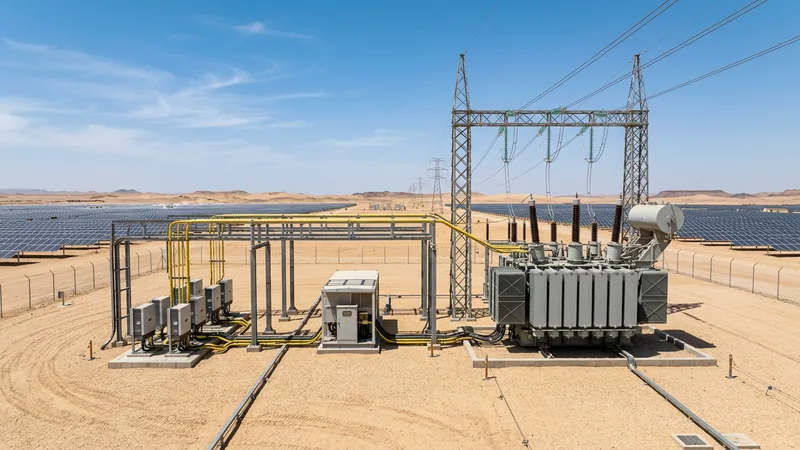
All of this capability is housed in a dedicated shore power substation. The linchpin of that substation is the transformer. It’s not just any distribution transformer; it’s a purpose-built machine designed for some of the most punishing service conditions an engineer can devise.
When 16 MVA Becomes a Very Expensive Paperweight
Let’s be clear: specifying the wrong transformer for a shore power application is a terminal-wide risk. A single connection for a large container ship can represent a 10-16 MVA load. That’s a significant percentage of a terminal’s total electrical demand appearing and disappearing in an instant. An underspecified transformer doesn’t just fail; it fails spectacularly, potentially causing a voltage sag that cascades through the terminal, tripping cranes and shutting down operations. Vessel turnaround schedules are measured in hours, and delays can cost operators hundreds of thousands of dollars.
Here are the technical gremlins that keep port electrical engineers up at night:
- Harmonic Distortion: Ships are not clean loads. Their power systems are full of variable frequency drives (VFDs) for pumps and thrusters, plus the rectifiers in thousands of reefer containers. These non-linear loads inject harmonic currents back into the grid, distorting the sine wave. An ordinary transformer will overheat and fail prematurely under this barrage of high-frequency "noise."
- Violent Load Swings: The power demand of a ship isn’t static. A bank of reefers might start its defrost cycle simultaneously, or a large bow thruster might kick in for repositioning. The load can swing by several MVA in seconds. The transformer must have the mechanical strength in its windings to withstand the immense electromagnetic forces generated by these events, day in, day out.
- Inrush Current: Energising a 16 MVA transformer is a significant event in itself. But connecting it to a ship’s "dead" electrical system, which has its own transformers, creates a compound inrush current event that can cause nuisance tripping of upstream protection relays if not properly studied and coordinated.
Ordering a standard distribution transformer and hoping for the best is not an engineering strategy. It’s an invitation for downtime.
5 Specification Considerations for Long-Term Reliability
Success in shore power hinges on getting the transformer right. It sits at the nexus of the utility grid and the vessel, and it bears the brunt of every electrical anomaly. When drafting the specification for a shore power transformer (compliant with IEC 60076), avoiding these five common errors is critical.
1. Ignoring the Harmonic Load Profile. Simply stating the MVA rating is not enough. The specification *must* detail the expected harmonic spectrum of the vessel loads. This dictates the use of a K-rated transformer (a term more common in North America but the principle applies everywhere) or, more accurately, designing the transformer to withstand the additional heating effects of specific harmonic orders as defined in IEEE C57.110 or equivalent IEC standards. This means thicker winding conductors and sometimes electrostatic shields between windings.
2. Underestimating Winding Bracing. The specification must call for reinforced winding construction to handle the repeated electromechanical stress of sudden load application and short circuits. It’s the difference between a transformer designed for a steady utility load and one designed for the chaotic reality of a port. Ask the manufacturer about their short-circuit withstand track record, certified by a body like KEMA. Yes, really.
3. Choosing the Wrong Vector Group. The transformer’s winding configuration (e.g., Dyn11, YNd5) is crucial for managing harmonics and grounding. A delta primary winding, for example, can help trap some harmonic currents from propagating back into the utility grid. Making the wrong choice can export your power quality problem to the rest of the terminal. It’s a decision that requires a full system study, not just a copy-paste from a previous project. See our guide on packaged substations for more info on integrated designs.
4. Skimping on the On-Load Tap Changer (OLTC). Shore power systems require fine voltage control. The OLTC is the primary mechanism for this, adjusting the transformer ratio to compensate for grid fluctuations or voltage drop under heavy load. A cheap, slow, or unreliable OLTC will fail to maintain the strict voltage tolerances required by the ship’s sensitive equipment, leading to protective trips. The spec should demand a vacuum-type OLTC from a reputable manufacturer, proven for high-cycle and reactive load applications.
5. Forgetting the Environment. A port is a harsh place. Salty, corrosive air and high ambient temperatures are the norm in the GCC. The transformer specification must detail the paint system (e.g., C5-M marine grade), the material for the cooling radiators (often galvanized steel or aluminium), and the maximum ambient operating temperature (50°C is a safe baseline in Dubai). Simply specifying "standard outdoor finish" is a recipe for premature corrosion and failure. A properly specified power transformer is built for its specific location from the inside out.
Getting these details right isn’t just about compliance; it’s about asset longevity and operational continuity.
Key Takeaways
- Shore power is more than a plug; it's a complex HV project where the transformer is the single most critical component for success and grid stability.
- Vessel loads are electrically "dirty" and dynamic, creating harmonic distortion and violent load swings that will destroy a standard distribution transformer.
- Transformer specifications must go far beyond MVA and voltage, detailing harmonic tolerance, mechanical bracing, vector group, and environmental hardening to ensure reliability.
The Engineer's Takeaway
Cold ironing is a powerful tool for decarbonizing the maritime industry, but the electrical interface is unforgiving. The success of a multi-million-dollar shore power installation doesn’t rest on the crane that lifts the cable or the VFD that converts the frequency. It rests on a few pages of a transformer specification document. Get those details right, and you’ve engineered a quiet, cleaner, and more efficient port. Get them wrong, and you’ve built a very expensive circuit breaker. If you need help, you know who to contact.