





Where reliability is actually won
A modern oil-immersed power transformer leaves a serious factory in better condition than it has ever been in: fully assembled under controlled humidity, type-tested to IEC 60076, routine-tested to the customer's specification, vacuum-dried, oil-filled, sealed, and signed off on a witness sheet. From that moment, every kilometre and every degree Celsius on the journey to a Gulf substation is a chance for that condition to drift.
Utilities, EPCs and asset managers across the UAE, Saudi Arabia, Oman and Qatar increasingly agree on a quiet truth that the wider industry has known for years: the overwhelming majority of in-service issues during the first two years are not built into the unit at the factory. They are introduced at site — by storage, by handling, by the speed of commissioning, by a torque value missed during a 48 °C afternoon. Installation support is how a serious supplier closes that gap.
This article is about why that matters more in the Gulf than almost anywhere else, what good installation support actually looks like, and how ETS works with customers from delivery through energisation.
The Gulf is a harder operating environment than the spec sheet suggests
Three things compound here in a way they do not in Northern Europe or temperate North America.
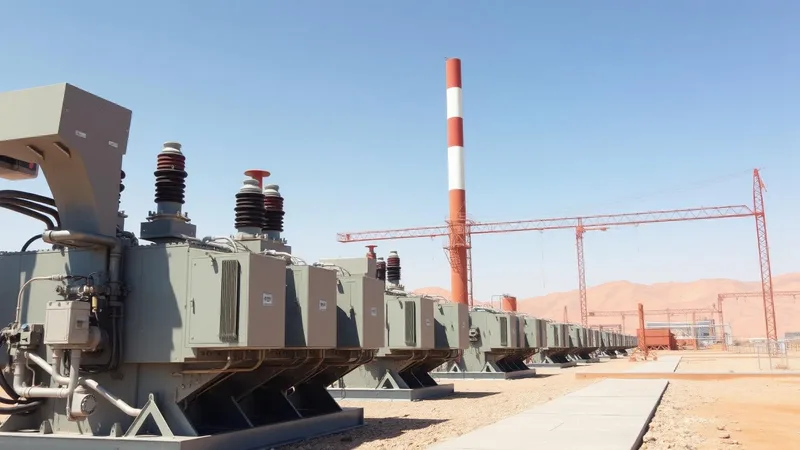
Heat. Ambient temperatures regularly clear 45 °C in the shade for weeks at a time. That is not just a cooling-curve problem; it is a torque-and-gasket problem. Bolts that were tightened in a 25 °C factory expand differently on a black tank in a Jebel Ali compound at noon. A flange that was sealed cold can weep oil hot.
Sand and humidity. Dust ingress during open-tank work and morning humidity during summer fills both attack the same enemy: oil moisture content. A unit delivered with 8 ppm water content can climb past 20 ppm if a vacuum break is opened without the right dew-point window. Once that moisture is in the cellulose, it stays there.
Schedule pressure. Vision 2030, NEOM, Etihad Rail, hyperscale data-centre campuses in SAIF and Khazna, ADNOC offshore expansion — every flagship programme is racing a calendar. EPCs are rewarded for energising on time; site engineers are punished for missing it. That compression is where corners get cut quietly.
None of this is a criticism of the region or the contractors operating in it. It is a description of the actual conditions that a transformer specified to IEC 60076 has to survive between leaving the factory gate and being energised onto an 11, 22, 33 or 132 kV network.
What great installation support looks like on site
A good installation supervision package is concrete. Six things should always be visible:
1. Site-readiness review before delivery. ETS engineers visit or remote-survey the pad: levelness, oil bund integrity, earthing grid continuity, access route, lay-down area, climate protection. Issues raised on day minus 30 are cheap; issues raised on day plus 1 are not.
2. Storage and laydown protocol. Units stored for more than four weeks need an active nitrogen blanket, breather monitoring, and a documented inspection cadence. In bonded yards near Khalifa Port and Jebel Ali this is the difference between a unit arriving energise-ready and one that needs a full reprocess.
3. Supervised vacuum oil filling. Treatment plant calibration, dew-point window verification, filtration to better than 3 micron, vacuum hold-and-rise tests — all witnessed and logged. This is the single highest-leverage step in extending transformer life in the Gulf.
4. Bushing, breather and Buchholz commissioning. Bushings torqued to manufacturer values with sealant integrity confirmed. Silica gel breathers proved colour-active. Buchholz oriented to the correct rising-pipe gradient with no air pockets. Radiator banks earth-bonded individually.
5. Pre-energisation SAT. Insulation resistance, polarisation index, winding resistance, turns ratio, magnetising current, DGA baseline, partial discharge, tap-changer operation. The point is not the tests — it is the baseline that lets future condition monitoring mean something.
6. Operator training in EN and AR. A unit that the on-shift team understands lasts longer than one they merely operate.
Why this is now a procurement question, not a site question
The industry has historically treated installation as the EPC's problem and the manufacturer's after-thought. That model is breaking down in the Gulf for a simple reason: lifetime cost.
A 40 MVA 132/33 kV power transformer that fails internally in year three costs the asset owner the original capital, the unplanned outage, the emergency replacement premium (now 14–22 weeks lead time across most OEMs), and the regulatory consequences. The total exposure is rarely under 4–6 times the original PO. Buying installation supervision as part of the original specification is one of the cheapest insurance products in the entire balance of plant.
Forward-leaning utilities — DEWA, EWEC, SEC, KAHRAMAA — are starting to write installation supervision and pre-energisation SAT explicitly into their tender documents. EPCs that bring it as a default offer rather than a change-order item are winning preferred-supplier status.
How ETS partners with customers from delivery to energisation
ETS treats installation as part of the product, not a service line that is sold afterwards. In practice, that means a single ETS engineer is named on the project from the factory acceptance test through to the energisation witness. That person owns:
- A pre-shipment site-readiness checklist agreed with the customer
- Supervised oil filling and vacuum treatment with an independent oil report
- FAT and SAT witness with a documented test pack ready for utility audit
- HV commissioning with partial-discharge SAT where the specification requires it
- Operator training delivered in EN and AR with a signed competency log
- A 24-month installed-asset support window backed by ETS service engineers based in the Gulf
Deeper detail on the individual services is on the Installation, Testing & Commissioning, and Consulting pages. The Standards & Compliance library covers the IEC 60076, IEEE C57.12 and regional utility-specific test packages we work to.
What to specify in your next PO
A short checklist any procurement engineer in the Gulf can drop into a transformer tender:
1. Installation supervision by a manufacturer engineer, named in the bid
2. Storage protocol for any laydown longer than four weeks
3. Supervised vacuum oil filling with dew-point and filtration acceptance limits
4. Pre-energisation SAT pack to IEC 60076-1 minimum, with DGA baseline and PD test where rated above 36 kV
5. Operator training in EN and AR with a signed competency record
6. 24-month installed-asset warranty extension contingent on the supervision being used
None of these add meaningful cost on a unit above 5 MVA. All of them measurably reduce the chance of an early-life event.
The takeaway
A transformer is only as reliable as the worst hour it spent between the factory and energisation. In the Gulf, those hours are harder than the spec sheet assumes. Installation support is the engineering discipline that closes the gap — and at ETS it is part of how the product is delivered, not an upsell after the fact.
If you have a project where the lay-down window is tight, the climate is hostile, or the SAT date is non-negotiable, talk to us early. The cheapest engineering decision you can make is the one taken before the unit ships.