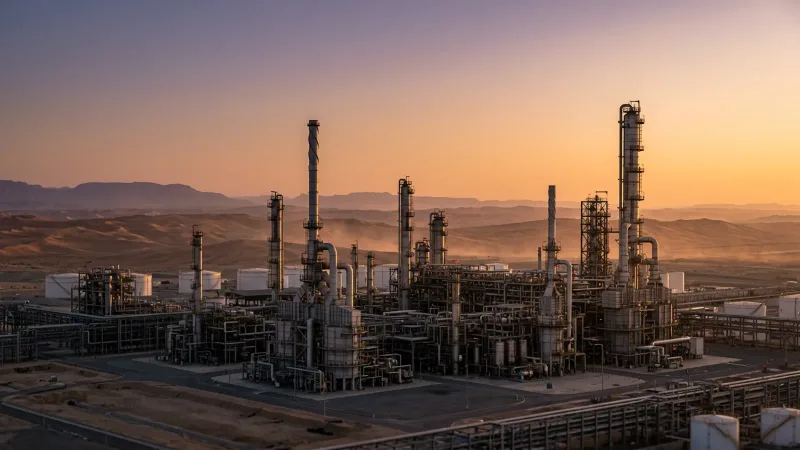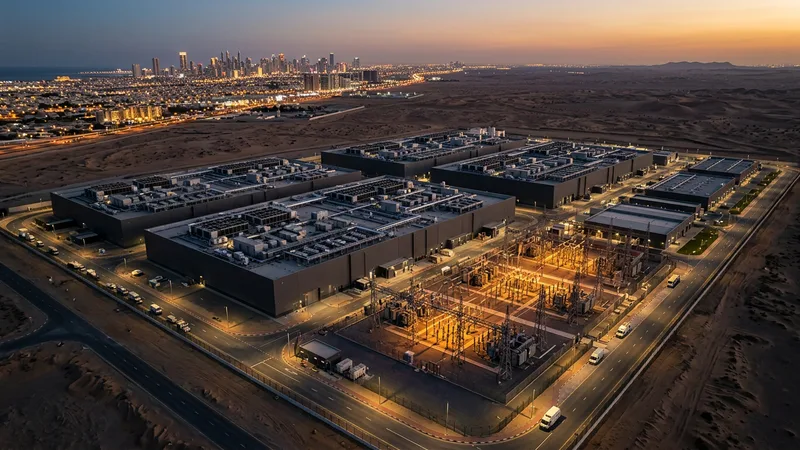






At three in the afternoon on a Tuesday in August, the air temperature on the perimeter road of a new hyperscale data-centre campus in the western Abu Dhabi desert reads 48 °C. The ground temperature reads 62 °C. Inside the campus, in white rooms with the air handlers running at full throw, the rack inlet temperatures sit at 24 °C and the GPU clusters are training without interruption.
This is, by any reasonable engineering measure, an unlikely outcome. It is also, in 2026, the new operating norm for a corridor that is being built into the largest concentration of AI training capacity outside the United States and China.
The UAE's data-centre build-out is no longer something that requires explanation. The Stargate UAE programme announced in 2025, the 5 GW Khazna campuses in Al Ajban and other locations, the G42 cluster around Masdar City, the Moro Hub expansions in Dubai, and the smaller specialist sites at Etisalat, du, and Mubadala's portfolio companies have together moved the country into a different conversation from any other GCC state, and from most countries anywhere. What has not been examined carefully enough, in the international press, is the engineering that makes it possible to run that compute at the ambient conditions the Arabian Peninsula imposes.
The 50 °C Problem, Stated Plainly
A modern AI training rack, populated with the current generation of high-end GPUs, dissipates somewhere between 60 and 130 kW of heat at full load. A row of such racks dissipates several megawatts. A modest AI training hall dissipates tens of megawatts. All of that heat has to be moved, in real time, from a silicon die at roughly 95 °C, through a cold plate at 60 °C, through a coolant distribution unit at 45 °C, and ultimately out of the building into the surrounding environment.
In a temperate-climate data centre — Dublin, Frankfurt, northern Virginia — the surrounding environment provides a 15 °C heat sink for most of the year, and free cooling or hybrid economiser arrangements can do a meaningful fraction of the work. In the western Abu Dhabi desert in August, the surrounding environment is at 48 °C. The heat-sink temperature is, depending on the chosen approach, somewhere between 35 °C and 50 °C — and the thermodynamic penalty for moving heat out of a 45 °C coolant loop into a 50 °C environment is severe. The cooling-system power, expressed as a fraction of IT load, is several times higher than the equivalent figure in a European campus.
That penalty is the central engineering problem of the regional industry, and the response to it has reshaped what a data centre actually looks like in this part of the world.
District Cooling Becomes Load-Bearing
The first response, which is now near-universal across the major UAE campuses, is to decouple the cooling problem from the data-centre site itself by connecting to a dedicated district cooling plant. Tabreed, Emirates Central Cooling Systems Corporation (Empower), and Emicool between them now operate dedicated plants serving most of the large data-centre clusters, with chilled-water supply at 5 to 7 °C delivered through insulated underground mains.
The advantages, from a data-centre operator's perspective, are several. The chilled-water plant can use seawater for condenser rejection on the coastal campuses, taking advantage of the Gulf's relatively stable 30 to 35 °C seawater temperature and avoiding the cooling-tower water consumption that would otherwise be prohibitive in an inland desert site. The plant can be sized for the cluster as a whole rather than for each campus individually, smoothing the cooling demand across thermal-load profiles that differ between operators. And the plant operates under its own dedicated electrical supply, often connected at a separate substation, which simplifies the data-centre electrical design and avoids loading the IT-feed transformers with auxiliary cooling load.
The trade-off is the chilled-water transport. A district main carrying 5 °C supply through ambient temperatures of 48 °C, even with high-specification insulation, picks up perceptible heat over a few hundred metres. The plant supply temperature is accordingly run slightly cooler than the rack-side return target, and the pumping power scales with the cube of the flow velocity.
The design engineers have been steadily pushing supply temperatures upward, towards 12 to 14 °C for high-density liquid-cooling campuses, to reduce both the chiller lift and the transport heat gain. The new generation of UAE hyperscale campuses is being designed for a supply-water temperature that would have been considered unworkable five years ago, on the grounds that it is now matched by the higher-temperature cold-plate technology on the IT side.
Liquid Cooling at the Rack
The second response is the rapid shift to direct-to-chip and immersion cooling at the rack. A traditional air-cooled rack tops out around 30 kW. A direct-to-chip liquid-cooled rack handles 100 to 150 kW. An immersion-cooled rack reaches 250 kW or more. For an AI training campus dissipating 200 MW of IT load, the choice between air and liquid is the difference between a campus of one square kilometre and a campus of one third of that.
The UAE operators have moved on this faster than most international comparators. Khazna's most recent campus designs are essentially fully liquid-cooled. G42's training facilities are designed around immersion.
The smaller specialist sites in the Masdar City cluster are increasingly hybrid, with air-cooled storage and network halls feeding liquid-cooled GPU clusters. The result is a campus density — measured in megawatts per hectare — that is, on the most recent published figures, approximately 2.5 times higher than the equivalent figure for the international average.
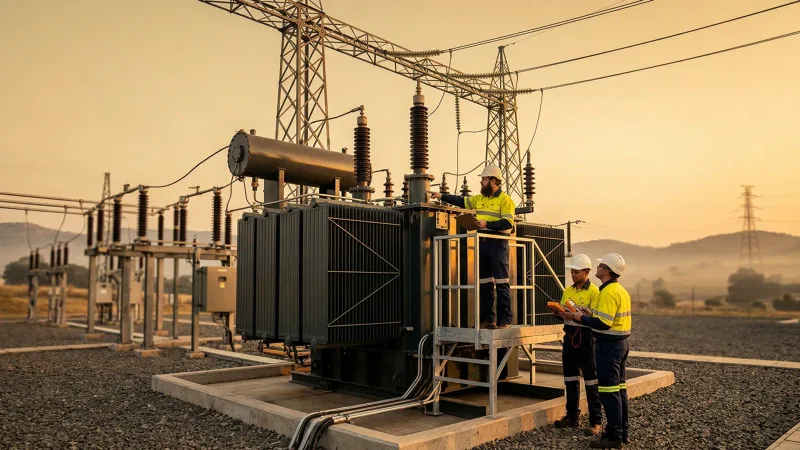
The substation side of that density is what most international observers underestimate. A 200 MW liquid-cooled AI campus draws all 200 MW from a relatively compact site, which means the on-campus main substation has to deliver that power into a footprint that, in older air-cooled designs, would have been spread across two or three separate substations. The standard regional specification is now a 132 kV main substation with four to six oil-filled main transformers of 50 to 75 MVA each, GIS switchgear to minimise footprint, and a 33 kV distribution loop feeding unit substations at the data-hall level.
The transformer specification is consistent with the regional climate envelope established for traditional utility loading — 50 °C ambient design point, thermally upgraded insulation, conservator preservation with sealed nitrogen blankets — but with one important addition. The harmonic profile of an AI training load, with its sub-second power swings driven by the GPU duty cycle, is more demanding than a conventional cloud-computing load, and the on-campus transformers are accordingly specified with larger stabilising tertiary windings and reinforced OLTC mechanisms.
Power, Not Land, Is Now the Constraint
For most of the past decade, the limiting input on the UAE data-centre build-out was political: the willingness to authorise large campuses on land that, in some cases, sits adjacent to sensitive infrastructure. That constraint has been resolved. The constraint that has replaced it is electrical capacity at the substation interface.
The major utilities — DEWA, EWEC, ADDC, AADC, TRANSCO at the transmission level, and SEWA and FEWA in the northern emirates — have all signalled multi-year transmission expansion programmes specifically scaled to the data-centre and AI compute pipeline. EWEC's most recent procurement programme covers approximately 7 GW of new generation, primarily solar PV with battery storage and gas-fired peaking, with a stated allocation to data-centre and industrial customers. TRANSCO's 400 kV network reinforcement programme into the western region carries explicit data-centre justification in the regulatory filings. DEWA's 400 kV ring expansion around the Hassyan and Al Aweer corridors is sized to deliver, by 2030, an incremental capacity that is comparable to the entire data-centre load presently installed in the country.
The procurement timeline is the other variable. A 132 kV main transformer of the size now standard for these campuses, with on-load tap changer, K-factor rating of 13 or higher, and the regional climate specification, currently quotes at 80 to 110 weeks from order to delivery in the regional supply chain — meaningfully shorter than the 130-week figure now standard in the US market, because several manufacturers operate dedicated regional facilities. ETS Group's manufacturing footprint in the GCC, together with the regional facilities of the other established suppliers, has been a structural factor in the speed at which the UAE pipeline has moved.
The buildings still take nine to twelve months. The transformers, in this market, take less than two years. The math works.
What the Region Is Quietly Building
The most important point about the UAE data-centre cluster is not the headline gigawatt figures. It is that the engineering programme behind those figures has been executed coherently across utilities, district cooling operators, equipment manufacturers, and developers, in a way that very few other markets in the world have managed. The 50 °C ambient does not go away.
The seawater is not getting colder. The compute is not getting less power-dense. The reason the racks are running at 24 °C inlet in August is that several thousand engineers across half a dozen organisations have, over the past decade, built an industrial system specifically designed to make that outcome routine.
The next decade of regional growth will rest on the same pattern. The substations are being built. The chilled-water plants are being expanded.
The transmission corridors are being reinforced. The compute will follow, in the same way it has followed every well-engineered electrical and cooling system in industrial history. The desert is, on the evidence of the past five years, a perfectly reasonable place to train an AI model — provided someone has thought carefully about the heat sink.