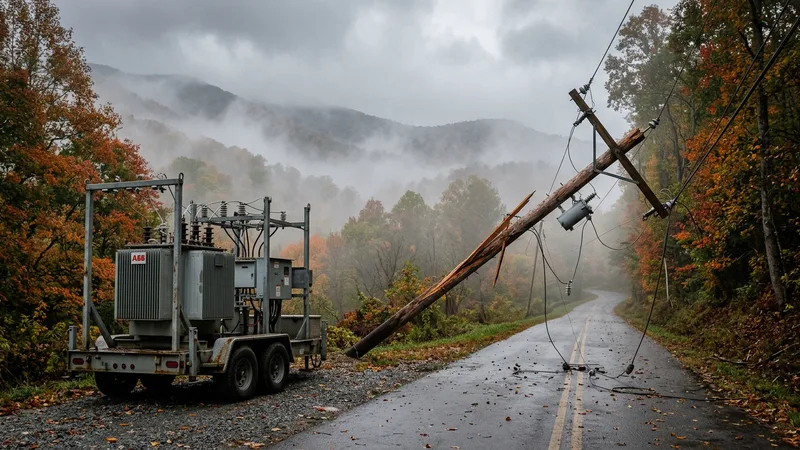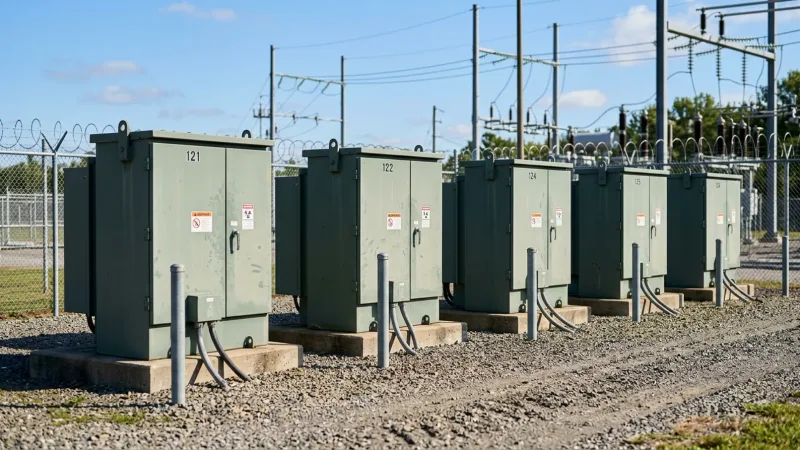






Independent Transmission Companies operate under FERC formula rates that compound the cost of a transformer over its full service life. A 60 MVA / 230 kV GSU procured under ITC-grade specifications is engineered for forty years of regulated return, not the twenty-five-year economic life baked into a typical merchant project. The specification choices that follow — hi-B core steel, thermally-upgraded paper, a vacuum-LTC, a fully-redundant cooling bank — read differently when each kilowatt of stray loss becomes a four-decade revenue drag.
The Age of Integrated Certainty
There was a time when the utility owned the whole chain: the coal plant, the wires, the GSU, and the meter on your house. In this vertically integrated world, building for a 50-year service life was not just a goal; it was the only sensible engineering and financial decision. Assets were entered onto the regulated asset base (RAB), and the utility earned a steady, state-approved rate of return on that capital for decades. Reliability was paramount, and the cost of an unexpected failure was so high that specifying hyper-robust equipment was an easy call.
Then came deregulation in the 1990s. The industry unbundled. Generation was spun off to become the competitive, high-risk, high-reward world of Independent Power Producers (IPPs). Transmission, a natural monopoly, remained regulated, but often as a separate entity—the "Transco." In the Midwest, this gave rise to companies like ITC, the nation’s largest independent electricity transmission company, and grid operators like the Midcontinent Independent System Operator (MISO), which manages the flow.
This split created a philosophical divide right at the high-voltage bushings of the GSU. The IPP generator now owned the first asset (the power plant) and the Transco owned the next (the transmission line). The GSU sat directly on this new fault line of ownership, incentives, and engineering culture. The old assumption of "build it to last forever" was no longer a given.
The GSU as a Regulated Cash Cow
For a FERC-regulated utility like ITC, the financial logic remains surprisingly similar to the old integrated model. When ITC builds or acquires a transmission asset—be it a 345 kV line or the GSU connecting a new wind farm—that asset goes into its capital base. On that base, FERC allows ITC to earn a regulated Rate of Return on Equity (ROE), a figure often hovering around 10%. A more expensive, more robust transformer, therefore, generates more revenue over its life than a cheaper one. It is, quite literally, a better earner.
This creates a powerful incentive to specify for longevity and reliability, not minimal upfront cost. Consider the typical duty cycle. A GSU owned by ITC as part of its transmission network is expected to be available, stable, and predictable for decades. It is a critical node in a system designed to meet strict N-1 reliability criteria, where the grid must remain stable even after the loss of any single component. The cost of an unscheduled GSU outage to ITC is not just the repair; it is a mark against its reliability metrics, which can impact its regulatory standing and revenue.
This is why their specifications often read like a "cost-is-no-object" wish list for a transformer engineer:
- On-Load Tap Changers (OLTCs): More frequent, smaller steps (e.g., 0.625%) for finer voltage control, built with extreme mechanical endurance in mind, as opposed to the more economical, larger-step (1.25% or 2.5%) tap changers often found in IPP applications.
- Lower Flux Density: Designing the core with lower magnetic flux density reduces core losses, but more importantly, it lowers audible noise, minimizes vibration, and dramatically reduces core heating and long-term degradation of insulation. This requires more, and higher-grade, core steel, increasing the unit's upfront cost and weight.
- More Copper: Increasing the cross-section of the windings beyond the minimum required by IEEE C57 standards reduces load losses (I²R losses). This not only improves efficiency but critically lowers the operational temperature, which is the single most important factor in the service life of the paper insulation.
For ITC, a GSU that costs 25% more but reliably operates for 40 years instead of 25 is a clear financial win. The additional CAPEX is more than paid for by the longer, more reliable revenue stream it generates from the regulated tariff structure.
Our large power transformers are specified to meet these demanding utility-grade requirements.
What IPP Engineers (Are Forced To) Get Wrong
An engineer at an IPP developing a new solar farm or a gas peaker plant lives in a different world. Their bible is not the FERC code of regulations; it is the project's pro-forma financial model. The GSU is pure capital expenditure—a hurdle to be cleared before the plant can generate revenue. The guiding principle is not "build to last," but "meet the interconnection agreement at the lowest possible cost."
This does not mean IPPs specify bad transformers. It means they specify *different* transformers. The unit must comply with the grid code (e.g., MISO’s requirements) and meet baseline standards like IEEE C57.12.00. But every dollar spent beyond that minimum is a dollar that hurts the project's Internal Rate of Return (IRR). Why pay for a 40-year life when the Power Purchase Agreement (PPA) is for 20 years and the project might be sold in ten?
This leads to different design choices:
1. Higher Temperatures: A transformer might be specified to run consistently at its nameplate 65°C average winding rise over ambient. This is perfectly compliant with standards, but it accelerates the aging of cellulose insulation far more quickly than a unit designed to run cooler.
2. Cycling Duty: Many IPP plants (especially gas peakers and renewables) cycle on and off daily. This thermal cycling of heating and cooling puts immense mechanical stress on the windings and insulation system. A transformer designed for minimal CAPEX may not have the robust clamping structure and winding support needed to endure 10,000 such cycles without issue.
3. Value-Engineered Components: Ancillary components like bushings, coolers, and tap changers will be specified to meet the standard, but perhaps not the most robust, maintenance-free versions a regulated utility would demand.
An IPP might even plan for a mid-life GSU replacement as a forecasted operating expense, a calculation that would be anathema to a transmission utility planner. The GSU is not an earning asset; it's a depreciating piece of machinery whose failure is a manageable, if painful, operational risk.
The Grid of Tomorrow Demands a Choice
For decades, this quiet divergence in asset philosophy didn’t cause systemic problems. But the grid is changing. The shift to inverter-based resources (solar, wind, batteries) is introducing complex harmonic profiles and dynamic voltage swings that place new stresses on magnetic equipment like GSUs. The once-predictable duty cycle of a baseload coal plant—ramping up in the morning and staying there all day—is being replaced by the volatile, intermittent output of a wind farm.
The "just-enough" IPP transformer, designed for a simpler time, may struggle. We are already seeing an increase in GSU failures at renewable sites that are less than ten years old. A GSU designed for the cost-focused world of a 20-year PPA may not be robust enough for the stability-focused needs of a 50-year grid.
This raises a critical question for grid planners and regulators: Should the robust, long-term asset philosophy of the Transco be extended to cover critical interconnection assets like GSUs? As the grid becomes more complex and interconnected, the failure of a single IPP-owned GSU can have cascading impacts that neighboring utilities and, ultimately, the entire MISO system must manage. Solutions could include stricter interconnection standards for GSUs or new ownership models where the Transco procures and owns the GSU, providing it as a service to the IPP. This would align incentives toward long-term reliability, much like the packaged substations model common in other sectors.
Key Takeaways
- A regulated utility like ITC earns a return on its capital base, creating a powerful incentive to invest in more robust, longer-lasting, and more expensive GSUs. For them, it is a 40-year earning asset.
- An Independent Power Producer (IPP) sees the GSU as a day-one capital cost. The incentive is to meet the minimum technical specification of the interconnection agreement at the lowest possible price to maximize project IRR.
- As the grid transitions to more intermittent, inverter-based resources, the stresses on GSUs are increasing, questioning whether the cost-optimized IPP asset philosophy can provide the long-term reliability the system requires.
The Engineer's Takeaway
A transformer is never just a transformer; its specification is a physical manifestation of the business model that paid for it. The deep philosophical divide between specifying for a 20-year project finance deal versus a 40-year regulated asset base is now having tangible consequences for grid reliability. Understanding which philosophy built the asset you’re relying on is no longer an academic exercise—it's a critical piece of risk assessment.