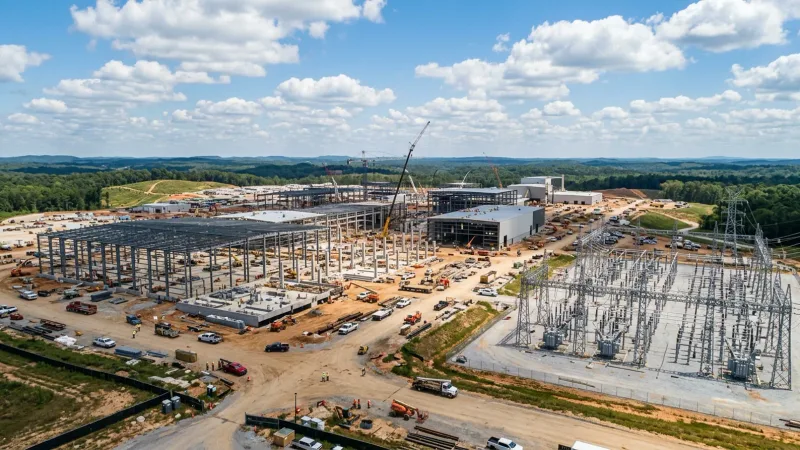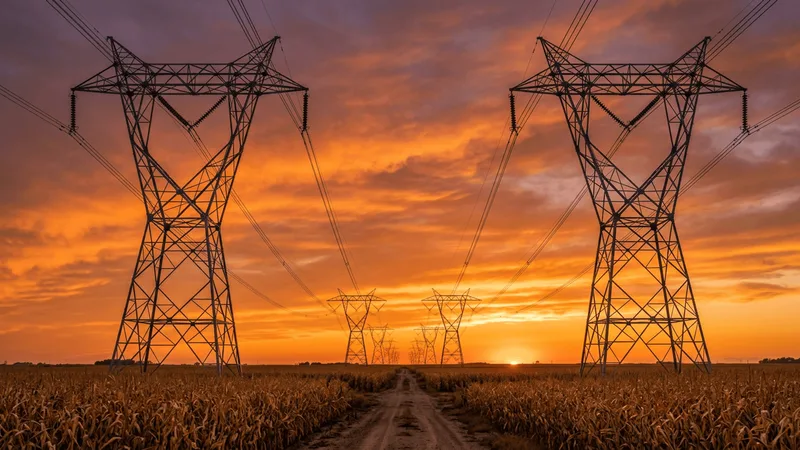






Capacity prices are macro signals. They land as micro problems. The 2025/26 PJM Base Residual Auction cleared at $269.92 / MW-day, ten times the prior year, and the developer response queued more than 2 GW of new combined-cycle and peaker capacity inside ninety days. Every megawatt of that capacity is matched by a generator step-up transformer that has to clear a domestic OEM lead time already running thirty-six months. The order-book mechanics are the article.
The Anatomy of a Price Separation
PJM's Base Residual Auction (BRA) is designed to procure sufficient power generation capacity three years in advance of when it will be needed. In a perfectly balanced system, the price for this capacity would be uniform across the entire 13-state grid. The system is not perfectly balanced. It is balkanized into Locational Deliverability Areas (LDAs), regional zones whose ability to import power from their neighbors is physically capped. This import capability is the Capacity Emergency Transfer Limit (CETL).
When an LDA, such as the Dominion (DOM) or APS zones, cannot meet its reliability requirement with its own generation plus the power it can import under its CETL, prices must rise. They "separate" from the broader RTO price, climbing precipitously to incentivize the retention of existing local generators or the construction of new ones. For years, the CETL was a relatively stable input in planning models. This is no longer true. The CETL itself is now hostage to the global supply chain for the heaviest of heavy industry: large power transformers.
A Generator Sits and Waits
Consider a 250 MW solar project under development in southern Virginia, inside the DOM LDA. The project sponsor has land, permits, panels, and a signed interconnection agreement. It successfully cleared a PJM capacity auction, committing to be available for a delivery year three years out. The entire financial model depends on meeting that commitment. But between the substation fence and the 345 kV transmission line stands a critical dependency: the Generator Step-Up (GSU) transformer.
This is not an off-the-shelf component. A GSU of this scale, perhaps 250-300 MVA, is a bespoke piece of equipment subject to intense manufacturing constraints. Lead times that were once a predictable 50-60 weeks are now routinely quoted at 110 to 160 weeks. For larger grid-class autotransformers, 200 weeks is not an outlier. Our solar project, therefore, faces a multi-year wait for a single piece of hardware. Its capacity commitment, once a secure asset, is now a significant liability. A failure to deliver results in steep non-performance penalties, a risk directly attributable to a manufacturing backlog thousands of miles away.
How One Transformer Breaks a Market Model
The solar project’s GSU delay is a private problem. A delayed transmission autotransformer is a public one that reshapes market outcomes. PJM’s Regional Transmission Expansion Plan (RTEP) is a portfolio of grid upgrades required to maintain reliability. Many of these projects involve replacing or adding transformers to increase transfer capability between regions, directly affecting the CETL of various LDAs.
Let us say a planned upgrade to increase import capability into the DOM zone by 500 MW depends on installing a new 500/230 kV, 450 MVA autotransformer. PJM’s models for the 2026/2027 BRA would have factored in this higher CETL value. But the transformer, ordered with what was once a conservative buffer, is now delayed by two years. Its manufacturing slot was pushed back, a high-voltage bushing supplier had its own delays, and shipping added another twelve weeks. The result is that the CETL increase does not materialize in time for the delivery year.
The auction proceeds based on the physical reality of the grid, not the planned version. The DOM LDA has 500 MW less import capacity than anticipated. The supply-demand balance tightens instantly. To meet its internal requirement, the zone must now procure more expensive, local-only capacity. The clearing price for the entire LDA separates and spikes, driven not by a generator outage or a fuel price swing, but by the absence of a single, 150-ton steel box.
The Factory Floor Dictates the Price Floor
The reasons for a 160-week lead time are not mysterious. They are a confluence of materials science, logistics, and concentrated manufacturing. The core of any transformer is made of grain-oriented electrical steel (GOES). Global production of high-grade GOES is limited to a handful of specialty mills. Input costs for these materials, alongside copper and mineral oil, saw dramatic inflation that manufacturers pass through with escalators.
Beyond raw materials lies the manufacturing process itself. Winding a large power transformer that complies with IEEE C57.12.90 standards is a craft that takes months. Then it must be baked out in a massive oven for weeks to remove all moisture before being sealed. The slightest imperfection can lead to catastrophic failure in the field.
The silent constraint is often the sub-components. High-voltage bushings—the porcelain or composite insulators that allow conductors to pass through the grounded transformer tank—are themselves a bottleneck. A 345 kV or 500 kV bushing is a highly specialized product with its own multi-year backlog. A transformer can be fully assembled and waiting for months on a factory floor for its bushings to arrive.
The Utility Response
Asset owners are not idle. The crisis in procurement has forced a long-overdue reckoning with historic purchasing practices. The era of endlessly customized, "gold-plated" transformer specifications for every new application is ending. Utilities are moving toward standardized "family" designs. A 138/69 kV transformer should have a common footprint, control cabinet layout, and cooling configuration. This allows for pooled inventory and strategic interchangeability.
This pooling is becoming formalized. FERC Order 829 provides a favorable regulatory framework for utilities to recover costs for participating in shared spare transformer programs. Organizations like Grid Assurance are manifestations of this strategy, creating a subscription-based reserve of critical, long-lead-time equipment for members.
Procurement itself is changing. The single-unit tender is giving way to multi-year framework agreements. Utilities are reserving production slots with manufacturers years in advance, often before a specific project has been fully approved. It is a shift from just-in-time purchasing to just-in-case resilience, a direct admission that the supply chain, not the regulator, now dictates project timelines.
Procurement Signals for Procurement Managers
The link between hardware and market prices is now indelible. For those procuring equipment or trading financial positions based on grid fundamentals, the signals of future price movements originate far from the trading floor. The essential watchlist should include:
1. Monitor Manufacturer Disclosures. Publicly traded transformer manufacturers (and their parent companies) discuss backlogs, production capacity, and material costs in their quarterly earnings reports and investor calls. A lengthening backlog is a direct leading indicator of future constraints.
2. Scrutinize Transmission Plans. PJM’s RTEP documents and the generator interconnection queue are public records. Identify critical-path projects that depend on new autotransformers at key interfaces. Systematically track their in-service dates against typical procurement timelines.
3. Track Key Sub-components. Follow the availability of high-voltage bushings, load tap changers, and even industrial-scale radiators. A shortage in any one of these can pace the entire delivery.
4. Model CETL Sensitivity. Run sensitivities on LDA import capabilities. Assess the marginal price impact of a single major transmission project, like a transformer replacement, being delayed by one, two, or three years. The results often reveal a non-linear relationship where a small delay triggers an outsized price response in the capacity auction.