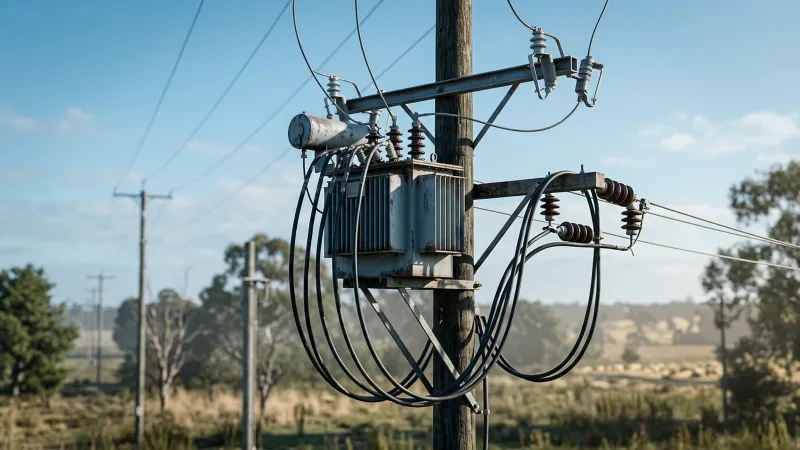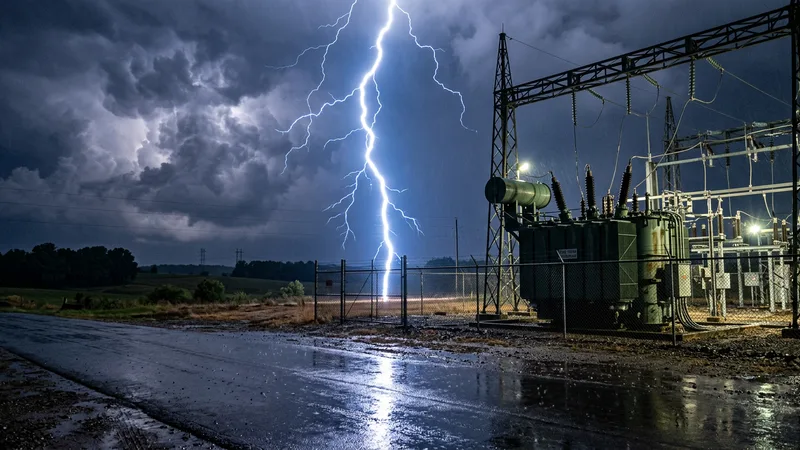






Mountain-region distribution co-ops were not designed for Category-4 hurricanes. Helene proved that. Within ninety days of restoration, French Broad EMC and Mountain Electric began cross-referencing the pad-mount hardening guidance ERCOT-area utilities developed after Winter Storm Uri — sealed-tank assemblies, raised pads, and externally-protected dead-front bushings. The economics of a co-op rebuild now look more like a coastal one. We walk through what changed.
The Old Playbook: Radial Feeds and a Prayer
For nearly a century, the rural grid has been a marvel of minimalist engineering. The Rural Electrification Act of 1936 prioritized reach, not resilience. The result was a hub-and-spoke masterpiece of long, stringy radial feeders snaking through rugged, tree-dense terrain. A single 34.5 kV transmission line might be the sole lifeline for three or four downstream substations, each serving thousands of members.
This design is brutally efficient from a cost-per-mile perspective. It is also exquisitely fragile. One ancient oak tree, felled by 80-mph winds, can de-energize a significant portion of a co-op’s territory. Restoration becomes a slow, linear process of finding the fault on a line that could be dozens of miles long. For members at the end of the line, a major storm doesn't mean a flicker; it can mean a week or more of waiting for the lights to come back on. This is the accepted, if aggravating, trade-off that has defined rural power. Helene didn't create this vulnerability; it just brought a multi-billion-dollar invoice for it.
Texas's Quiet Overbuild Becomes a Blueprint
While Appalachian co-ops were perfecting the art of vegetation management, a different evolutionary path was unfolding in Texas. Driven not by storm-hardening but by the ruthless economics of the ERCOT market, a robust microgrid ecosystem emerged. Large industrial facilities, data centers, and even grocery chains like H-E-B invested in behind-the-meter generation and batteries. Their goal was twofold: shave exorbitant peak demand charges and sell ancillary services like frequency response back to the grid.
These weren't just backup generators; they were sophisticated, grid-interactive assets. They were designed to operate seamlessly connected to the grid, then disconnect and carry their own load indefinitely in an island. Built around natural gas reciprocating engines, solar PV, and increasingly, battery energy storage systems (BESS), these private microgrids proved the technical feasibility of localized energy islands. They mastered the complex dance of controls, protection, and generation needed to create a stable, independent power system. In doing so, they wrote the engineering playbook that Appalachian co-ops are now studying intently.
The Post-Helene Scramble
In the wake of the hurricane, the calculus for co-ops in Duke Energy and Dominion Energy territory shifted overnight. The conversation switched from "how do we restore it faster?" to "how do we build it so it doesn’t fail catastrophically?" Suddenly, the Texas model looked less like a niche market application and more like an essential survival guide.
The timing was fortuitous. The federal government, through the USDA's Empowering Rural America (New ERA) program, has made nearly $10 billion available to co-ops for projects that improve resilience and transition to cleaner energy. This infusion of capital provides the means to turn blueprint into reality. NRECA, the co-ops' national association, is actively guiding its members toward these funds, with microgrids becoming a centerpiece of grant applications. The goal is to build 2-10 MW "community lifeboats"—small power systems capable of isolating a town, a commercial center, or a critical facility hub from a downed transmission feed and running independently for days.
Sizing the Community Lifeboat
Building that lifeboat, however, is not as simple as buying a generator and some solar panels. The critical link, and the place where these projects often stumble, is the interconnection and step-up transformer. This piece of equipment sits at the gateway between the microgrid and the wider utility, and in an islanded scenario, it becomes the foundation of your new, smaller grid. Sizing a 5 MVA step-up transformer for a community microgrid, for instance, requires a completely different mindset than sizing a standard distribution transformer.
Engineers must account for dynamics that are trivial on an interconnected system but critical in an island. Key considerations include:
1. Fault Current & Protection: The transformer must be able to handle fault current from the utility side when connected. But when islanded, the microgrid's generators (especially inverter-based ones) produce much lower fault current. The protection scheme needs to be sophisticated enough to work in both modes, which often means moving beyond simple fuses and relays to microprocessor-based systems.
2. Motor Starting Loads: That 5 MW island needs to be able to start the large motors at the town's water treatment plant. The voltage dip caused by that motor's inrush current can be crippling to a small grid. The transformer's impedance and the microgrid controller's response speed are critical.
3. Harmonics and Power Quality: Inverter-based resources like solar and batteries are non-sinusoidal. On the main grid, their harmonics are a drop in the ocean. On a small island, they can become a major power quality problem, requiring careful filter design and consideration in the transformer specification (e.g., K-factor rating).
4. Grounding and Vector Group: A utility-side grid is a solid ground reference. When you island, you have to *create* your own. The transformer's winding configuration (typically a Delta on the low-voltage microgrid side and a grounded Wye on the high-voltage utility side, or Dyn1) is fundamental to establishing a stable ground reference for the islanded system. Getting this wrong is a recipe for instability.
Building a robust microgrid often requires a purpose-built package substation that integrates the transformer, protection, and medium-voltage switchgear into a single, factory-tested unit.
Beyond Iron and Copper
The challenges aren't just hardware. The shift to microgrids requires a fundamental change in a co-op's operational DNA. For decades, they have been masters of a passive distribution network. Now, they must become operators of active, dynamic generation and control systems. This introduces a host of new concerns:
- Cybersecurity: An internet-connected microgrid controller is a target. What was once an air-gapped system of poles and wires now has an IP address, bringing it under the purview of NERC CIP-style thinking, even if not formally regulated as such. Securing these assets is paramount.
- Control Philosophy: Who decides when to island? Is it an automated function, a call from the control center, or a manual switch at the substation? How do you smoothly re-synchronize with the grid when the main feed is restored?
- Economic Dispatch: With solar, batteries, and maybe a genset, how do you dispatch them cost-effectively when islanded? Do you burn fuel to preserve battery for emergencies, or drain the battery to save on fuel costs? You can find more analysis of these trade-offs on our resources page.
These are no longer just power engineering problems; they are software, security, and economic modeling problems, too.
Key Takeaways
- Protracted outages from storms like Helene have revealed the fundamental fragility of the traditional, long-radial-line model for rural electric cooperatives.
- Economically-driven microgrids in Texas, built for market participation, have unintentionally created a proven technical blueprint for the resilience-focused needs in Appalachia.
- A massive influx of federal funding is enabling co-ops to act, but success hinges on meticulous engineering, especially in the often-overlooked sizing and specification of the main step-up transformer.
The Engineer's Takeaway
The most resilient grid isn't the one that never fails; it's the one designed to break apart cleanly and survive on its own. For the modern co-op, mastering the island is no longer a niche specialty. It is the new mandate.