





TL;DR:
- CIP-014 is not just about fences; it’s a risk-based framework requiring a detailed threat assessment (R4) and tailored mitigation plans (R6) for critical substations.
- Hardening extends beyond the perimeter to the equipment itself, including ballistic-rated radiator shields, blast-resistant buildings, and even armored transformer tanks.
- Vendors are now offering factory-installed hardening solutions, but integrating them effectively requires early engagement in the specification process, not as a post-design afterthought.
It Started With Cut Fiber
On April 16, 2013, someone with a pair of wire cutters snipped fiber-optic cables in a vault near San Jose, California. Shortly after, rifle shots echoed through the pre-dawn quiet. Over the next 19 minutes, gunmen fired more than 100 rounds of 7.62×39mm ammunition into the cooling radiators of 17 large power transformers at PG&E's Metcalf 500 kV substation. The attack was sophisticated, disabling and destroying millions of dollars of critical equipment. It was also the incident that directly gave us NERC CIP-014.
Before Metcalf, physical security was largely about keeping honest people out and deterring casual vandalism. After Metcalf, the industry had to confront the reality of a determined, coordinated attack on the Bulk Electric System (BES). NERC CIP-014, "Physical Security," was the result. It’s not just another regulation; it’s a fundamental shift in how we must think about substation design.
The standard applies to transmission owners with BES assets, compelling them to identify their most critical substations—the ones whose loss could cause instability, uncontrolled separation, or cascading failures across the interconnection. Once a station is identified as "critical" through a verified planning assessment (R1, R2), a rigorous process of threat evaluation and mitigation begins.
R4: The Threat Assessment You're Under-Scoping
Here lies the first major hurdle for many utilities. Requirement 4 (R4) mandates that the transmission owner perform a periodic evaluation of the potential threats and vulnerabilities of a physical attack on their critical facilities. This is where compliance often goes sideways. A generic checklist, assuming a fence and a camera are sufficient, will not pass an audit.
A proper threat and vulnerability assessment is an active, intelligence-driven process. It isn’t a one-and-done report that gathers dust. It needs to be a living document, revisited every 24 to 36 months, that considers the specific, localized threat landscape. What does a robust R4 assessment include?
- Analysis of Attack Vectors: It’s not just about who might climb the fence. You must evaluate the potential for ballistic attacks from outside the perimeter, the use of explosives, and complex, coordinated intrusions.
- Line-of-Sight Vulnerability: Get out of the engineering office and walk the perimeter. If you can see a transformer's radiators or a critical bushing from a public road, a wooded area, or a nearby building, an attacker can too.
- Modeling and Cascading Impact: The assessment must be informed by the same power-flow and stability studies that designated the site as "critical" in the first place. You need to understand precisely *how* the station’s failure would affect the grid.
- Coordination with Law Enforcement: The plan requires evaluating law enforcement response time and capabilities. A five-minute response time in a dense urban area is very different from a 45-minute response to a remote desert substation. Your mitigation strategy must account for this reality.
Auditors want to see that your security plan is a direct, logical consequence of this specific, documented assessment. If you can’t draw a straight line from a vulnerability identified in R4 to a mitigation deployed under R6, you have a problem.
7 Considerations That Strengthen Your R6 Mitigation Plan
Requirement 6 (R6) is the "show me" part of the standard: implementing and documenting the physical security plan from R5 that addresses the threats from R4. This is where engineering, security, and procurement must converge. Simply throwing up a concrete wall is rarely the answer. Here are the common mistakes we see.
1. Treating the Perimeter as the Only Defense. A chain-link fence topped with barbed wire is great for deterrence and delay. It does absolutely nothing to stop a .30-06 round. A security plan that relies exclusively on the perimeter for protection against the threats identified in R4 is fundamentally non-compliant.
2. Ignoring Ballistic Line-of-Sight. That transformer radiator visible from the highway a quarter-mile away? It’s a target. Effective R6 mitigation often involves deploying ballistic-rated shields or walls. These aren’t just generic steel plates; they are engineered systems rated to a specific UL 752 level (e.g., Level 8 for 7.62mm rifle fire). Berms and non-traditional visual obstructions can also work, but their effectiveness must be documented.
3. Forgetting the Control Building. An attacker doesn’t need to destroy a 500 MVA transformer if they can disable its controls and protection relays. A standard prefabricated control house is a soft target. R6 plans for high-risk sites now routinely specify blast-resistant and ballistically-rated building designs. The door, the HVAC louvers, the cable entry points—every penetration point must be hardened.
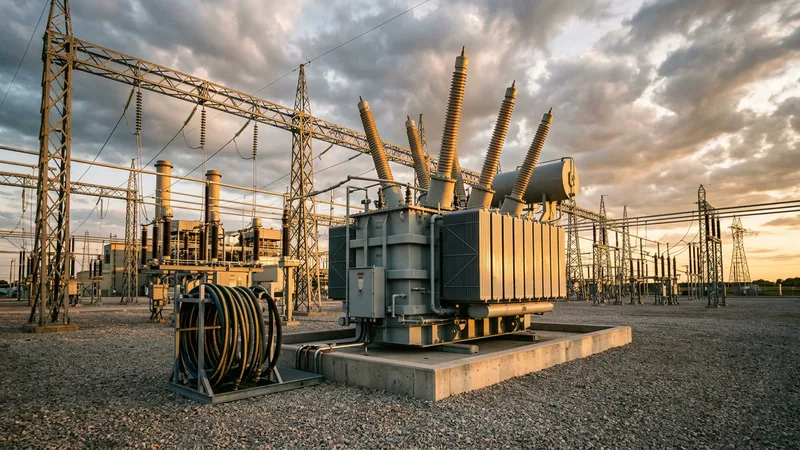
4. Neglecting Transformer Cooling Systems. Metcalf proved that a transformer’s cooling system is its Achilles' heel. A few well-placed shots can drain the oil and lead to a thermal runaway and total failure. Mitigation here means more than just a wall; it can involve ballistic shields placed directly on or around the radiator banks. Some vendors even offer ballistic-rated steel louvers that protect the fragile cooling fins without impeding airflow. Learn more about our robust transformer designs.
5. Underestimating Lead Times and Cost. Hardened equipment is not an off-the-shelf product. A standard 500 kV transformer may have a lead time of 70-80 weeks. Adding a full ballistic hardening package can easily add 15-20 weeks on top of that, not to mention a cost increase of 20-30%. This cannot be a procurement afterthought; it must be designed into the project schedule and budget from day one.
6. Siloing Security and Electrical Engineering. A ballistic shield is useless if it causes the transformer to overheat and derate on a hot summer day. The security team may specify a UL Level 8 wall, but the electrical and thermal engineers must validate its impact on airflow and cooling performance. This requires collaboration and often sophisticated thermal modeling. It’s a classic example of where organizational charts can become a barrier to good engineering.
7. Failing to Document the "Why." You installed a $200,000 ballistic shield. Why? An auditor will ask. Your documentation must clearly state: "Due to a clear line-of-sight vulnerability from the adjacent access road identified in our R4 Threat Assessment, we deployed a UL Level 8 rated shield to protect the primary cooling bank of T1, mitigating the risk of a ballistic attack leading to forced outage." Without that link, the shield is just an expensive piece of steel.
The Rise of the Armored Transformer
The market is responding. Where hardening was once a custom, field-installed affair, transformer manufacturers are now integrating physical protection directly into their designs. It’s increasingly common to see specifications calling for factory-installed ballistic armoring on the main tank, tap changer compartments, and conservator tanks. Some designs even incorporate this armor as a structural element.
This approach has advantages. Factory installation ensures better quality control and fitment compared to field retrofits. It also allows the thermal impacts to be accounted for in the transformer’s original performance guarantee. However, it also adds significant weight. A 400 MVA transformer that already pushes shipping weight limits may become impossible to transport to a site with road or bridge restrictions once several tons of steel are added.
Engineers must consider the entire lifecycle, from foundation design to transportation logistics. Engaging with vendors early to discuss these trade-offs is critical. A hardened transformer is more than just a component; it’s a key part of an integrated system, much like the protective shell of a packaged substation.
The Engineer's Takeaway
NERC CIP-014 isn't a prescriptive security standard; it's a forcing function for risk engineering. It compels us to move beyond designing for N-1 contingencies and start designing for a determined adversary. The most compliant substation isn't the one with the highest walls, but the one where every security measure—from a simple lock to a half-million-dollar ballistic wall—can be traced directly back to a specific, credible threat identified and documented in your assessment. It’s about thinking like your opponent, then out-engineering them. For additional guides and tools, visit our resources section.