





Modern power engineering often feels like a slow, iterative dance of incremental efficiencies, but the sudden rise of large-scale artificial intelligence has broken the rhythm. Imagine a city the size of a regional state capital—its hospitals, residential blocks, streetlights, and industrial parks all pulsing with energy. Now, imagine folding all that demand into a single footprint, perhaps no larger than a few warehouses.
This is the reality of the hyperscale AI data center. The narrative of the digital age used to be about miniaturization, but today, that story has inverted. As we pack more GPU power into smaller chassis, the engineering challenge has migrated from the chip to the copper and steel of the electrical infrastructure.
In the era of CPU-centric computing, a standard server rack pulled roughly the same power as a few high-end kitchen appliances. At five to ten kilowatts per rack, the electrical design was straightforward, manageable within standard commercial cooling and distribution limits. The advent of high-density AI accelerators has changed the fundamental physics of the facility.
We are now seeing specialized racks that pull fifty to one hundred kilowatts each. When you aggregate these racks by the hundreds or thousands, the data center ceases to be a commercial building and effectively becomes a heavy industrial load, requiring the kind of high-voltage interface once reserved for aluminum smelters or major automotive plants. For utility planners and EPCs, this shift necessitates a complete rethink of how power is stepped down, conditioned, and distributed.
The Transformation of the Grid Interface
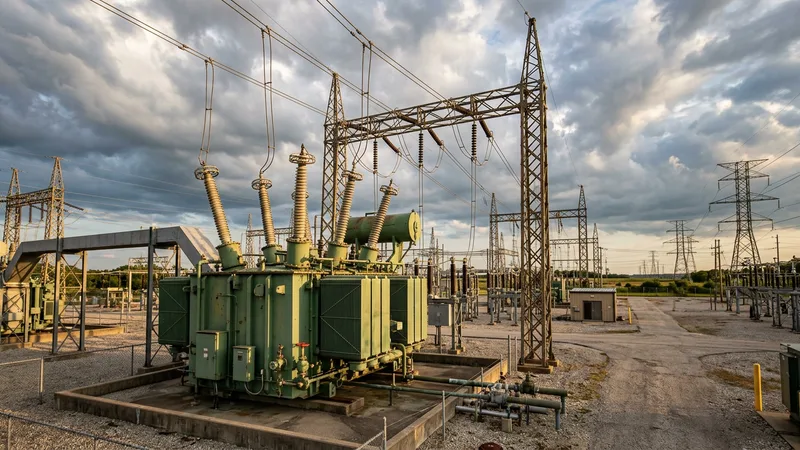
The move toward hyperscale AI workloads has pushed the primary electrical interface further up the utility food chain. Where previous generations of data centers might have tapped into a local distribution network at 13.8 kV, modern AI facilities are often connecting directly to the high-voltage transmission backbone. We are seeing a proliferation of dedicated on-site medium-voltage (MV) substations, with step-down configurations such as 138/13.8 kV or 230/34.5 kV becoming the new standard.
This is not merely about volume; it is about the physics of delivery. Higher distribution voltages like 34.5 kV allow for longer runs and more efficient power density within the campus, reducing the massive amounts of copper cabling required while minimizing line losses.
However, this shift creates a profound tension in the supply chain. The lead times for the large power transformers (LPTs) required for these substations have become a critical bottleneck for the entire global technology sector. While a developer may be able to procure servers in a matter of months, the robust, custom-engineered transformers that anchor the grid connection take significantly longer to design, manufacture, and test.
These units must be built to withstand the rigorous 24/7 high-diversity load profile of a data center, which lacks the typical troughs and peaks of residential or commercial consumption. In the AI world, the load is almost always 'on,' putting continuous thermal stress on the dielectric fluids and insulation systems within the transformer tank.
Redundancy and the Magnification of Equipment
In most industrial settings, a N+1 redundancy strategy is sufficient to maintain uptime. In the world of hyperscale AI, where a five-minute outage can result in days of lost computational training time and potential hardware stress, the demand for 2N or even 'distributed redundant' topologies is the baseline. This design philosophy mandates that every critical component—from the MV switchgear to the secondary substations—has a parallel twin or a highly coordinated backup path.
This redundancy significantly magnifies the equipment count. For every megawatt of actual computational load, the facility often installs nearly double that in transformer capacity and switchgear. This redundancy is not just about reliability; it is about maintainability.
In a 24/7 environment, engineers must be able to isolate an entire transformer or bus and perform maintenance without ever dropping the IT load. This creates a dense forest of electrical infrastructure where the complexity lies in the coordination of protective relays and the seamless transition of power paths. The coordination of these systems requires an intimate understanding of inrush currents and fault levels, ensuring that a flicker on the utility side doesn't trigger a cascading shutdown of the high-density GPU clusters.
Solving the Harmonic Puzzle: K-Factor and IEEE C57.110
The electrical load of an AI data center is notoriously 'dirty.' The servers are powered by switched-mode power supplies (SMPS) and high-frequency inverters that, by their very nature, introduce non-linearities into the electrical system. This manifests as harmonic distortion—current that flows at multiples of the fundamental 60 Hz frequency. These harmonics do not contribute to useful work but they do generate significant heat, particularly in the transformer windings and the neutral conductors.
To prevent premature failure, engineers must look to specialized equipment. Enter the K-factor transformer. Unlike a standard distribution transformer, a K-factor rated unit is specifically designed to handle the additional thermal stress caused by harmonic currents.
We rely heavily on IEEE C57.110, which provides the recommended practice for establishing a transformer's capability when supplying non-sinusoidal load currents. Following these guidelines, we often see a necessary derating of standard units or, more commonly, the deployment of transformers with upsized neutral conductors and specialized winding geometries designed to mitigate the skin effect and eddy current losses intensified by high-frequency harmonics.
Power quality is governed by IEEE 519, which sets the limits for total harmonic distortion (THD). Maintaining these limits is a constant battle in an AI facility. As GPU racks cycle through complex training algorithms, the fluctuating demand can create transient voltages and harmonic surges. Engineers must deploy a mix of active harmonic filters and zig-zag transformer configurations to trap triplen harmonics and ensure that the 'noise' from the data center does not pollute the utility grid, which could otherwise lead to issues for neighboring industrial customers.
The Cooling-Power Nexus
One cannot discuss AI power without discussing the cooling that enables it. The jump to 100 kW per rack has effectively rendered traditional air-cooling obsolete for the highest-performing clusters. We are seeing a rapid pivot toward liquid cooling—either through Rear Door Heat Exchangers (RDHx) or direct-to-chip cold plates.
From an electrical engineering perspective, this adds a new layer of complexity. The thermal management system itself becomes a massive, mission-critical motor load. Pumps, chillers, and cooling tower fans must be integrated into the same redundancy and power quality framework as the servers themselves.
This integration means that the 'tail' is now wagging the dog. The power required to move heat away from the chips is a significant portion of the total facility load. Designing the secondary substations to handle both the highly non-linear IT load and the inductive motor loads of the cooling system requires careful balancing to avoid resonance and maintain a high power factor. Every transformer must be specified with the understanding that its load is not just silicon, but the massive mechanical infrastructure that keeps that silicon from melting.
A Story Told in Copper and Steel
Despite the breathless coverage of software breakthroughs and neural network architectures, the AI revolution is fundamentally a story of electrical engineering. The transition from general-purpose computing to massive-scale acceleration has moved the focal point of the industry from the server room to the substation. The challenges we face today are visceral: managing intense harmonic loads, securing long-lead MV equipment, and designing for a level of density that was unthinkable a decade ago.
As we look at the future of the American grid, the hyperscale data center stands as a testament to the enduring importance of heavy power engineering. We are no longer simply 'plugging in' computers; we are building some of the most complex, high-voltage environments on earth. Success in this new era requires more than just code—it requires a deep respect for the standards of IEEE, the thermal realities of transformer design, and the unwavering physics of the grid. Before the first AI model can provide an answer, a transformer somewhere must step down the lightning to a level that silicon can handle.