




For thirty years, anyone in American real estate who said "data center market" meant Loudoun County, Virginia. The shorthand was so durable that the second-largest cluster in the country — Dallas-Fort Worth — barely registered in the conversation, and the third — Silicon Valley — was understood mostly as the place where the customers were, not where the buildings actually went. That conversation has now quietly shifted. Today, if you ask a hyperscaler site-selection team where the next twenty gigawatts of American data-center capacity will land, the answer increasingly begins with one word: Columbus.
The city sits on flat, agricultural land in central Ohio, two-hundred-and-fifty miles east of Chicago and roughly three-hundred miles west of Washington, D.C. It has, on paper, none of Loudoun County's accumulated advantages. There is no legacy peering exchange, no dense corporate-headquarters base, no twenty-year colocation tradition. What it does have is electricity, water, fiber, and — most importantly in 2026 — political and regulatory willingness to let a hyperscale campus connect to the grid in something less than a decade. Those four things now matter more than everything Loudoun built up over the previous twenty years.
How Central Ohio Became the Quiet Frontier
The first signal that Columbus was different came in 2017, when Facebook announced its New Albany campus on what had been soybean fields north-east of the city. The decision baffled most of the industry at the time. New Albany was not a data-center town. AEP Ohio, the local utility, had no portfolio of multi-hundred-megawatt customers. The fiber routes were thin. The bet, from Facebook's perspective, was that all four of those things could be built — and that the local political environment would make them easier to build than to expand within an already-mature market.
That bet has been vindicated several times over. Google followed with a campus in the same New Albany cluster. Amazon Web Services committed to multiple sites across central Ohio. Microsoft opened in Heath, west of Columbus. Meta expanded. And in 2022, Intel announced a 1,000-acre semiconductor manufacturing complex in Licking County — a separate industry, but one that put the same kind of large-load pressure on AEP Ohio's planning teams and forced the kind of transmission upgrades that benefit everyone in the queue behind them.
The cumulative effect, on PJM's most recent published load forecast for the Ohio zone, is striking. Total Ohio peak load is projected to grow from roughly 22 GW in 2024 to somewhere between 30 and 33 GW by 2030, with the overwhelming majority of that growth coming from data-center and advanced-manufacturing customers concentrated in a ninety-mile arc around Columbus. That growth rate — roughly 6 percent per year — is more than ten times the long-run national average and is, in absolute terms, comparable to adding the entire peak demand of Massachusetts to a single PJM zone.
The AEP Ohio Queue, and How It Reads Differently
In Virginia, Dominion Energy's interconnection queue for Loudoun is now a wait of five to seven years for a new large load. In central Ohio, AEP's published queue for the same kind of customer was, at the most recent regulatory filing, closer to thirty months for a 200 MW request on an existing 138 kV substation, and roughly forty-eight months for a 500 MW request that requires new 345 kV infrastructure. Those are not relaxed numbers. They are, however, half the wait at the alternative.
The reason is mostly transmission topology. AEP Ohio inherited the network built to serve the post-war industrial corridor — steel mills, glass plants, automotive stamping, chemical processing — that ran from Cleveland through Akron, Canton, and the Mahoning Valley down to the Ohio River. That network was overbuilt for loads that consolidated or relocated through the 1990s and 2000s, and a significant portion of the available transmission capacity has been quietly sitting in reserve. Central Ohio sits at the southern end of that corridor and benefits from it directly.
PJM's planning process recognises this. The most recent regional transmission expansion plan includes three new 765 kV projects feeding into the central Ohio zone, all targeted for service between 2028 and 2031, all driven explicitly by data-center load growth, and all sized for the kind of cluster that nobody was planning to build five years ago. The total transmission capital program behind the central Ohio data-center cluster is now larger than any single transmission expansion program PJM has run since the 1970s.
The Substations Behind the Fence Line
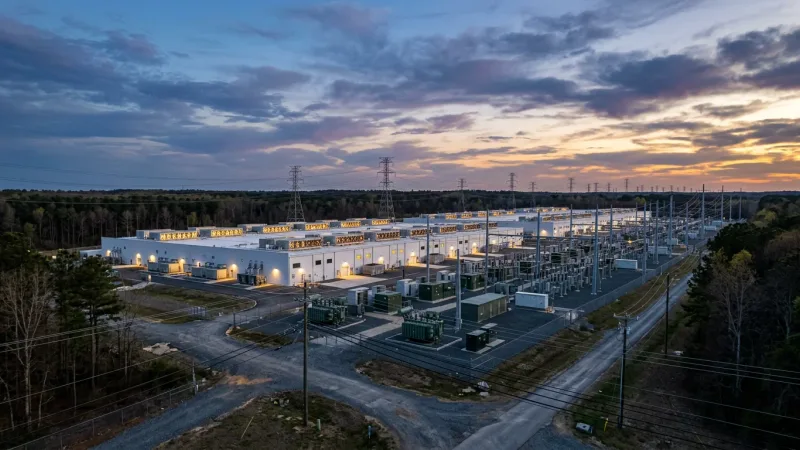
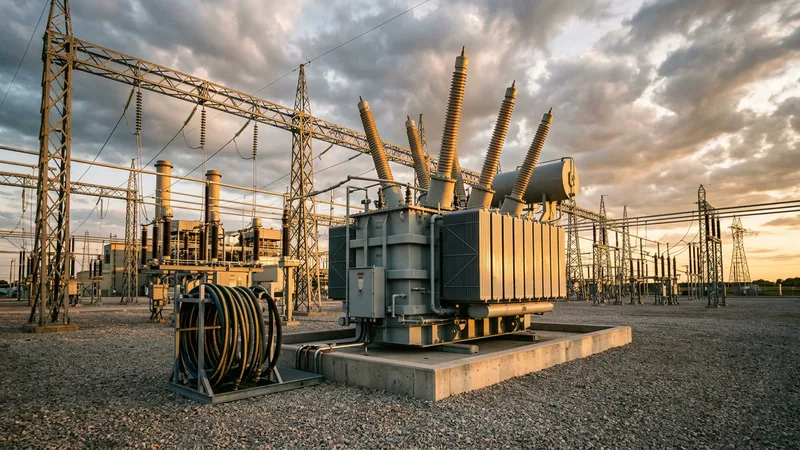
What is happening inside the fence is, in engineering terms, very similar to what happens in Loudoun, but on a slightly different scale and with one important regional difference. The hyperscalers in central Ohio almost universally specify customer-owned 138 kV main substations on the campus, stepping down to a 34.5 kV distribution loop that feeds the unit substations inside each data hall. A typical 400 MW campus carries four to five 75 MVA main transformers plus at least one full spare on energized standby, the same N+1-or-better philosophy that has become standard in the industry.
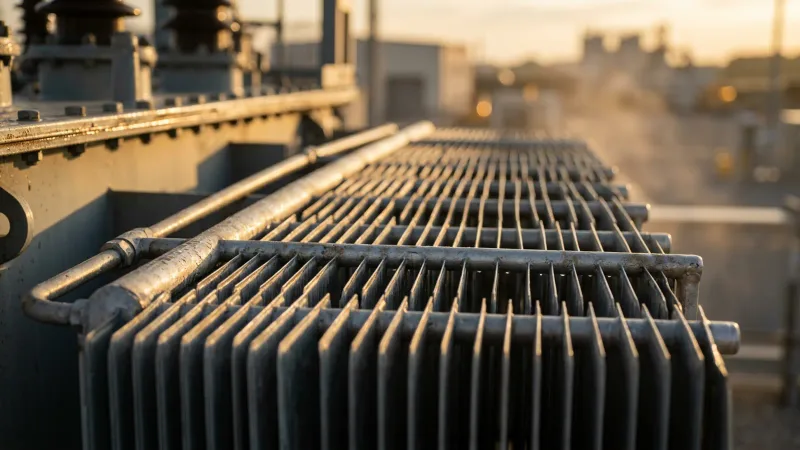
The regional difference is the harmonic profile and the cold-weather rating. Central Ohio winters reach minus 20 °C with some regularity, and the diurnal swings between summer and winter are wider than most parts of the continental US. The main transformers being specified for the new campuses are accordingly built with a wider thermal envelope than their Virginia equivalents: lower-pour-point oil, conservator preservation systems sized for full thermal cycling, and on-load tap changers rated for high-frequency operation against a load that, in this corridor, is often paired with on-site battery storage acting as a frequency-regulation resource.
The harmonic profile is similar to Loudoun's — heavy UPS-rectifier content, K-factor specifications of 13 and above, stabilising tertiary windings — but with one additional consideration. Several of the central Ohio campuses have been designed from the outset around AI training workloads with GPU-cluster power-draw profiles that swing tens of megawatts within seconds. The transformer specification has had to incorporate that dynamic loading, particularly on the OLTC mechanical-cycle rating and on the cooling-stage transition behavior. The unit being built for a 2026 central Ohio AI campus is, on paper, a more demanding piece of equipment than the unit being built for a 2020 Virginia cloud-computing campus.
Water, Gas, and the Politics of Sequencing
Two non-electrical inputs have shaped the central Ohio cluster more than is usually acknowledged. The first is water. The Scioto and Olentangy river systems, together with the deep glacial aquifer beneath central Ohio, give the region a water availability that arid US data-center markets — Phoenix, Salt Lake City, Reno — simply cannot match. The newer campuses are increasingly designed around closed-loop liquid cooling or partial immersion, which sharply reduces consumptive water use, but the underlying availability still matters for the cooling-tower fraction of the load and for the political ease of obtaining a water permit.
The second is natural gas. Several of the new central Ohio campuses include on-site combined-cycle or simple-cycle gas generation, sized between 100 and 400 MW, intended originally as resilience capacity and increasingly being run as a permanent peak-shaver during the years before the next round of 765 kV transmission lands. The Utica Shale formation underneath eastern Ohio provides gas at a delivered price that few other US markets can match, and the pipeline infrastructure to deliver it was largely built during the 2012 to 2018 shale boom and now sits with available capacity. That combination — abundant local gas, an existing pipeline network, and a friendly state regulatory environment for large-customer gas connections — has made behind-the-meter generation a meaningful component of the central Ohio data-center build, and it changes the way the campuses interact with the PJM market.
What This Means for the Rest of the Country
Central Ohio is not the only second-tier market that has moved forward in this cycle. Northern Indiana, central Iowa, the Atlanta-to-Augusta corridor in Georgia, the Quad Cities, and the Phoenix West Valley have all attracted multi-gigawatt commitments since 2022. But Columbus is the cleanest example of what happens when an under-utilized post-industrial transmission network meets a hyperscaler procurement strategy that has finally accepted it cannot wait in the queue any longer.
For the manufacturers of large power transformers, switchgear, and substation control systems, the implication is straightforward. The next decade of American hyperscaler growth will not be served by adding capacity to Loudoun. It will be served by building substantially new substation infrastructure in markets that, five years ago, were not on the industry's planning maps at all. The 138/34.5 kV main transformer that gets installed in a New Albany campus in 2027 is the same physical equipment, to the same demanding specification, that goes into a Loudoun campus today — just with a different ambient envelope, a different harmonic context, and a different conversation with the local utility about the queue beyond the fence.
The buildings will still go up in nine months. The transformers will still take three years. But increasingly, the buildings will go up in places like central Ohio, where the queue beyond the fence is short enough that the math works.