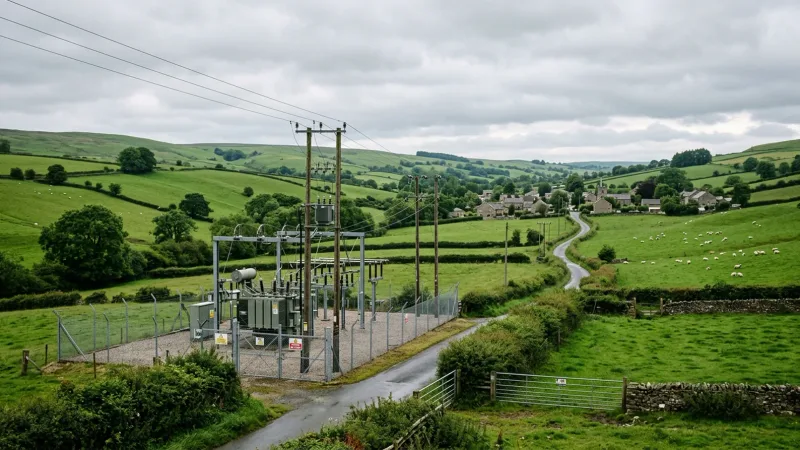






Where reliability is actually won
A modern oil- or ester-filled power transformer leaves a serious factory in the best condition it has ever been in: fully assembled, type-tested to IEC 60076 and BS EN 60076, routine-tested to the customer's specification, vacuum-dried, oil-filled, sealed, and signed off on a witness pack. From that moment, every mile and every degree on the journey to a Midlands compound or a Scottish primary site is a chance for that condition to drift.
DNOs, IDNOs, independent connections providers and large industrial customers across the UK increasingly agree on a quiet truth the wider industry has known for years: the overwhelming majority of in-service issues during the first two years are not built into the unit at the factory. They are introduced on site — by storage, by handling, by the speed of energisation, by a tap-changer position checked at the wrong moment.
Installation support is how a serious supplier closes that gap. It is also, on a UK totex balance sheet, one of the most quietly profitable lines you can write into a transformer PO.
The UK is a harder operating environment than the spec sheet suggests
It is not the climate that makes the UK difficult. It is the operating model.
Connection-queue pressure. The ENA G99 connection backlog and the NGESO TM04/TM05 reform mean that once a date is in the diary, contractors energise to it. That compression is where corners get cut quietly.
Wet, muddy, cold-stored sites. Units arriving at DNO compounds in February sit on hardstanding that is rarely as dry as the factory hall. Condensation forming inside a sealed tank during a UK winter is a real risk if the unit is left without an active nitrogen blanket for more than a few weeks.
Ester-fluid logistics. Natural and synthetic ester retrofits are accelerating across UKPN, SSEN, ENWL and SP Energy Networks. Ester fluids are not a drop-in substitute for mineral oil at site level: hoses, drums, sample bottles and even the oil-treatment plant itself must be ester-clean. Cross-contamination with mineral oil residue is the most common avoidable mistake on UK ester sites.
RIIO-ED2 totex. Ofgem's totex framework means a DNO is rewarded for the lifetime cost of an asset, not its installed cost. That is exactly the economics that makes installation supervision the smartest line on a PO.
None of this is a criticism of British contractors. It is a description of the actual conditions that a transformer specified to BS EN 60076 has to survive between leaving the factory gate and being energised onto an 11, 33 or 132 kV network.
What great installation support looks like on a UK site
A good installation supervision package is concrete. Six things should always be visible:
1. Site-readiness review before delivery. A manufacturer engineer surveys the plinth: levelness, bund integrity, earthing grid continuity, ENA-compliant fencing, cable trench close-out, IP rating of gland plates. Issues raised on day minus 30 are cheap; issues raised on day plus 1 are not.
2. Cold-store and laydown protocol. Units stored for more than four weeks on a UK site need an active nitrogen blanket, a documented inspection cadence, and condensation-controlled covering. Leaving a unit uncovered on muddy hardstanding through a wet British autumn is the single most common cause of early-life DGA anomalies in this market.
3. Supervised vacuum oil or ester filling. Treatment-plant calibration, dew-point window verification, filtration to better than 3 micron, vacuum hold-and-rise tests — all witnessed and logged. For ester retrofits, a documented ester-only hose set and a pre-fill swab test for mineral residue.
4. Bushing, breather, Buchholz and tap-changer commissioning. Bushings torqued to manufacturer values. Silica-gel breathers proved colour-active. Buchholz oriented to the correct gradient with no air pockets. Tap-changer position confirmed at the right step before energisation — this is the most common preventable cause of in-rush misoperation on UK sites.
5. Pre-energisation SAT. Insulation resistance, polarisation index, winding resistance, turns ratio, magnetising current, DGA baseline, partial-discharge SAT where the specification requires it. The point is not the tests; it is the baseline that lets future condition monitoring mean something.
6. Totex documentation pack. A signed FAT/SAT pack, oil-quality report, commissioning log and competency record that drops straight into the DNO's asset-life file ready for Ofgem audit.
Why this is now a procurement question, not a site question
The UK industry has historically treated installation as the contractor's problem and the manufacturer's afterthought. That model is breaking under RIIO-ED2.
A 20 MVA 33/11 kV primary that fails internally in year three costs a DNO the original capital, the unplanned outage, the emergency replacement premium (now 16–24 weeks across most OEMs supplying the UK), and the regulatory consequences. The total exposure is rarely under four times the original PO. Buying installation supervision into the original specification is one of the cheapest insurance lines on the entire balance of plant.
Forward-leaning UK operators — UKPN, SSEN, ENWL, SP Energy Networks, National Grid Electricity Distribution — are starting to write installation supervision and pre-energisation SAT explicitly into framework specifications. Suppliers and EPCs that bring it as a default rather than a change-order item are winning long-term framework positions.
How ETS partners with UK customers from delivery to energisation
ETS treats installation as part of the product, not a service line that is sold afterwards. A single ETS engineer is named on the project from FAT through to energisation witness, and owns:
- A pre-shipment site-readiness checklist agreed with the DNO or end customer
- Supervised vacuum oil or ester filling with an independent oil report
- FAT and SAT witness with a documented test pack ready for the asset-life file
- HV commissioning with partial-discharge SAT where the specification requires it
- A 24-month installed-asset support window backed by ETS service engineers covering the UK
- A totex documentation pack formatted for Ofgem audit
Deeper detail on the individual services is on the Installation, Testing & Commissioning, and Consulting pages. The Standards & Compliance library covers the BS EN 60076, ENA TS, G99 and DNO-specific test packages we work to.
What to specify in your next PO
A short checklist any UK procurement engineer can drop into a transformer tender:
1. Installation supervision by a manufacturer engineer, named in the bid
2. Cold-store and laydown protocol for any wait longer than four weeks
3. Supervised vacuum oil or ester filling with dew-point and filtration acceptance limits
4. Pre-energisation SAT pack to BS EN 60076-1 minimum, with DGA baseline and PD test for units rated above 36 kV
5. Totex documentation pack formatted for Ofgem audit
6. 24-month installed-asset warranty extension contingent on the supervision being used
None of these add meaningful cost on a unit above 5 MVA. All of them measurably reduce the chance of an early-life event and the totex penalty that follows.
The takeaway
A transformer is only as reliable as the worst day it spent between the factory and energisation. On a UK site, that worst day is rarely about manufacturing — it is about a wet hardstanding, a tight DNO date, or an ester hose used the day before for mineral oil. Installation support is the engineering discipline that closes the gap. At ETS, it is part of how the product is delivered, not an upsell after the fact.
If you have a UK project where the connection date is tight or the totex case has to stand up to Ofgem, talk to us early. The cheapest engineering decision you can make is the one taken before the unit ships.