





For most of the last twenty years, Britain's data-centre map looked like a single dot. That dot sat in Slough, the unremarkable commuter town on the western edge of London where Equinix, Digital Realty, Virtus, Ark, and a dozen smaller operators built campuses on top of one another until the cluster carried roughly one third of UK internet traffic and a meaningful fraction of European cloud workloads. The rest of Britain — Manchester, Leeds, Edinburgh, Cardiff — registered on the map only as small satellite markets, useful for content distribution but not for serious compute.
That map is now being redrawn, and the agent of change is not the data-centre industry. It is the British electricity system. The grid into Slough cannot accept another large customer until late this decade. The next gigawatt of UK hyperscaler capacity has been signed, paid for in deposit, and committed to a build schedule — and almost none of it is going to Slough. A surprising amount of it is going to Scotland.
Why the Wind Lands Where the Compute Doesn't
The underlying problem in the British grid is geographic. Roughly 60 percent of UK installed wind capacity sits in Scotland, including the bulk of the offshore wind farms in the North Sea and the onshore clusters across the Highlands, the Borders, and the Western Isles. Roughly 75 percent of UK electricity demand sits south of Manchester. The transmission network connecting the two — anchored on the B6 boundary between Scotland and England, and the parallel B7 and B8 boundaries further south — was built for a generation profile that does not exist any more.
The result is the now-familiar pattern of curtailment. On a windy night in February, Scottish wind farms routinely produce more electricity than the transmission system can move south, and the National Grid Electricity System Operator pays them to switch off while paying gas generators in England to switch on. The constraint-payment bill in the 2024 financial year exceeded one and a half billion pounds, and is on a trajectory to double again before the major HVDC reinforcements — Eastern Green Link 1 and 2, the Western HVDC Link upgrade — come into service between 2027 and 2031.
For a hyperscaler building an AI training campus, the geography of British wind and the geography of British demand have one obvious implication. The cheapest electrons in the United Kingdom, by a meaningful margin, are the ones the system is currently paying to throw away. If a 200 MW data-centre campus sits in front of the constraint rather than behind it, those electrons go into GPUs instead of curtailment. Several large operators have now done that math, and the conclusion has been the same in each case: the next British data centre belongs in Scotland.
What the AI Growth Zones Actually Do
The UK government's announcement of AI Growth Zones in 2025 — anchored on Culham in Oxfordshire and a second cluster across central Scotland — has often been read as a planning-policy gesture. It is more substantive than that. The Growth Zones come with three concrete mechanisms.
First, the connection-queue treatment for designated Growth Zone projects sits outside the standard interconnection queue. The transmission owner — for the Scottish Growth Zone, this is SSEN Transmission in the north and SP Transmission in the central belt — is required to provide an indicative connection offer within six months and a firm offer within twelve, against a queue that for ordinary projects can take three to five years to clear.
Second, the planning regime is compressed. A data-centre campus inside a Growth Zone is treated as a Nationally Significant Infrastructure Project, with the same accelerated consenting framework that applies to offshore wind farms and major transmission lines. The local-authority planning process, which has historically taken eighteen to thirty months for a campus of this scale, is replaced with a Development Consent Order procedure targeted at twelve to fifteen.
Third, and most importantly, the framework explicitly accommodates private-wire and behind-the-meter generation. A Scottish Growth Zone campus can take its primary supply from a directly-connected wind farm, bypassing the constrained transmission boundaries entirely, and can sell surplus back into the public grid under a simplified arrangement. The economic logic is straightforward: a data-centre operator pays a long-term price for firm wind output, the wind farm avoids curtailment risk, and the constrained transmission boundary becomes irrelevant to the transaction. This is the structural change. Everything else follows from it.
The Substations Behind the New Map
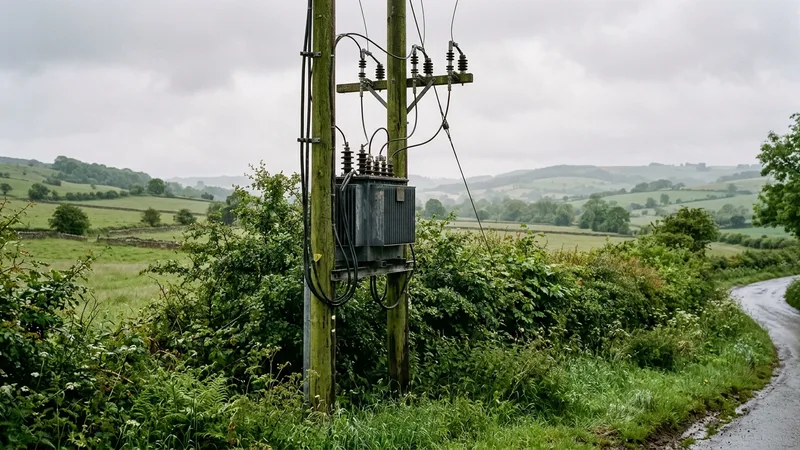
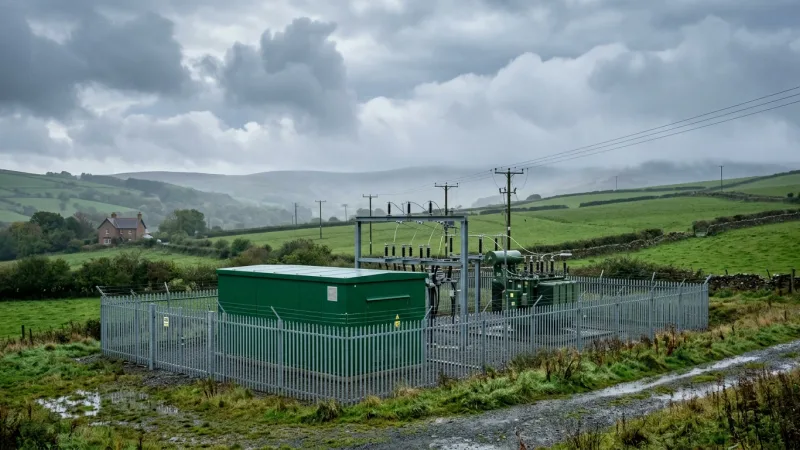
What this means for the engineering side of the industry is that a new generation of British 132 kV and 275 kV customer substations is now being designed and procured for sites that did not exist on any planning map five years ago. The substations themselves are technically conventional — large oil-filled main transformers, GIS or hybrid switchgear, on-load tap changers, the same N+1 redundancy philosophy as anywhere in the world — but the operating context is genuinely new in two respects.
The first is the dynamic profile. A Scottish data-centre campus that takes its primary supply from a private-wire wind connection sees a load-following requirement on its main transformers that is unlike anything in the British data-centre fleet to date. The unit has to absorb the swings between full wind generation and grid-import top-up smoothly, manage on-load tap operations against a primary-voltage source that fluctuates with the wind, and protect against the harmonic distortion that arrives from the wind-farm power-electronics interface as well as the harmonic profile of the UPS load on the customer side. The transformer specification accordingly carries higher impulse and short-circuit ratings, larger stabilising tertiary windings, and OLTC mechanisms specified for substantially higher operation counts than a London equivalent.
The second is the environmental envelope. Inverness in February reaches minus 12 °C with ten-metre-per-second sustained wind. Caithness gets sea-salt deposition that is, by IEC heavy-pollution standards, in the highest category in mainland Britain. The composite insulators, the breather designs, the cooling-fan controls, and the auxiliary supplies all have to be specified for an environmental envelope that is closer to North Sea offshore than to anything in the Thames Valley. Several manufacturers — including ETS Group on the SSEN and SPT networks — are now running parallel design lines: a Slough-equivalent specification for the southern campuses, and a coastal-Scottish specification for the new Growth Zone work.
The Tier-2 Cities Quietly Catching Up
Scotland is the most visible part of the new map, but it is not the only part. Manchester has emerged as the second-largest UK data-centre cluster in committed pipeline terms, behind only the legacy Slough corridor. The NorthernPowergrid and SP Energy Networks distribution areas across the M62 corridor have absorbed a meaningful share of the post-Slough overflow. Leeds, Sheffield, and Liverpool all carry committed campuses of 100 to 250 MW.
Wales, after years of attracting relatively little hyperscaler interest, has signed two large campuses in the south Wales corridor between Newport and Bridgend, anchored on the available 275 kV transmission capacity left over from the former heavy-industry load that the region has lost over the past two decades. The pattern is the same in every case: a post-industrial transmission network that has spare capacity, a planning regime that has become more accommodating, and a hyperscaler procurement team that has accepted the queue at the alternative is unworkable.
What Slough Becomes
The Slough corridor will not lose its central role overnight. The accumulated peering and interconnection density there is genuinely unique in Britain, and the latency-sensitive workloads — financial, gaming, content-distribution — will continue to anchor on it for the foreseeable future. What changes is the proportion of the new build that goes there. The next gigawatt of UK hyperscaler capacity will, on the committed pipeline, sit roughly 35 percent in the Slough corridor, 30 percent in the M62 and Welsh clusters, and 35 percent in Scotland. Five years ago the equivalent split was 90 percent Slough, 8 percent everywhere else, 2 percent Scotland.
The transmission system that the data-centre industry now needs is not the one Britain built in the post-war period. It is the one Britain is building now — the Eastern Green Links carrying Scottish wind south under the North Sea, the new 400 kV reinforcement across the central belt, the HVDC interconnectors at the Northumberland and Suffolk landfalls. Each of those projects is a multi-year, multi-billion-pound undertaking, and each of them is being followed closely by the hyperscaler site-selection teams in a way that, ten years ago, would have been unthinkable.
The British data-centre map is no longer a single dot. It is becoming, slowly and at considerable cost, a country-shaped map. The compute is moving to where the electricity is. The transmission system, with some help from the AI Growth Zone framework, is finally being built to match.