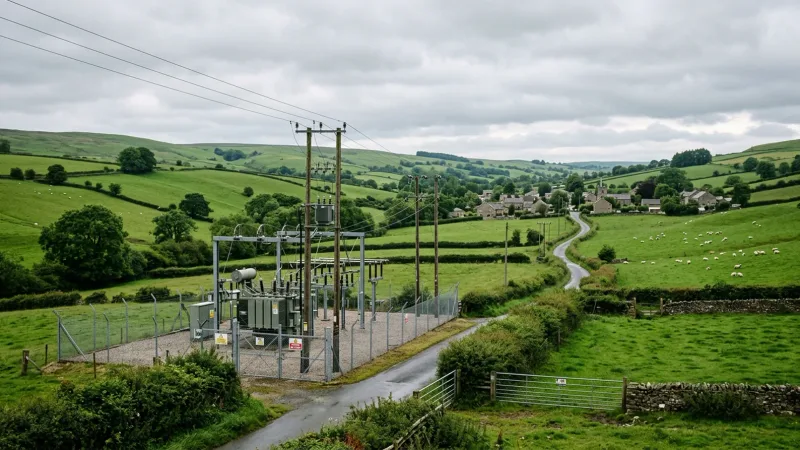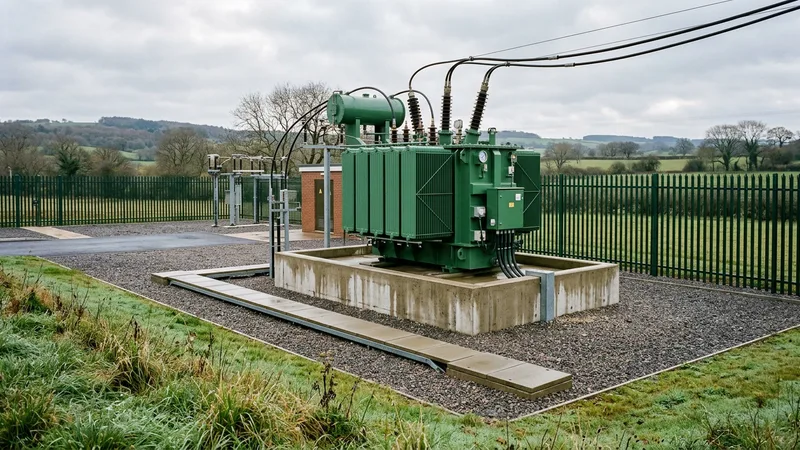






Totex regulation rewards a Distribution Network Operator for spending the right amount, not for spending it on capital. Under RIIO-ED2 the marginal pound on an OLTC refurbishment is treated identically to the marginal pound on a new transformer, and that single accounting change has reshaped how UK Power Networks plans its 33/11 kV refurbishment programme. We trace the economics through one West London primary substation.
From Capex Cycles to Cellulose Degradation
The previous regulatory settlement encouraged a reasonably straightforward capital expenditure cycle. An asset reached a certain age or condition, and a business case for its replacement was a simple affair. The Totex model, which treats operational and capital spending with near-parity, buries that simplicity. It forces a more granular, risk-based assessment where extending an asset’s life through intervention becomes not just an option, but a baseline expectation. A transformer’s life is no longer a fixed number, but a curve of accelerating risk that can be managed.
At its core, a transformer is a static device of deceptive simplicity: steel cores, copper windings, and insulating oil. Its operational life, however, is dictated almost entirely by the health of its solid insulation system—the paper and pressboard wrapped around the windings. This cellulose material is a polymer, and its long-chain molecules are broken down over time by heat, moisture, and oxygen. As the degree of polymerisation falls, the paper becomes brittle and mechanically weak, dramatically increasing the risk of dielectric failure under electrical or mechanical stress.
This physical degradation process is where the new economics take hold. It is a process, not an event. A well-timed, ten-thousand-pound repair—such as installing a better breather system to keep moisture out or performing an oil regeneration to remove acidic by-products—doesn’t just fix a minor problem. It changes the chemistry of the entire system. It slows the rate of cellulose decay, preserving the paper’s integrity and pushing the cliff-edge of failure probability several years further into the future. That deferral of a multi-million-pound replacement is the entire point of the exercise.
The Component-Level Gamble
Zooming in from the physics of the insulating paper, we arrive at the components—the specific bits and pieces that fail and create a new set of calculations for asset managers. A transformer is a system of parts, and not all parts age equally.
Consider a classic GEC 33kV primary transformer from the 1970s. The core and windings might be perfectly sound, but its tap-changer is showing signs of contact coking, or its ancient bushings have deteriorating porcelain. Pre-RIIO, the discovery of a serious but repairable component flaw might have been the final justification needed to condemn the whole unit. The logic was defensive: why spend £100k refurbishing a tap-changer on a 45-year-old asset that’s ‘due for replacement’ anyway? The risk of an uninsurable through-fault failure, with its associated widespread customer interruptions (CIs) and Customer Minutes Lost (CMLs), was too great. The penalties were too high.
Under RIIO-ED2, the calculation flips. The Output Delivery Incentives (ODIs) for CIs and CMLs are still very real, but they are now balanced by the powerful Totex efficiency incentive. The new question is: can a targeted, surgical intervention on a single component buy significant and reliable life extension for the whole unit? This has given rise to a boom in what DNOs call their PMS programmes (Plant Maintenance and Servicing).
This involves a surgical, component-level approach to life extension:
- Tap-Changers: Instead of full replacement, DNOs are favouring intensive refurbishment, sometimes replacing entire vacuum interrupter assemblies within the legacy tank.
- Bushings: The move is towards online monitoring for partial discharge and capacitance drift, allowing for proactive replacement of only the most at-risk units.
- Cooling Systems: Radiators and fans are being replaced or upgraded on otherwise healthy transformers to improve thermal performance and slow the ageing of the windings.
It’s a far cry from the old fit-and-forget mentality. It’s active, interventionist, and data-driven. It’s also a bit of a bet. By replacing a failing component, you are implicitly betting that another, unmonitored failure mode won’t suddenly manifest itself a year later. It’s a gamble that requires high-quality data and deep engineering expertise, which is why many DNOs are now investing heavily in their own asset management and analytics teams.
The System View: Where Totex Meets the Grid
Now let’s pull back to the system level. A transformer doesn’t exist in isolation; it’s a node in a complex network. Its replacement (or non-replacement) has cascading effects on everything from network topology to fault level management. And here, the Totex philosophy makes some of its most interesting—and challenging—demands.
One of the biggest headaches for a DNO planner is fault level headroom. As more distributed generation (DG), from solar farms to battery storage, connects to the 11kV and 33kV networks, the prospective short-circuit current often creeps up towards the breaking capacity of the existing switchgear. In the past, a major asset replacement project, like upgrading a primary substation, was the perfect opportunity to solve this problem wholesale. The old 90 MVA transformer would be replaced with a new, higher-impedance unit, simultaneously increasing capacity and naturally reducing fault levels downstream. Capex solved everything.
But Totex asks a harder question: Do you really need to spend millions on a new transformer just to solve a fault level problem? Or could a targeted, far cheaper solution get the job done?
This prompts engineers to look at alternatives they might have once dismissed:
1. Series Reactors: Installing a simple air-cored reactor on the secondary side of the transformer to add impedance. It’s a fraction of the cost of a new transformer. The downside? It introduces losses—a permanent Opex cost that must be modelled over the asset’s life.
2. Active Fault Level Management: Using sophisticated protection and control schemes to momentarily reconfigure the network during a fault, sharing the current between multiple substations.
3. Is-limiters: Superconducting fault current limiters are still at the exotic end of the scale, but they represent the ultimate surgical tool—an asset that does nothing except cap fault current, leaving the existing distribution transformers and switchgear in place.
This is where RIIO-ED2 gets tough. It forces a level of integrated thinking that cuts across traditional departmental silos. The protection engineers, the plant engineers, and the strategic planners all need to be in the same room, evaluating the total cost of each option. The ‘best’ engineering solution (a new transformer) might not be the most ‘efficient’ Totex solution (a reactor plus ongoing losses). This can be a bitter pill to swallow for engineers accustomed to building robust, gold-plated systems. The regulator, however, is unsentimental; the business plans are clear and the efficiency targets are demanding.
The Grid of the Future is Brownfield
Ultimately, the shift from Capex to Totex is a tacit admission that the grid of the future will not be a gleaming, new-build utopia. It will be overwhelmingly ‘brownfield’—a constantly evolving patchwork of legacy assets and modern systems, managed with a new level of intelligence and economic rigour. Ofgem’s goal with RIIO-ED2 is to create a regulatory environment that mirrors the financial discipline of a truly competitive market. In such a market, you don’t replace a machine that’s still making you money. You sweat it, you monitor it, you patch it, and you run it until the day the cost of nursing it exceeds the value it provides.
This presents both opportunities and risks for the entire supply chain. For companies that specialise in diagnostics, life extension services, and component-level repairs, the future is bright. For traditional OEMs focused solely on selling new package substations or transformers, the market is becoming more complex. They now need to provide not just the product, but the lifetime value proposition, including the data and support to justify its Totex advantages over simply sweating the old asset for another decade.
It demands a more sophisticated client, too. DNOs need engineers who are as comfortable with a discounted cash flow analysis as they are with interpreting a DGA report. They need procurement teams who can write contracts for outcomes and reliability, not just for the supply of a product. It’s a significant cultural shift. The old joke about the finance director asking the chief engineer “What happens if we train our people and they leave?” is met with the engineer’s reply: “What happens if we don’t, and they stay?” Under RIIO-ED2, that question has never been more relevant.
Key Takeaways
- Condition Over Age: RIIO-ED2’s Totex model incentivises Distribution Network Operators (DNOs) to base asset replacement decisions on detailed diagnostic data (like furans and DGA) rather than simple chronological age, favouring life extension.
- Surgical Opex Beats Wholesale Capex: Spending a smaller amount of Opex on targeted component repairs (like tap-changers or bushings) is now preferable to a large Capex spend on a full asset replacement if it can reliably defer the investment.
- System Problems Need Non-Traditional Fixes: Instead of replacing a transformer to solve a system-level issue like high fault levels, Totex encourages cheaper, targeted solutions like series reactors or advanced network management schemes, even if they add complexity.
The Engineer's Takeaway
For decades, the utility engineer’s mindset was geared towards maximising reliability through planned replacement and capital investment. RIIO-ED2 fundamentally alters that logic. The new mantra is maximising whole-life *value*, which means embracing a world where a well-timed repair is often mightier than a brand-new replacement.