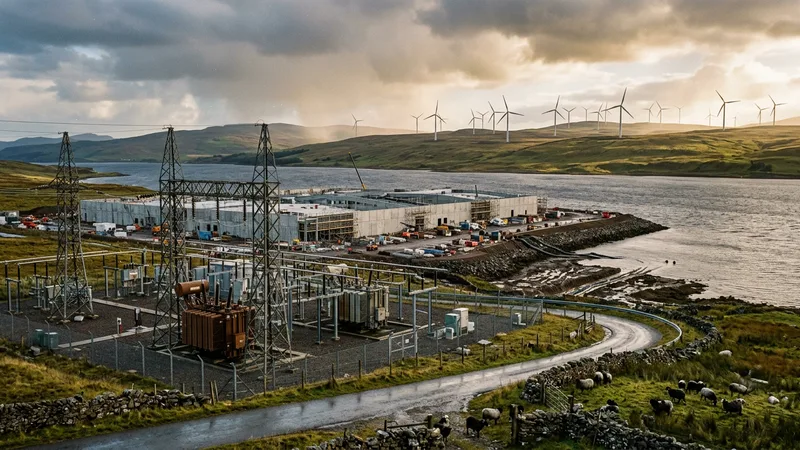






Picture a midnight gale howling across the Cairngorms. High on the ridges, hundreds of carbon-fibre blades are poised to harvest the kinetic energy of the North Sea, capable of powering millions of kettles and electric vehicle chargers five hundred miles to the south. But instead of spinning at full tilt, the turbines are frozen. They have been commanded to stand still by a remote signal, while further down the map, a gas-fired thermal plant is paid a premium to ramp up its production. This is the absurdity of wind curtailment, a systematic bottleneck where we pay to stop the wind because our aging transmission network simply cannot carry the load.
It is a paradox that defines the modern British energy landscape. In the industry, we call these constraint payments—financial compensations paid to generators when the grid cannot physically accommodate the power they are ready to supply. While the headlines focus on the eye-watering costs of these payments, which have reached billions of pounds annually, the real story is being written by the engineers, transformer manufacturers, and grid operators working behind the scenes. At ETS Group, we see this transition from the factory floor upward, where the shift toward a more resilient, bidirectional grid is transforming the very hardware that sits inside our substations.
The Physical Reality of Wind Curtailment
To understand why a breeze in Scotland cannot always boil water in London, one must look at the geography of the UK electricity network. The grid was historically designed around large, centralized coal and nuclear plants located near centres of heavy industry or the coast. Power flowed in one predictable direction. Today, the most productive wind resources are situated at the periphery—offshore or in the far north—while the primary demand remains in the south. When the wind blows harder than the "B6 boundary" (the primary transmission bottleneck between Scotland and England) can handle, the National Grid ESO has no choice but to intervene.
This is not a limitation of renewable technology, but a lag in transmission infrastructure. The grid is governed by rigorous safety and performance protocols, such as the IEC 60076 series of standards, which dictate how power transformers must operate under varying loads. When a line becomes congested, pushing more current through it would violate thermal limits, potentially causing physical damage to conductors or catastrophic failure in cooling systems. Solving wind curtailment requires more than just longer wires; it requires a fundamental redesign of how we step up, step down, and regulate voltage across thousands of miles of varied terrain.
Reimagining the Substation for RIIO-ED2
The regulatory framework known as RIIO-ED2 (Revenue = Incentives + Innovation + Outputs) has set the stage for how UK Distribution Network Operators (DNOs) must modernise. This period focuses heavily on decarbonization and the integration of low-carbon technologies. For engineers, this means the humble substation is no longer just a static node; it is an active, intelligent hub. To mitigate curtailment, we are seeing a move toward higher-capacity, more efficient transformer units that comply with the stringent EcoDesign Tier 2 requirements under EN 50588-1.
Upgrading these nodes involves more than just swapping an old unit for a new one. Modern transmission-level transformers must be designed to handle the volatile, intermittent nature of wind power. Unlike coal, which provides a steady, inertial mass of spinning generation, wind is high-variability. This places unique mechanical stresses on transformer windings during rapid load fluctuations. By adhering to IEEE C57.12.00 standards for general requirements in liquid-immersed transformers, manufacturers like ETS ensure that the internal bracing and insulation systems can withstand the "hiccups" of a renewable-heavy grid without premature aging or insulation breakdown.
The Role of Reactive Power and Voltage Stability
A common misconception is that the grid's only limitation is current. In reality, voltage stability is often the silent killer of renewable integration. As power travels long distances from Scottish wind farms to English cities, voltage levels can drop or fluctuate, lead to localized instability. This is where the engineering of switchgear and specialised transformer configurations becomes critical. To manage the "weak" sections of the grid, operators are increasingly utilising Static VAR Compensators and synchronous condensers, but the primary transformer remains the first line of defence.
Modern units are now frequently equipped with sophisticated On-Load Tap Changers (OLTC). Under BS EN 60214-1, these components allow a transformer to adjust its voltage ratio without interrupting the power flow. This flexibility is essential for "unsticking" the grid. When a surge of wind power enters the system, the OLTC can compensate for the resulting voltage rise, ensuring that the power stays within the statutory limits defined by the Electricity Safety, Quality and Continuity Regulations (ESQCR). Without this fine-tuned control, more wind farms would be forced into curtailment simply to prevent local voltage violations.
Reinforcing the Boundary Limits
The B6 boundary mentioned earlier is the subject of massive investment. Projects like the Eastern Green Link—a series of subsea HVDC (High Voltage Direct Current) cables—aim to bypass the terrestrial bottlenecks entirely. However, these DC links still require massive converter stations on either end. These stations house some of the most complex transformer technology in existence, designed to handle the harmonic distortions inherent in DC-to-AC conversion.
For these high-stakes installations, compliance with IEC 61378-1 (Converter Transformers) is non-negotiable. These units must be built to withstand the unique dielectric stresses of non-sinusoidal currents. By reinforcing these boundaries with industrial-grade hardware, we allow for a higher "base load" of renewables to flow south, reducing the frequency and duration of those expensive "stop" commands sent to wind farm operators.
Resilience in the Face of Climate Extremes
As we build out the infrastructure to solve wind curtailment, we are also contending with the very climate we are trying to save. A grid that relies on wind must also be a grid that can survive the storms that provide the energy. This extends to the secondary equipment that protects our transformers. Grounding and earthing systems, governed by BS EN 50522, must be robust enough to handle high-fault currents in remote, often rocky Scottish terrain where soil resistivity is high.
Furthermore, the shift toward "green" transformers is helping the industry meet its own Net Zero goals. We are seeing a significant rise in the use of ester-based natural fluids instead of traditional mineral oils. These biodegradable fluids not only reduce the environmental impact of a potential leak but also have a higher fire point, allowing for more compact substation designs in sensitive areas. When coupled with the efficiency mandates of NEMA TP-1 or the European equivalent EN 50464-1, the result is a grid that is not only more capable of carrying wind power but is also more efficient in its own right.
Bridging the Gap with Secondary Distribution
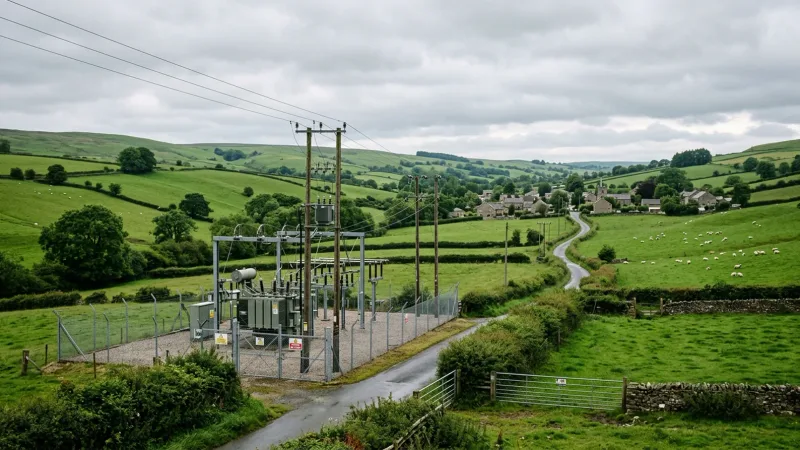
While the "supergrid" transmission lines get the most attention, the distribution level is where the final hurdle of curtailment is often cleared. In the UK, many wind farms are "embedded" generators connected at lower voltage levels. If the local DNO's primary substation is at capacity, that wind farm is curtailed just as surely as if the B6 boundary were the issue. Engineering solutions here involve upgrading 11kV and 33kV switchgear to handle higher fault levels and bidirectional power flows.
We often look to ENATS 35-1 (the Energy Networks Association Technical Specification) for the design and procurement of these distribution-level transformers. The modern requirement is for units that are "smarter"—capable of providing real-time data on oil temperature, dissolved gas analysis (DGA), and loading profiles back to the control room. This data allows for "Dynamic Thermal Rating." Instead of assuming a transformer has a fixed capacity, engineers can push more power through a unit on a cold, windy night when the ambient air provides better cooling, effectively "finding" extra capacity in the existing wire without building a single new pylon.
The Engineering Path Forward
The "Curtailed Wind" challenge is a temporary growing pain of a rapid energy revolution. The technology required to solve it exists; the challenge lies in the scale and speed of deployment. As a manufacturer established in 1987, ETS Group has seen the grid evolve from a rigid, predictable machine into a living, breathing ecosystem. We are moving toward a future where "constraint" is a rare exception rather than a nightly occurrence.
This transition requires a deep commitment to international engineering standards and a willingness to move beyond "off-the-shelf" solutions. Every substation upgrade, every new HVDC link, and every high-efficiency transformer installed takes us one step closer to a grid that turns every gust of wind into a useful electron. The problem of curtailment is not one of wind or weather, but of the marriage between high-tech generation and high-strength transmission.
The story of the British grid is no longer about just keeping the lights on. It is about building a nervous system for the nation that is as flexible as the energy sources it carries. By focusing on the thermal dynamics, the voltage regulation, and the material integrity of our transformer stock, we are finally beginning to unstick the wires. The wind is there for the taking; we just need to make sure we have the hardware ready to catch it.