





If you stand on the western edge of the M25 just south of Heathrow and look toward Slough, you are looking at the densest cluster of data centres in Europe. The town that gave the world The Office now carries an estimated 30 to 35 percent of the United Kingdom's internet traffic, and a meaningful share of Western Europe's cloud workload. Most of it runs out of a few square miles between the A4 and the Grand Union Canal, in buildings that look from the outside like ordinary distribution warehouses.
What is not visible from the road is how full Slough is — not of space, but of electricity. The National Grid's 400 kV connection at Iver, which feeds the Slough Trading Estate's deep web of 132 kV and 33 kV circuits, has been effectively saturated for new large connections since 2022. Operators with paper applications dating back to 2021 are still being told their energisation dates sit in 2030, 2031, in some cases 2033. The buildings are designed, the foundations are poured, the racks are on order. The grid connection is the long pole, and it is getting longer.
This is the UK's grid queue, and for hyperscalers it has become the single biggest variable in how the next gigawatt of British compute capacity gets built.
How Slough Became Saturated
Slough's electrical advantage was historical. The Slough Trading Estate, established in 1920, was one of the first large industrial sites in Britain to be designed around a private electrical network. By the 1990s, when the first colocation operators arrived, that legacy network — and the unusually strong 132 kV transmission feeding it — gave Slough a head start no other UK location could match. Latency to the City of London was tolerable. Fibre to Frankfurt and Amsterdam was a single hop. And the local distribution network operator, Scottish and Southern Electricity Networks, had a decades-long working relationship with the estate's operator.
For most of the 2000s and 2010s, that combination meant a new data centre in Slough could secure a 30 to 50 MW connection in twelve to eighteen months. By 2019 the typical timeline had stretched to three years. By 2022 the National Grid was telling new applicants in west London that fresh connections above 50 MW would not be energised until the end of the decade. The reason is straightforward: the 400 kV transmission corridor into west London is fully subscribed, and the reinforcements required — most visibly the London Power Tunnels Phase 2 project and a series of new bulk supply points — are physical civil engineering jobs that no procurement strategy can compress.
The Queue Itself
The UK's grid queue is not a single list. It is the sum of every application sitting with National Grid Electricity System Operator (ESO) and with each of the regional distribution network operators. As of mid-2025 it contained somewhere over 700 GW of generation and demand projects — vastly more than the UK's total installed capacity. A meaningful fraction is speculative; some applications are placeholders held by developers hoping to flip a site. But a non-trivial slice is real data centre demand, and the regulator, Ofgem, has now formally backed a reform programme to move from a first-come, first-served queue to a first-ready, first-needed model.
The practical effect for a hyperscaler is that a connection offer issued in 2024 with an energisation date of 2032 is not, by itself, useless. It is a placeholder. The real work is everything that happens between the offer and the energisation: securing the site, getting planning permission, ordering long-lead electrical equipment, and convincing the network operator that the project is "ready" enough to keep its slot when the queue is reshuffled.
What a UK Hyperscaler Substation Looks Like Today
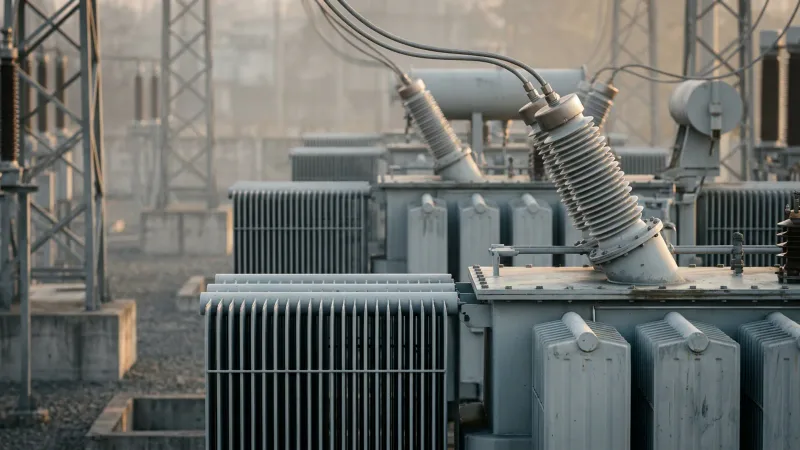
The connection point for a new west London hyperscaler is typically a 132/33 kV bulk supply point, owned by SSEN or UK Power Networks, with the customer building a dedicated 33 kV switchroom and a bank of 33/11 kV unit substations inside the campus. For the larger AI training campuses now being planned outside the M25 — in places like Didcot, Cambridge, and increasingly the East Midlands — the connection is moving directly to 132 kV or even 275 kV, with the customer building a full GIS substation on site.
Three engineering characteristics distinguish these UK builds from their American counterparts. The first is voltage. The UK distribution stack runs 132/33/11 kV rather than the 138/34.5/12.47 kV familiar in the US, and the transformer designs reflect British Standard impedance and noise specifications — typically BS EN 60076 with noise levels of 65 to 68 dB(A) measured at one metre, which matters because most British data centre sites sit closer to residential boundaries than their US equivalents.
The second is short-circuit duty. The 132 kV network in west London is electrically stiff — fault levels of 30 to 40 kA are common — and the 33 kV switchgear and unit transformers behind it have to ride through fault clearing times measured in tens of milliseconds. Specifying for that level of fault duty pushes up cost and lead time on switchgear in particular, where SF6-free alternatives are now the default for new orders following Ofgem's 2024 procurement guidance.
The third is climate. Britain's cool, damp climate is, on balance, a gift to data centre operators — free cooling is available for most of the year — but it is a complication for outdoor electrical equipment. Conservator-tank breathers, silica gel dehumidifiers, and properly specified IP ratings for marshalling kiosks are not afterthoughts here. They are the difference between a transformer that runs for forty years and one that develops moisture-driven insulation degradation in its second decade.
The Move Beyond the M25
Because Slough is full, and because Heathrow's expansion plans complicate any further data centre densification in the immediate corridor, the next wave of UK hyperscaler builds is moving outward. Three clusters are now visible.
The Thames Valley west, beyond Slough proper, into Iver, Hayes, and Park Royal. These sites are still constrained by the same 400 kV corridor, but they can hang off different bulk supply points and, with the right reinforcement, can be brought online a year or two faster than the central Slough sites.
Didcot and the Oxfordshire arc. The closure of Didcot A coal station and the wind-down of Didcot B gas station have left transmission capacity stranded in the area. Several hyperscalers have signed letters of intent for sites that would, in effect, recycle the connection rights of the retiring power stations. This is the cleanest example in the UK of "first-ready" queue reform delivering real capacity in a sensible timeframe.
The East Midlands, particularly the corridor between Nottingham and the Humber. Land is cheaper, planning is more permissive, and the 400 kV backbone running north from London has spare capacity in several substations. The trade-off is latency — a Nottingham campus adds three to four milliseconds round-trip to London — but for AI training workloads, that latency is irrelevant. For real-time inference and the latency-sensitive trading workloads that anchor central London, it is not.
Generation, Heat, and the Wider Politics
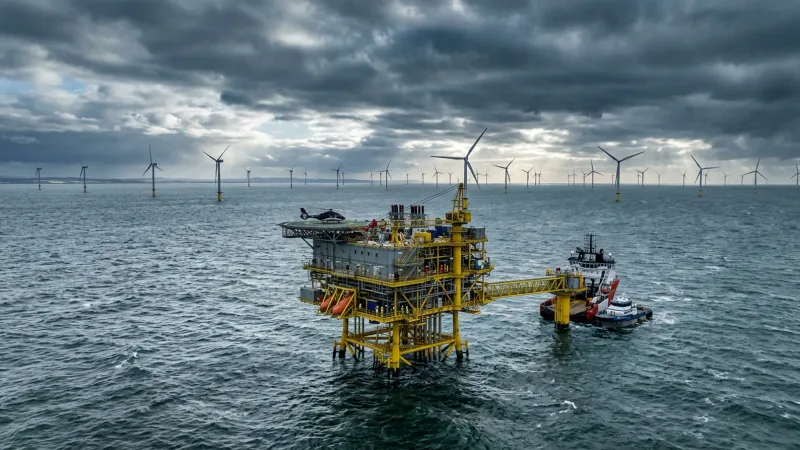
Two further pressures are shaping the British picture. The first is the Climate Change Committee's increasingly explicit position that data centres should contribute to, not detract from, the UK's decarbonisation pathway. In practice this means new campuses are being asked to demonstrate that their additional load can be met by additional clean generation — Power Purchase Agreements with offshore wind, in most cases — and that their waste heat is, where possible, recovered. A handful of recent planning consents in west London have made district heat connections an explicit condition.
The second is the question of strategic resilience. The UK government's view, articulated through the National Data Strategy and reinforced by the AI Opportunities Action Plan, is that hyperscale compute is now national infrastructure. That framing matters for the grid queue because it gives Ofgem and the ESO political cover to prioritise data centre connections over speculative generation projects — and because it makes the case for transmission reinforcement a national-security argument rather than a commercial one.
For the operators in the queue, the practical effect is that the conversation with the network operator is no longer just about kilowatts. It is about decarbonisation, about heat offtake, about strategic alignment with British industrial policy. The campuses being designed today are negotiated as much in Whitehall as they are in Slough.
What Comes Next
The 2030s will determine whether Britain remains a top-tier European data centre market or cedes ground to Ireland, the Nordics, and the Iberian Peninsula. The bottleneck is solvable — the transmission projects are scoped, the regulatory reform is in motion, and the transformer factories are ramping up — but solvable on a timeline measured in years, not months.
For now, the British hyperscaler operates with a paradox. The buildings can be built. The compute can be deployed. The customers are signed. What cannot yet be delivered, at the scale the market is asking for, is the electrons. London's data capital sits, patient and well-funded, in the grid queue.