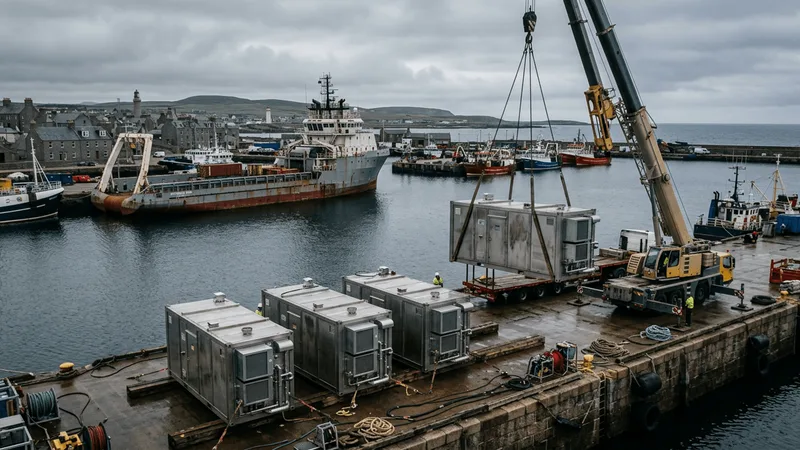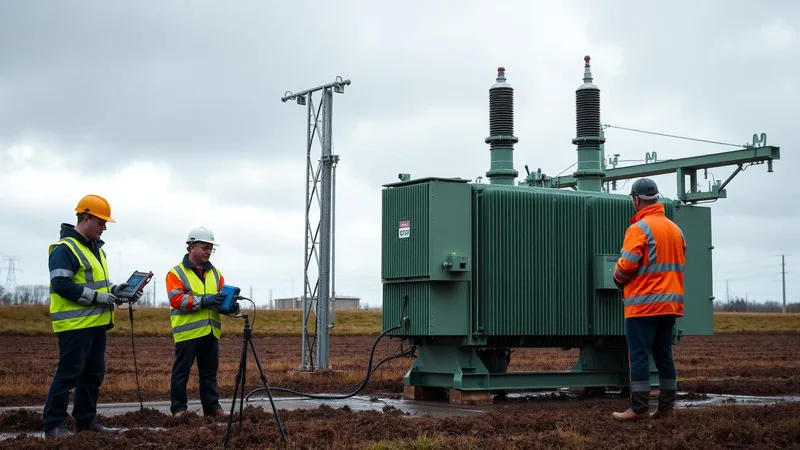






Class-1E qualification governs every auxiliary transformer that supports an EPR reactor's safety-related load. At Hinkley Point C, that envelope reaches from the 400 kV reserve auxiliary transformers through the medium-voltage emergency boards to the 6.6 kV motor-control centres serving the safety-injection pumps. Each step compounds testing requirements that mainline UK substation procurement never encounters. We map the chain.
The Unforgiving Logic of Decay Heat
Counter-intuitively, a nuclear power station's most vulnerable moment is immediately following an emergency shutdown. Inserting the control rods—a 'SCRAM'—halts the primary fission chain reaction in under two seconds. The main turbine generators spin down. But the reactor core remains intensely hot, a thermal battery powered by the radioactive decay of fission products.
This residual energy is substantial and non-negotiable. Without a constant coolant flow to remove it, the core's temperature would rise past the melting point of the fuel cladding and structural steel, initiating a meltdown. Active cooling is not an operational convenience; it is a fundamental safety requirement dictated by physics.
Supplying uninterrupted power to the pumps and valves of these cooling systems is therefore a safety function of the highest order. While the giant Generator Step-Up transformers and 400 kV transmission lines handle the grand task of exporting power, a far more intricate network ensures the plant can save itself. This is the world of the electrical auxiliary supplies, a system designed for one purpose: to never fail.
The Class 1E Workhorse: Not Your Average Transformer
This is where the station’s auxiliary transformers come in. And they are not simply smaller versions of the GSU workhorses. The most critical among them are a different species of component altogether, designated as "Class 1E".
In the lexicon of the International Atomic Energy Agency (IAEA) and IEEE standards, Class 1E is the highest safety classification for electrical equipment. It applies to equipment and systems that are essential to the safe shutdown of the reactor, containment isolation, core cooling, and heat removal. Its defining characteristic is not just robustness, but a proven ability to function during and after design-basis events—like an earthquake.
This proof is established through a brutal qualification process, governed by standards like IEEE 344, *Standard for Seismic Qualification of Equipment for Nuclear Power Generating Stations*. This isn’t a paper exercise. For a component like an 11kV auxiliary transformer, it involves:
1. Analysis: Creating a detailed finite element model of the transformer to simulate its response to seismic stresses.
2. Shake Table Testing: Bolting a prototype or an identical production unit onto a massive tri-axial shake table. This platform then simulates the ground motion of a severe earthquake, programmed with a Required Response Spectrum (RRS) specific to the plant’s location. For Hinkley Point C, this means withstanding significant horizontal and vertical accelerations.
3. Functional Verification: The component isn’t just expected to survive. It must remain energised and operate flawlessly *while* being shaken. Engineers check for any deviation in voltage, current, or internal diagnostics.
These are typically cast-resin or other dry-type transformers to eliminate the fire risk associated with mineral oil. They are the unglamorous but utterly essential workhorses that form the backbone of the on-site distribution network.
A Redundant Nervous System: The Four-Train Auxiliary Grid
The UK EPR design at Hinkley Point C elevates redundancy to an art form. This isn’t one auxiliary electrical system; it’s four, organised into a divisionalised "train" structure that was a key requirement from the UK’s Office for Nuclear Regulation (ONR).
This design philosophy was heavily informed by lessons learned at the Flamanville 3 and Olkiluoto 3 EPR projects in France and Finland. Early regulatory assessments of those plants raised concerns about the physical and electrical separation of safety systems. A fire, flood, or single component failure could, in theory, disable multiple "redundant" systems simultaneously—a common cause failure that undermines the entire concept of defence-in-depth.
The ONR insisted on a higher standard. At Hinkley Point C, the four safety divisions (let’s call them A, B, C, and D) are housed in separate, seismically qualified concrete buildings with a high degree of physical and electrical independence. Each division has access to its own dedicated slice of the auxiliary electrical system, including its own transformers, switchgear, and distribution boards.
During normal operation, these auxiliary transformers get their power from several sources:
- During Operation: Primarily from Unit Auxiliary Transformers (UATs), which tap power directly from the main generator’s 21kV output before it’s stepped up to 400kV.
- On Standby: From Station Auxiliary Transformers (SATs), which draw power from the National Grid. This is the primary source when the reactor is shut down for refuelling.
- Emergency Power: From four enormous Emergency Diesel Generators (EDGs) for each reactor. These V20 engines can start and accept 100% load within seconds of a loss of power.
- Ultimate Backup: From two additional Station Blackout (SBO) diesel generators, housed in their own separate, hardened facility.
This multi-layered approach ensures that even if several power sources are lost, the essential safety loads still have a reliable supply.
Surviving The Unthinkable: Islanding From The Grid
Let’s walk through the nightmare scenario: a major disturbance causes the National Grid connection to sever. This Loss of Off-site Power (LOSP) automatically triggers a reactor trip. The main turbine spins down, so the UATs become useless. The plant’s brain—its I&C system—must now automatically switch the auxiliary electrical system over to its emergency sources.
Now, compound the problem. Imagine the LOSP was *caused* by a seismic event that also damages on-site equipment. This is the