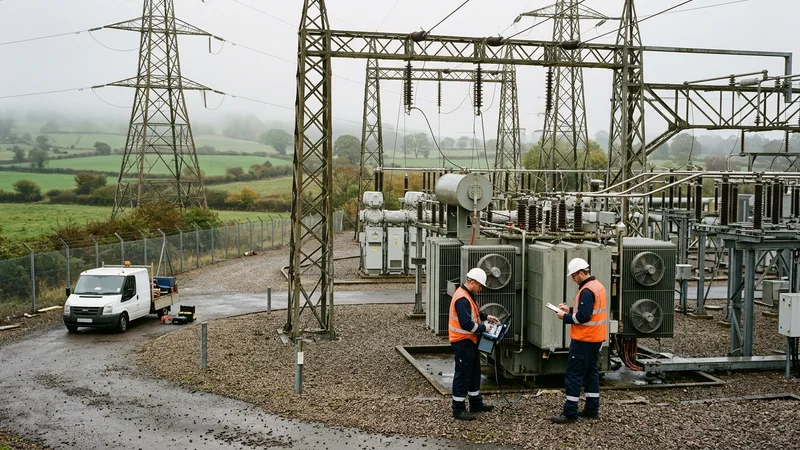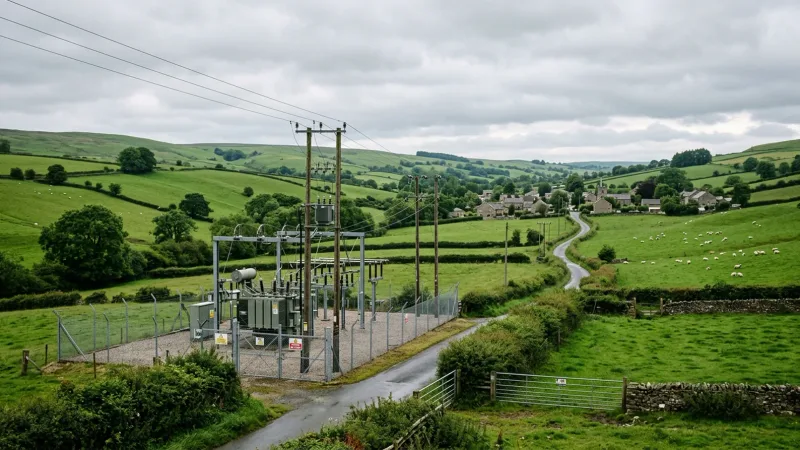






Open T5's electrical room drawings and the architecture is immediately legible. Two independent 132 kV intakes from National Grid land on two transformer halls, each holding 60 MVA units paralleled into a tied 11 kV switchboard. Bus-section breakers stay normally-open. A loss-of-supply event takes one half down; the other half holds the airport. This is what airport-grade redundancy looks like in metal.
The Dual-Radial Heartbeat
Most critical infrastructure is designed for N-1 resilience, meaning it can survive the failure of a single major component. Heathrow’s Terminal 5 was designed from first principles for N-2 security, a far more demanding standard where the system can withstand the simultaneous loss of any two components without compromising its 25-megawatt load. This is the level of resilience expected of a major data centre or a financial-market trading floor, built to serve passengers and baggage carts.
The architecture is elegant in its separation. T5 receives power from two independent 132kV grid connections, which are stepped down to 11kV. From there, the supply is split into two entirely discrete radial networks, ‘A’ and ‘B’. These two systems run in parallel through the terminal but never meet, feeding dual-input transformers at the final point of low-voltage distribution. Critical loads, from server racks to the baggage sorters, are equipped with static switches that can transfer their power source from one network to the other with no interruption.
This design acknowledges a fundamental truth of large-scale electrical engineering: the most damaging failure is rarely a complete blackout. It is the targeted loss of a single, crucial subsystem. For T5, losing power to the departure lounge displays is an inconvenience; losing a single motor control centre in the baggage hall creates a logistical crisis that could halt the entire operation. The dual-radial design is an expensive insurance policy against precisely that kind of surgical, high-impact failure.
A Tale of Two Transformers
The workhorses of the T5 distribution network are the 33/11.5 kV transformers that step down the voltage from the Distribution Network Operator (DNO) incomers. But it's the secondary distribution transformers, located deep within the terminal's operational areas, that tell the most interesting story. Take the baggage handling hall—a cavernous, complex space that is the operational heart of the terminal.
Here, dozens of 11 kV/415 V transformers feed the miles of conveyor belts, sorters, and scanners. Due to their location inside the building and directly adjacent to critical public infrastructure, fire safety was a non-negotiable design constraint. Traditionally, this would have meant specifying dry-type cast-resin transformers. However, the T5 engineers opted for a more forward-thinking solution: liquid-filled transformers using K-class ester fluid.
This choice, governed by BS EN 60076, offered several distinct advantages over both traditional mineral oil and cast-resin alternatives:
- High Fire Point: K-class synthetic esters have a fire point exceeding 300°C, compared to around 170°C for mineral oil. This makes them exceptionally safe for indoor installation, classifying them as 'less flammable' and removing the need for costly fire suppression systems and blast walls that would otherwise be required.
- Superior Cooling: As a liquid, ester fluid provides more effective cooling for the transformer windings under heavy load compared to the air-cooling of a cast-resin unit. This allows for a more compact design for a given MVA rating and a better ability to handle temporary overloads—a common occurrence in a baggage system with its stop-start, motor-heavy load profile.
- Environmental Benefits: Esters are fully biodegradable and non-toxic, mitigating the environmental risk in the event of a leak. This was a key consideration for Heathrow's broader sustainability commitments.
A visit to our products/transformers page can provide more detail on the specifications of these modern fluids. The decision at T5 demonstrated that liquid-filled transformers, often stereotyped as outdoor substation units, had a crucial role to play indoors.
The Dual-Radial System in Practice
Zooming out, the entire T5 electrical system is a study in elegant separation. It is fed by two entirely independent 33 kV circuits from the local DNO's primary substation. These aren't just two cables running in the same trench; they follow diverse physical routes to the airport boundary to protect against single-point-of-failure events like excavation damage.
Once on-site, they terminate at two separate intake substations, each housing a dedicated 33/11.5 kV transformer. For clarity, let's call them Substation A and Substation B.
1. Normal Operation: In a normal state, the 11 kV busbars of Substation A and Substation B are not connected. Substation A feeds one half of the terminal's load (e.g., Pier A) and Substation B feeds the other (e.g., Pier B). The total load of ~25 MW is split roughly evenly between them. This open-bus configuration is key to limiting the aforementioned fault levels.
2. First Failure (N-1): Imagine the DNO feeder to Substation A is lost. The system automatically detects the loss of voltage. An 11 kV bus-coupler breaker closes, allowing Substation B to energise the busbar from Substation A and take up the entire terminal load. T5 continues to operate seamlessly, albeit now with all its eggs in one basket. The system is designed so that either of the main transformers can handle the full 25 MW load for a sustained period.
3. Second Failure (N-2): Herein lies the true test. Let's say, while running on Substation B alone, a critical piece of switchgear on its main 11 kV board fails. This is the N-2 scenario. At this point, the system sheds non-essential loads (e.g., some retail units, office HVAC) via a prioritised load-shedding scheme. The essential systems—check-in, security, flight information, life safety, and of course, the baggage sorters—are maintained by the terminal's own standby generation capacity. The system is designed to fail gracefully, preserving core function even in a degraded state.
This architecture provides the resilience needed to give an airport operator peace of mind. While the initial capital cost is higher than a simpler radial or single-transformer setup, the long-term operational security is invaluable for an asset that operates 24/7/365.
The DNO Handshake
Finally, no great infrastructure project exists in a vacuum. Connecting a 25 MW, N-2 critical load to an already-strained urban grid like London's is a significant engineering challenge in itself. The entire design had to be developed and approved in close partnership with the local DNO. The connection agreement would have been a document stretching to hundreds of pages, covering everything from protection settings to harmonics.
Compliance with the Distribution Code and Engineering Recommendation G99 is the price of admission. The DNO needed absolute assurance that a fault within the T5 network wouldn't propagate back onto their 33 kV system and affect other customers in West London. The protection scheme, with its directional relays, inter-tripping, and precise grading studies, is the invisible handshake between the private network of the airport and the public grid. It ensures that T5 is a good neighbour, capable of isolating its own problems instantly. Lessons learned from the T5 build, particularly around the DNO interface and the practicalities of proving N-2 resilience, were later applied to the redevelopment of Terminal 2, creating a standardised approach for the airport's future capital works.
Building your own large-scale private network? Our team has experience navigating the complexities of DNO applications and designing compliant package substations for major connections. Don't hesitate to get in contact.
The Engineer's Takeaway
Terminal 5's power system teaches a crucial lesson. True resilience isn't found in a backup generator waiting in a basement, but in an architecture that intelligently limits the impact of failure from the very first principles of physics. It proves that for critical infrastructure, uptime is not an afterthought—it must be designed into the core from the ground up.