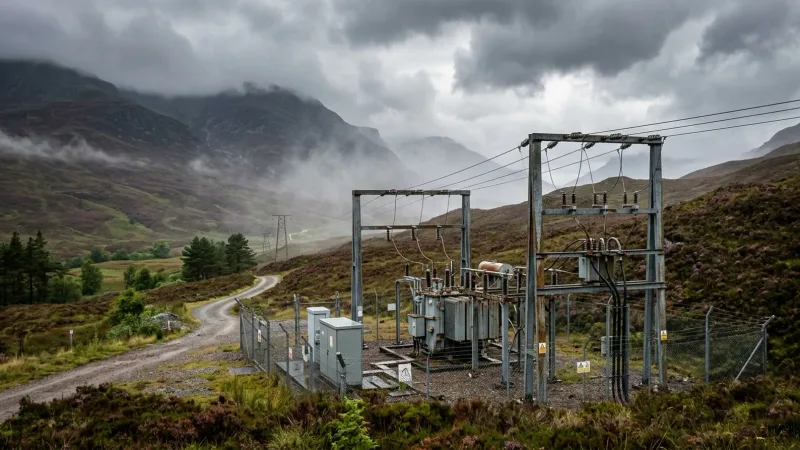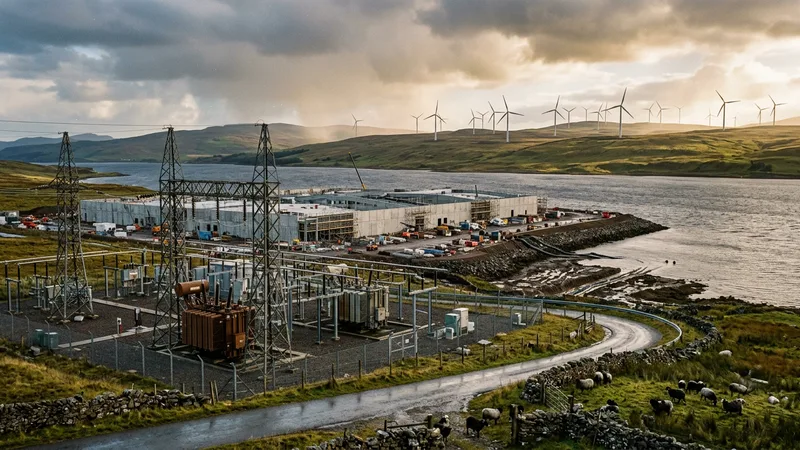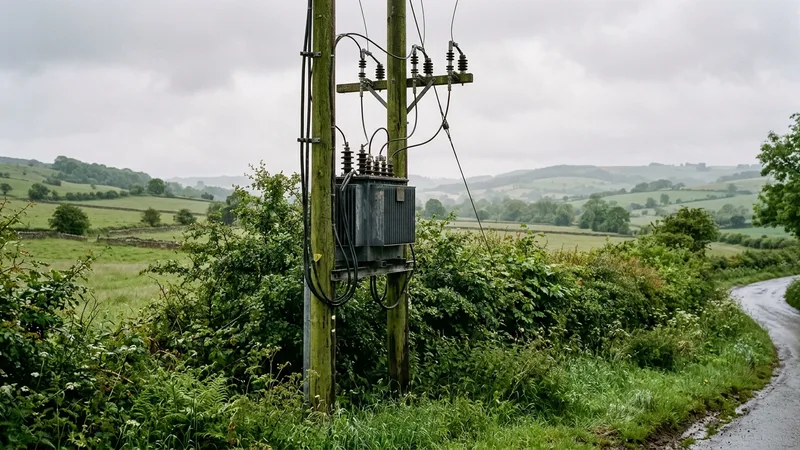






Network Rail and Crossrail Ltd. negotiated the traction-substation programme for the Elizabeth Line under a constraint set unlike any other UK electrification. Substation footprints had to fit civil envelopes already let to a station-box contractor. Acoustic limits were set by tenants in the buildings overhead. The 25 kV AC autotransformer architecture that resulted is a useful case study in compact urban traction power.
A Brutal Electrical Personality
At its core, the problem is one of character. A modern AC-powered train, like the Alstom-built Class 345s used on the line, is a difficult load to place on any grid. Where an industrial motor offers a predictable hum, a traction load is spiky, non-linear, and mobile. When a 220-metre-long train accelerates from a station, its power electronics draw a massive inrush of current that can cause grid voltage to dip. When it applies regenerative braking minutes later, it injects power back into the network, causing voltage to swell.
This two-way surge is challenging enough, but the more subtle problem lies with harmonics. The solid-state converters that manage the train's power do not draw a clean, sinusoidal AC waveform. Instead, they take aggressive "bites" of the waveform, introducing distortion—unwanted frequencies that propagate back into the distribution network. For a utility grid already operating at its limit, this electrical "noise" is not just unwelcome; it threatens the stability of the supply itself and the equipment of every other connected customer.
The Component-Level Solution: Custom Transformers and Filters
Meeting the G5/5 challenge, and simply supplying the required power, could not be achieved with off-the-shelf components. The solution started at the bulk supply points (BSPs), where power is drawn from the transmission system. Two main sites were built to power the central section: one at Pudding Mill Lane in the east and another at Plumstead.
These are not your average distribution substations. Each BSP takes a dual 132 kV feed from the National Grid and steps it down to the 25 kV traction voltage. The core of each site is a pair of colossal traction transformers, each rated at over 60 MVA. These aren't just larger versions of their distribution counterparts; they're specialist machines designed for the rigours of a railway.
Key design features included:
- High Impedance: The transformers were specified with a higher-than-normal impedance. This helps to inherently limit the fault current, a critical consideration when a short circuit could be caused by anything from equipment failure to a metallic party balloon drifting into the tunnel. It also provides a degree of buffering against the sharp swings in load from the trains.
- Bespoke Windings: The windings were designed to cope with the significant thermal and mechanical stresses of a traction load cycle, which involves near-instantaneous swings from zero to full load.
- Harmonic Resilience: The design had to account for the additional heating effects caused by the G5/5-offending harmonic currents generated by the trains. These are the very same currents that the network operator is worried about, and they also threaten the health of the transformer itself.
To clean up the electrical noise before it hit the grid, each BSP is equipped with a large bank of harmonic filters. These are essentially passive circuits of inductors, capacitors, and resistors, precisely tuned to absorb specific harmonic frequencies—typically the 3rd, 5th, and 7th harmonics, which are the most troublesome for traction systems. Without these filters, which look like a small forest of post insulators and coils, the Elizabeth Line would not have been allowed to connect to the grid. For a sense of scale, a single filter bank can weigh upwards of 40 tonnes. For those specifying similar systems, our range of cast resin and liquid-filled transformers are designed with these kinds of demanding applications in mind.
The System Architecture: Bringing Mainline Tricks Underground
Stepping the voltage down was only half the battle. The next problem is getting the power through miles of tunnel to a moving train without excessive voltage drop. A simple 25 kV single-phase AC feed just wouldn't cut it; the voltage at the far end of the line would be too low to operate the trains reliably.
The solution is a classic of mainline railway engineering, but a novelty for a service that feels like a tube: the 25-0-25 kV autotransformer system.
Instead of a simple "live" and "return" conductor, this system uses three: the catenary (or overhead line equipment) at +25 kV, a feeder wire at -25 kV, and the running rails as the return path at 0 V. This creates a 50 kV transmission system from the perspective of the cabling, but the train itself still only sees a 25 kV difference between the catenary and the rails.
Here’s how it works:
1. The main traction transformer at the BSP feeds the 50 kV to the two conductors.
2. At intervals of roughly 10-15 km along the track, an autotransformer is connected between the +25 kV catenary and the -25 kV feeder wire.
3. The centre-point of the autotransformer