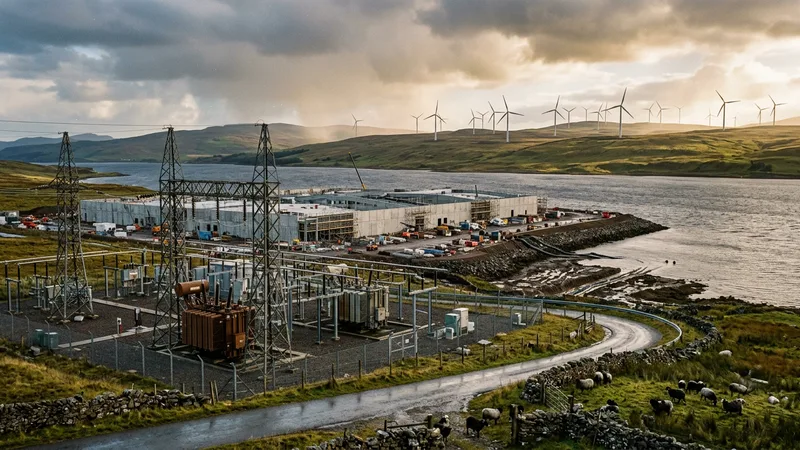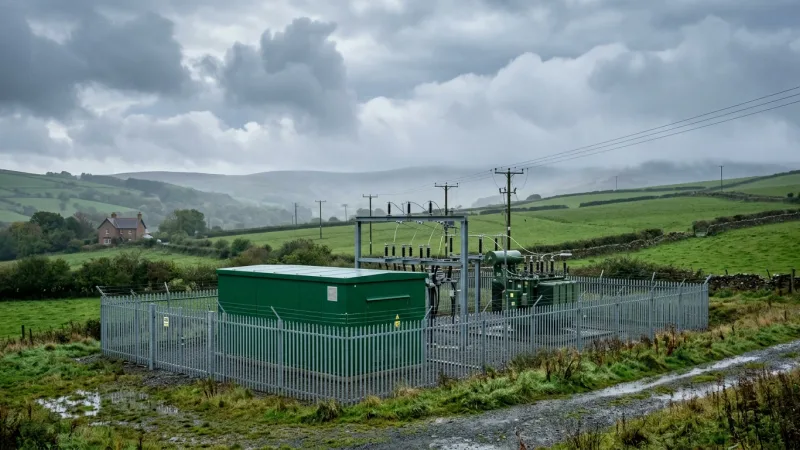






"The public never sees it, but the LFB does," a senior UKPN planner told me last spring, gesturing at a schematic of an old transmission substation wedged between a hospital and a block of flats. "For them, a hundred tonnes of mineral oil next to a public building isn't an asset. It's a risk we have to manage to zero." And that, in a nutshell, is why one of Britain's biggest DNOs is spending millions to replace a perfectly functional fluid in its most critical transformers.
This isn’t about chasing performance gains or green credentials, though those are welcome side-effects. This is about the quiet, methodical removal of a single, stubborn failure mode that keeps grid operators up at night: the risk of a transformer fire in the middle of one of the world's most densely populated cities.
It's Not The Heat, It's The Flash Point
To understand the logic, you have to get back to the basic physics of dielectric fluids. For nearly a century, mineral oil has been the default choice for large power transformers. It cools, it insulates, and it’s cheap. Its properties are a known quantity, codified in standards like IEC 60296. The problem isn't its performance in the 99.99% of its operational life. The problem is what happens in the 0.01% when a catastrophic internal fault occurs.
Mineral oil has a fire point of around 170°C. While it takes a lot to get it there, a sustained arcing fault inside a transformer tank absolutely can. If the tank ruptures, you suddenly have a pool of burning oil. In a spacious rural substation with gravel pits and fire-suppression walls, this is a manageable—if expensive—event. In a basement substation in Knightsbridge, it’s a civic disaster.
This is where synthetic and natural esters come in. These fluids, governed by standards like BS EN 61099 (synthetic esters) and BS EN 62770 (natural esters), are classified as K-class fluids. The "K" designation is key. It means they have a fire point above 300°C. This simple-sounding difference is profound. A fluid that won’t ignite until it’s twice as hot fundamentally changes the risk equation.
A few key differences stand out:
- Fire Point: Mineral oil at ~170°C vs. Ester at >300°C. This is the main driver for the UKPN programme. An arc flash might still breach the tank, but the resulting leak is far less likely to become a self-sustaining fire.
- Biodegradability: Esters are readily biodegradable, whereas mineral oil is not. A leak that doesn’t ignite is still an environmental problem, and esters significantly reduce the clean-up headache.
- Hygroscopicity: Esters can absorb a great deal more water than mineral oil before their dielectric strength is compromised. This has interesting implications for the transformer's other main ageing component: the paper insulation.
Switching to ester isn't a trivial decision. The fluid is more expensive per litre. But as the UKPN programme shows, when the asset is a 60 MVA transformer powering a London borough, the total cost of risk far outweighs the marginal cost of the fluid itself.
Inside a 132 kV Retrofit
So how do you actually change the oil in a 200-tonne, 132/11 kV grid transformer that’s been in service for 25 years? You can’t just turn it off for a month and ship it back to the factory. These assets are critical nodes in London's power network; their outage windows are planned years in advance and last days, not weeks.
The process is called a live or on-site retrofit, and it’s a piece of industrial choreography. While not "live" in the sense of being energised, it happens in-situ, often in the constrained space of a concrete substation vault. UKPN has been working with specialist contractors to refine the procedure for its inner-city sites.
The goal is to replace the existing mineral oil and leave a residual concentration of less than 5%, and ideally less than 2%, to maintain the fire-safety benefits of the new ester fluid. Any more than that, and the flash point of the mixture starts to creep back down.
A typical retrofit on a large grid transformer follows a precise, multi-stage plan:
1. De-energise and Isolate: The transformer is taken offline according to a strict outage plan. Bushings are earthed. The site is secured.
2. Initial Drain: The bulk of the mineral oil is drained from the main tank, radiators, and conservator. This is done using high-capacity pumps into sealed tankers for responsible disposal or recycling.
3. Flushing Cycles: This is the critical part. A "flushing charge" of new ester fluid is circulated through the transformer. The goal is to wash out the mineral oil that clings to internal surfaces and is saturated within the windings and insulation. This ester is then also drained.
4. Vacuum and Final Fill: The transformer is pulled into a deep vacuum to remove air and any remaining moisture. The final charge of fresh, dry ester fluid is then drawn into the tank under vacuum, ensuring a void-free fill.
5. Re-energisation and Monitoring: Once filled, the transformer undergoes a battery of electrical tests before being carefully re-energised. Oil samples are taken at intervals—after 24 hours, one week, one month—to confirm the final mineral oil concentration and monitor how the new fluid is behaving.
This process is a delicate balance. You must work quickly to fit inside the DNO’s outage window, but you must be meticulous to ensure the long-term health of an irreplaceable asset. It requires deep expertise in both fluid handling and our approach to transformers, something that can only be built through experience.
Why Aldgate Changed Everything for London's Grid
The physics are compelling and the engineering is clever, but neither fully explains the urgency. To understand that, you need to go back to a specific incident: the 2011 Aldgate cable tunnel fire. While not a transformer fire, this event, which burned for days beneath the streets of the City of London, crystallised the thinking of both Ofgem and the London Fire Brigade (LFB).
The LFB’s subsequent review of risks from utility infrastructure was pointed. They looked at ageing assets in confined, often subterranean, spaces and saw unacceptable fire-loading risks. High-voltage transformers, particularly those in basements or enclosed vaults in dense commercial and residential buildings, came under intense scrutiny.
These are not the sprawling, open-air grid substations you see in the countryside. They are often anonymous buildings or deep basements, housing what are essentially packaged substations on a massive scale. A fire here doesn’t just threaten the grid; it threatens offices, homes, and public-transit infrastructure. Following the LFB's push, DNOs like UKPN were compelled to re-evaluate their entire fire-risk mitigation strategy.
Simply adding more external fire suppression systems is often not feasible in these tightly packed legacy sites. The most effective engineering control is to remove the source of the fuel—the flammable oil itself. The ester retrofit programme is a direct, engineered response to this systemic urban risk. It is a design choice that places public safety, as defined by the LFB, as the primary operational constraint, even above cost or simple operational convenience.
The 25-Year Question: Ageing and Network Resilience
Removing a fire risk is a powerful motivator, but what does this fluid swap mean for the health of the transformer itself over the next 25 years? This is where the story gets even more interesting for asset managers.
The life of a transformer is not determined by its steel tank or even its copper windings. It is determined by the life of its solid insulation: the cellulose paper and pressboard wrapped around the conductors. As this paper ages, it becomes brittle, loses its mechanical strength, and is more likely to fail during a through-fault event, leading to a catastrophic failure.
The two enemies of cellulose paper are heat and water. Here, the hygroscopic nature of ester fluid becomes a powerful advantage. Because ester can hold significantly more water in suspension than mineral oil, it effectively "dries out" the paper insulation over time, pulling moisture out of the cellulose fibres.
Studies have shown that by reducing the water content in the paper, its useful life can be substantially extended. A transformer that might have been due for replacement in 10 years could, after being retrofilled with ester, have its life extended by another 10 or 20 years. For a DNO managing a fleet of thousands of aging assets, this is a massive financial and logistical benefit. It transforms a project driven by safety compliance into a powerful tool for asset life extension.
This isn’t just speculation. UKPN is actively monitoring the dissolved gas analysis (DGA) and moisture levels in the retrofilled transformers to build a real-world data set on these long-term benefits. The early signs are that the fire-proofing programme may also be one of the most effective life-extension programmes they have ever run, deferring billions in replacement capital expenditure.
If you're wrestling with similar challenges in your network, it's a conversation worth having. Sometimes the solution to multiple problems comes in a single drum. If you’d like to discuss the specifics of your site, get in touch with one of our engineers.
The Engineer's Takeaway
This is engineering at its most practical. It’s not about designing a new product from scratch, but about intelligently managing the risks and liabilities of a massive, installed base of legacy assets. The London ester programme shows that the most impactful upgrades are often invisible to the public—a quiet fluid swap in a basement that ensures the city above it stays safe, and the lights stay on for another generation.