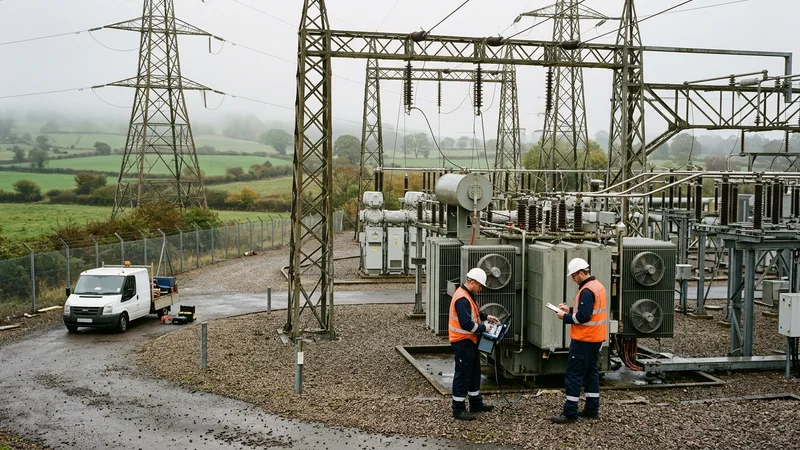






Energy Networks Association Technical Specification 35 has been the UK's site-acceptance lodestar for two decades. Its requirements diverge from IEC 60076 in ways that catch importing OEMs off-guard — particularly around impulse-waveshape tolerances, leak-test procedure, and the chromatograph baseline expected after the first thermal cycle. This article walks through the divergences a UK DNO commissioning engineer actually flags.
The Physics: What Is Partial Discharge, Really?
Before we descend into the minutiae of standards, let's talk physics. Partial Discharge (PD) is the silent killer of high-voltage insulation. It’s not a direct short circuit, but rather a series of tiny, localised dielectric breakdowns. Imagine a microscopic gas-filled void trapped within the solid paper insulation of a winding, or a bubble in the transformer oil. When the electric field stress across that void exceeds the breakdown strength of the gas within it, it sparks. It's a tiny lightning storm, measured in pico-Coulombs (pC), happening deep inside the transformer's most critical system.
This isn't a benign phenomenon. Each discharge event is like a tiny hammer blow to the surrounding insulation, chemically degrading and eroding it. Over months and years, these microscopic events create carbonised pathways, weakening the insulation system until it can no longer withstand normal operational stress. The result is an eventual, catastrophic dielectric failure. A transformer with high initial PD might pass its initial tests, but its operational life is already compromised. It’s the closest thing our industry has to a terminal diagnosis.
This is why DNOs are obsessed with it. A low PD measurement at the factory isn't just about passing a test; it's the best available proxy for a clean, well-processed insulation system. It’s an indicator of quality manufacturing and a predictor of a 40-year asset life.
The Component: IEC vs. ENATS on the Factory Floor
The core of the issue for our Midlands planner lies here. A transformer may be fully compliant with the internationally recognised IEC 60076 series of standards, particularly IEC 60076-3 for insulation tests. A manufacturer in Germany, Italy, or Turkey can run a perfectly valid set of tests, generate a certificate, and declare the unit compliant. But that certificate often isn’t worth the paper it’s printed on when a UK DNO witness is present.
UK Distribution Network Operators (DNOs) like SP Energy Networks, Western Power Distribution (now National Grid), and UK Power Networks don’t just buy to IEC standards. They procure distribution transformers against ENA Technical Specification 35-1 (ENATS 35-1). While this document cross-references IEC standards heavily, it adds its own crucial, and significantly stricter, layers of compliance. When it comes to partial discharge, these differences become expensive sticking points.
Here’s where a vendor’s standard test can unravel:
1. Acceptance Limits: While IEC standards provide a framework, DNO specifications are often brutally simple. Many ENATS-based tenders will specify a maximum discharge magnitude of just 10 pC at the specified test voltage. An IEC test might permit a higher level depending on the transformer's rating and configuration. A vendor accustomed to seeing 50 or 100 pC pass an IEC test can be shocked when a DNO witness points to a 12 pC reading and says, "That's a fail."
2. Background Noise Levels: This is the most common pitfall. To accurately measure 10 pC of discharge *from* the transformer, you must be certain you aren't just measuring electrical noise in the test bay itself. ENATS 35-1 is stringent on this. Test providers must demonstrate that the background electrical noise in their setup is exceptionally low—typically below 5 pC. Many European labs, while perfectly adequate for routine IEC testing, simply cannot achieve this level of silence in their high-voltage hall. Their baseline noise is higher than the DNO's acceptance limit for the transformer itself, rendering the test invalid from the start.
3. Test Sequence & Voltage: The ENATS 35-1 procedure is highly prescriptive. It involves a specific sequence of raising the voltage, letting it "soak" to excite any potential PD sites, and then lowering it to the measurement voltage. Any deviation, or any sign of discharge inception or extinction at the wrong voltage level, is grounds for scrutiny and, potentially, rejection. For a procurement engineer, understanding that your spec needs to go beyond "IEC compliant" is critical. Your spec needs to be "ENATS 35-1 compliant". For help ensuring your equipment meets these robust requirements, our team is always available via our contact page.
The System: Assembling the FAT Witness Test
A Factory Acceptance Test (FAT) isn't a single measurement; it's a systematic verification of the entire finished product. The partial discharge test may be the most feared, but it’s part of a larger suite of routine tests mandated by ENATS 35-1, all performed under the watchful eye of the client’s engineer or a third-party inspector.
For a typical 11kV/433V, 1000 kVA distribution transformer, a witness FAT will include a series of checks that build a complete picture of the unit's health:
- Measurement of winding resistance: Verifies the copper windings are correctly sized and joined.
- Measurement of voltage ratio: Confirms the turns ratio is exact, ensuring the secondary voltage is precisely what it should be.
- Check of phase displacement (vector group): Ensures the transformer will correctly parallel with other transformers on the network.
- Measurement of short-circuit impedance and load loss: These values are critical for fault level calculations and capitalised loss evaluation.
- Measurement of no-load loss and current: A key measure of the efficiency of the magnetic core, directly impacting the TCO (Total Cost of Ownership) under the BS EN 50588 Eco Design framework (Tier 1 or Tier 2).
- Dielectric routine tests: The main event, a battery of voltage withstand tests that prove the insulation system