





When the last turbine of a great coal-fired power station spins down, the silence is more than auditory. An invisible, stabilising force is lost along with the megawatts: system inertia. As Great Britain transitions to a grid dominated by non-synchronous renewables, a new generation of engineering solutions has been deployed to restore this crucial property and ensure an orderly and reliable power system.
The Physics of a Stable Grid: What is Inertia?
In a power system, inertia is the stored kinetic energy within the large, rotating masses of synchronous generators found in traditional thermal and nuclear power plants. This immense rotating mass acts as a physical buffer, inherently resisting changes in system frequency. When a major disturbance occurs—such as the sudden trip of a large power plant or interconnector—the grid frequency begins to fall.
The stored energy in these spinning generators is momentarily released, dramatically slowing the Rate of Change of Frequency (RoCoF). This provides a critical window of a few seconds, giving slower-acting frequency response services time to react, stabilise the system, and prevent protective devices from disconnecting generation and load in a cascading failure.
The challenge for a modern grid is the displacement of these high-inertia synchronous machines with inverter-based resources like wind, solar, and battery storage. While these resources are essential for decarbonisation, their power electronics have historically lacked a native inertial response. As their penetration increases, the overall inertia of the system falls, making the grid more susceptible to rapid frequency deviations. Measuring and managing inertia has therefore shifted from an inherent property of the system to a critical, procurable service essential for maintaining operational security.
Synchronous Condensers: An Old Idea for a New Era
The concept of using a synchronous machine purely for grid stability is not new. Synchronous condensers—effectively large synchronous motors running without a mechanical load—were used in the mid-20th century to provide voltage support on long transmission lines. Today, they have been repurposed as a primary solution for the modern inertia deficit. By spinning in sync with the grid, a synchronous condenser’s significant rotating mass provides the exact same stabilising inertial response as a traditional generator, slowing RoCoF during a contingency.
Unlike a power plant, however, a synchronous condenser does not produce real power (megawatts). Its sole purpose is to provide stability services. It consumes a small amount of active power to overcome its own losses but is a flexible provider of reactive power, helping to manage voltage levels locally.
This decoupling of energy and stability is a crucial development. It allows grid operators to add inertia wherever it is needed on the network, often at strategic substations, without being tied to the location of a large power station. This targeted approach is more efficient and provides a robust solution to stability shortfalls created by the retirement of assets like coal-fired power stations.
The Pathfinder for Stability: A New Procurement Model
Recognising the systemic need for inertia, the National Grid ESO in Great Britain pioneered a market-based solution through its Stability Pathfinder programme. This represents a fundamental shift in how grid services are procured. Instead of the traditional approach of purchasing energy (MWh) or generation capacity (MW), the Pathfinder created a commercial framework to directly purchase specific stability characteristics, principally inertia and a sufficient short-circuit level.
This innovative model invited developers to propose and build assets that could meet defined stability requirements at specific points on the grid. By creating a market for these services, it incentivised investment in technologies like synchronous condensers and others, ensuring the system could secure the necessary stabilising properties for the long term. This forward-looking procurement moves away from last-minute interventions and establishes stability as a planned, essential component of the network architecture.
The approach allows the grid to accommodate ever-increasing levels of renewable generation securely, by ensuring the underlying physical properties of the system remain robust, regardless of which generators are producing power at any given moment. It has become a global exemplar for managing the transition to a low-inertia power system.
> Quick Reference: Key Stability Services
>
> * Inertia: The resistance of the grid to changes in frequency, provided by the kinetic energy in large rotating machines. It slows down the Rate of Change of Frequency (RoCoF).
> * Short Circuit Level (SCL): The amount of current that would flow during a fault. A high SCL indicates a "strong" grid, helping to maintain voltage stability and ensuring protection systems operate correctly.
> * Reactive Power: Manages grid voltage levels. It is required by most AC loads and is essential for preventing voltage collapse or overvoltage conditions.
Beyond Condensers: Flywheels and Grid-Forming Inverters
While synchronous condensers are a cornerstone of new inertia provision, they are not the only solution. Another technology seeing a resurgence is the flywheel. A flywheel energy storage system uses a motor to spin a compact, high-mass rotor to extremely high speeds in a near-frictionless enclosure.
This stored kinetic energy can be converted back into electricity in milliseconds, providing a very fast injection of power to counteract frequency drops. While a single flywheel provides less inertia than a large condenser, they can be installed in modular arrays and offer extremely fast response times, helping to arrest the initial frequency deviation even before the bulk inertia from larger machines is released.
Further on the horizon is the advancement of power electronics themselves. First-generation inverters used in wind and solar farms were "grid-following," meaning they relied on a strong grid signal created by synchronous machines to operate. The next evolution is the "grid-forming" inverter.
This advanced software and hardware allows an inverter-based resource, such as a battery energy storage system, to autonomously create its own stable voltage and frequency reference. In doing so, it can be programmed to mimic the behaviour of a synchronous generator, providing "synthetic" or "emulated" inertia and contributing to grid strength. The combination of these different technologies provides the operator with a rich toolkit to manage system stability efficiently.
Engineering Standards for a New Application: The Transformer Interface
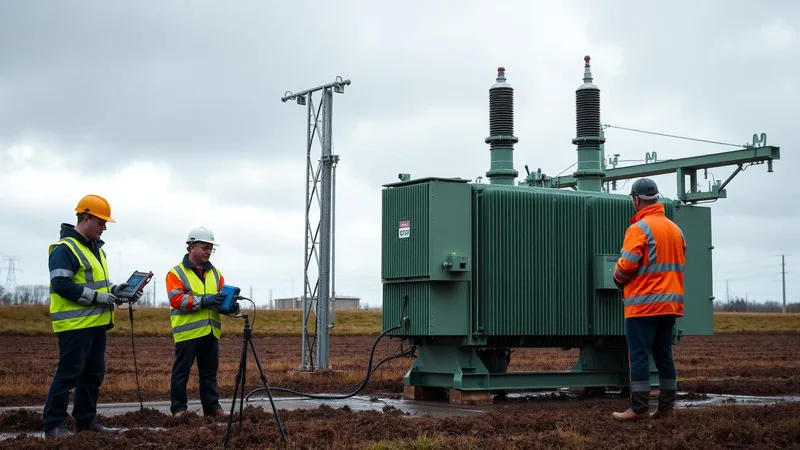
The practical implementation of synchronous condenser projects introduces specific high-voltage engineering challenges, particularly for the main interface transformer connecting the unit to the grid. These assets are often sited at existing 275 kV or 400 kV transmission substations, requiring a large step-up transformer to match the condenser’s terminal voltage. While the function appears similar to a conventional generator step-up (GSU) transformer, the duty cycle is significantly different, demanding careful interpretation of established standards like IEC and BS EN.
A key difference is the start-up sequence. The high torque required to spin the condenser’s mass from a standstill results in very high inrush currents, which the transformer windings must be braced to withstand repeatedly over their design life. Furthermore, in normal operation, the transformer handles very little real power (MW) but must facilitate significant reactive power (MVAr) exchange, often for long durations.
This creates a unique thermal profile that differs from a GSU carrying heavy active load. The specification of the on-load tap changer (OLTC) is also critical, as it must manage voltage regulation under these specific reactive-power-flow conditions. Engineers are therefore tasked with applying established transformer design principles to this novel use case, focusing on mechanical strength for start-up, thermal design for reactive duty, and ensuring the overall unit meets the stringent reliability requirements of a critical national infrastructure asset.
The successful integration of these new stability assets ultimately hinges on established component engineering. The careful specification of the interface transformer—balancing start-up dynamics against steady-state reactive power duty—demonstrates that while the sources of grid stability are changing, the fundamental principles of high-voltage engineering remain as critical as ever.